

Technical SEO for Website Performance: Make or Break Guide (2026)
In the digital landscape, a website is your business’s 24/7 storefront. No matter how brilliant your content or how robust your backlink profile, underlying technical flaws can cripple your visibility and user experience. This is why mastering Technical SEO for Website Performance is not just an option—it is the non-negotiable foundation for online success.
Technical SEO refers to optimizing the structural and backend elements of your website to improve how search engines like Google crawl, index, and understand your content. Think of it as ensuring the plumbing, electricity, and foundation of your house are perfect before you worry about the interior decor (content). If the foundation is shaky, the whole structure will eventually fall.
The Paramount Importance of Technical SEO: Building a Rank-Worthy Foundation
The digital landscape is relentlessly competitive. While compelling content and strong authority (backlinks) are vital, they operate within the framework set by Technical SEO for Website Performance. The search engine algorithms are constantly evolving, but their core mission remains the same: to provide users with the best, fastest, and most relevant experience. When your site is technically sound, it signals to search engines that your platform is trustworthy, efficient, and easy to use.
If you ignore the technical foundation, it’s like trying to run a marathon in a car with a flat tire—you simply won’t reach your destination, no matter how great your driver is (content).
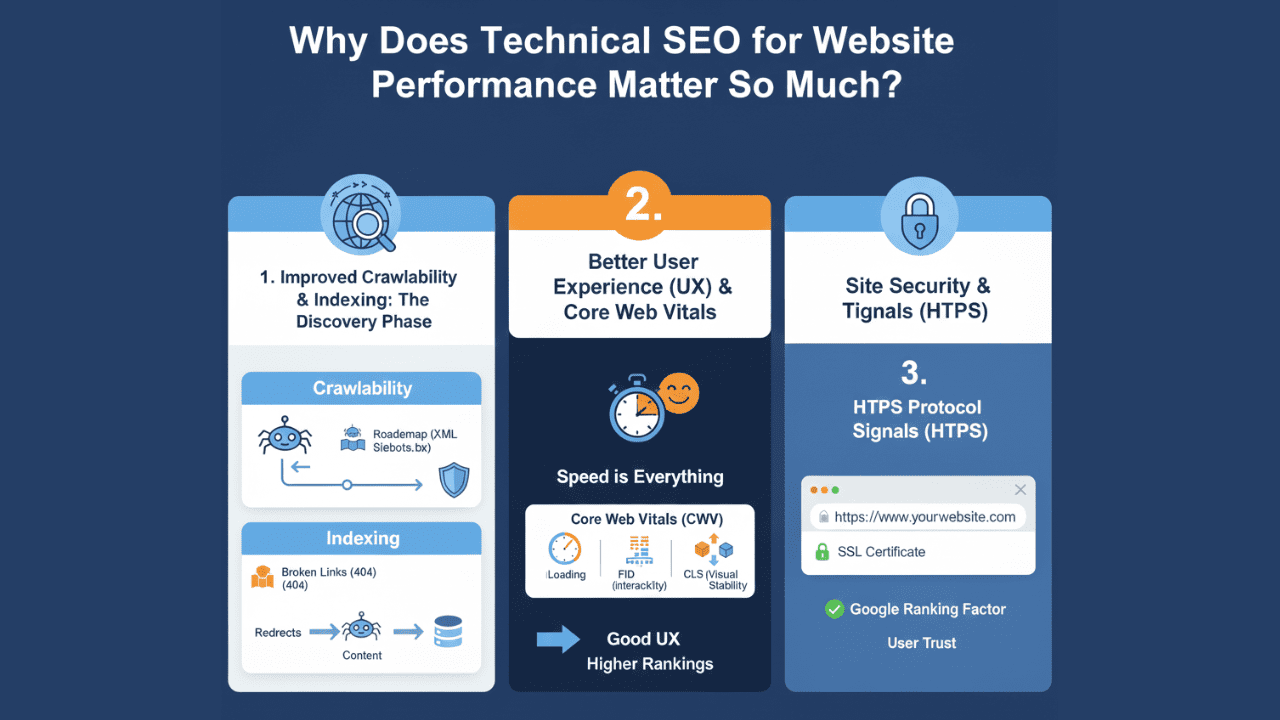
Why Does Technical SEO for Website Performance Matter So Much?
1. Improved Crawlability and Indexing: The Discovery Phase
Before your content can rank, Google must first be able to find and store it. This process is called Crawlability and Indexing.
⇒ Crawlability: Search engine bots, often called “spiders,” crawl your site by following links to discover new and updated content. Technical SEO ensures that the bots can navigate your site efficiently without encountering critical roadblocks.
→ The Roadmap (XML Sitemaps): A well-optimized XML sitemap acts as a complete, organized map of your site, guiding bots directly to all important pages.
→ The Gatekeeper (Robots.txt): The robots.txt file tells crawlers which sections of your site they should (and should not) visit, allowing you to manage your crawl budget effectively. If this file is misconfigured, it can block search engines from viewing your entire site.
⇒ Indexing: Once crawled, the pages are processed and added to Google’s massive index (database). Technical SEO addresses issues like broken links (404 errors), improper redirects, or poor internal linking structures, which would otherwise prevent pages from being successfully indexed. If Google can’t find and understand your pages, they simply won’t rank.
2. Better User Experience (UX) and Core Web Vitals
Google has increasingly shifted its focus to User Experience (UX) as a primary ranking signal. Factors like page loading speed, visual stability, and mobile-friendliness directly impact how a visitor interacts with your site.
⇒ Speed is Everything: Slow-loading pages frustrate users, leading to high bounce rates and low time-on-page—strong negative signals to Google. Search engines prioritize sites that load instantaneously.
⇒ The Core Web Vitals (CWV) Mandate: Google formalized its focus on UX through the Core Web Vitals initiative. These metrics directly measure real-world user experience:
→ Largest Contentful Paint (LCP): Measures loading performance (how quickly the main content of the page loads).
→ First Input Delay (FID): Measures interactivity (how fast the site responds to the user’s first click).
→ Cumulative Layout Shift (CLS): Measures visual stability (how much the page elements jump around during loading). By mastering Technical SEO for Website Performance and optimizing these metrics, you satisfy both the user and the algorithm.
3. Site Security and Trust Signals (HTTPS)
In a world increasingly concerned with data privacy, security is not just a feature—it’s a fundamental requirement.
⇒ HTTPS Protocol: Implementing an SSL certificate to ensure your site uses the secure HTTPS protocol is a basic, yet crucial, technical step. Google officially confirmed that security is a minor, but foundational, ranking factor. More importantly, browsers mark non-secure HTTP sites as “Not Secure,” instantly eroding user trust.
Ultimately, neglecting Technical SEO for Website Performance results in wasting your content efforts. A technically sound website translates into high efficiency, trust, and a seamless journey for both search engine bots and human visitors, laying the groundwork for consistent traffic and Technical SEO for better rankings.
Key Pillars of Technical SEO for Better Rankings
To truly unlock your website’s potential, you must focus on specific technical elements that directly influence your search engine rankings and user satisfaction.
⇒ Page Speed Optimization SEO
Speed is a top-tier ranking factor. Slow-loading pages frustrate users and lead to high bounce rates—a signal to Google that your site is not providing a good experience. Effective page speed optimization SEO involves several crucial steps:
→ Core Web Vitals: Google uses Core Web Vitals (CWV) metrics—Largest Contentful Paint (LCP), First Input Delay (FID), and Cumulative Layout Shift (CLS)—to assess user experience based on loading, interactivity, and visual stability.
→ Image Optimization: Compressing images and using modern formats like WebP significantly reduces load times.
→ Minification: Reducing CSS, JavaScript, and HTML file sizes by removing unnecessary characters.
→ Server Response Time: Optimizing your web host and server configuration to deliver content faster.
⇒ Mobile Optimization
With most online traffic coming from smartphones, mobile optimization is no longer optional; it is mandatory. Google operates a “mobile-first” indexing approach, meaning the mobile version of your site is the primary one used for ranking.
→ Responsive Design: Your website should adapt seamlessly to any screen size—from desktop monitors to tablets and smartphones.
→ Touch Targets: Ensure buttons and links are large enough and spaced correctly for easy tapping on a mobile screen.
→ Fast Mobile Loading: The same speed principles apply, but they are even more critical for mobile users who may be on slower networks.
⇒ Site Structure and Security
A well-organized site structure, often referred to as “site architecture,” helps search engines understand the hierarchy and relationship between your pages.
→ Secure HTTPS Protocol: Installing an SSL certificate to enable HTTPS is a fundamental technical requirement. Security is a direct ranking factor and builds user trust.
→ XML Sitemaps: An up-to-date XML sitemap acts as a roadmap for search bots, ensuring they can find all your important pages.
→ Robots.txt: This file tells crawlers which pages or sections of your site to ignore, helping you manage your crawl budget effectively.
The Essential Technical SEO Checklist
A periodic technical audit is vital to maintaining peak performance. Here is a brief Technical SEO checklist to guide your efforts:
| Technical Element | Actionable Steps |
| Crawlability & Indexing | Check Google Search Console for crawl errors, review robots.txt, and verify your XML sitemap. |
| Site Speed | Test speed using PageSpeed Insights, compress images, and leverage browser caching. |
| Mobile-Friendliness | Ensure a responsive design and check the Mobile Usability report in Google Search Console. |
| Security | Confirm your site uses HTTPS and all non-secure URLs redirect correctly. |
| Structured Data | Implement schema markup to help search engines understand your content and enable rich snippets. |
| Duplicate Content | Use canonical tags to specify the preferred version of a page and resolve content duplication issues. |
| Broken Links | Use a crawling tool to find and fix all 404 errors and broken internal/external links. |
Conclusion: Investing in the Foundation
The phrase “Content is King” still holds true, but Technical SEO for Website Performance is the kingdom it reigns over. Ignoring this crucial behind-the-scenes work means your most valuable content could be hidden from users and search engines alike.
By diligently implementing Technical SEO for better rankings—focusing on speed, mobile compatibility, and solid site architecture—you build a powerful, sustainable foundation. This investment will not only enhance your visibility but also provide a superior user experience, leading to lower bounce rates, higher engagement, and ultimately, a significant competitive advantage in the SERPs. Technical SEO doesn’t just improve your website; it defines your website’s performance and long-term success.
FAQs
Q1: What is the main difference between Technical SEO and On-Page SEO?
Technical SEO focuses on the website’s infrastructure (speed, crawlability, mobile-friendliness) to improve how search engines access and index the site. On-Page SEO, conversely, focuses on optimizing the content elements on a page (keywords, titles, headers, image alt text) to make the content more relevant to search queries.
Q2: How often should I perform a Technical SEO audit?
It is recommended to conduct a comprehensive Technical SEO audit at least twice a year, or immediately after a major website change, redesign, or migration. Continuous monitoring of Core Web Vitals and Search Console reports should be done weekly or monthly.
Q3: Does page speed optimization SEO directly impact my rankings?
Yes, absolutely. Since 2018, page speed has been a direct ranking factor for mobile searches. Furthermore, it is a key component of Core Web Vitals, which is a major signal for user experience and directly influences search engine ranking positions.
Q4: Why is mobile optimization so critical for rankings today?
Google uses mobile-first indexing, meaning the search engine primarily uses the content and structure of your mobile site for indexing and ranking purposes. If your mobile site is slow or difficult to use, your rankings will suffer, even if your desktop site is excellent.
Q5: Can I improve my Technical SEO for better rankings without knowing how to code?
While deep coding knowledge is helpful for complex fixes, many fundamental Technical SEO improvements (like optimizing images, updating sitemaps, checking for crawl errors, and ensuring HTTPS) can be done using common CMS plugins and tools like Google Search Console and Lighthouse.
IF YOU LIKED THIS BLOG, DON’T FORGET TO CHECK OUT: How to Create a Responsive Web Design

(11) Comments