
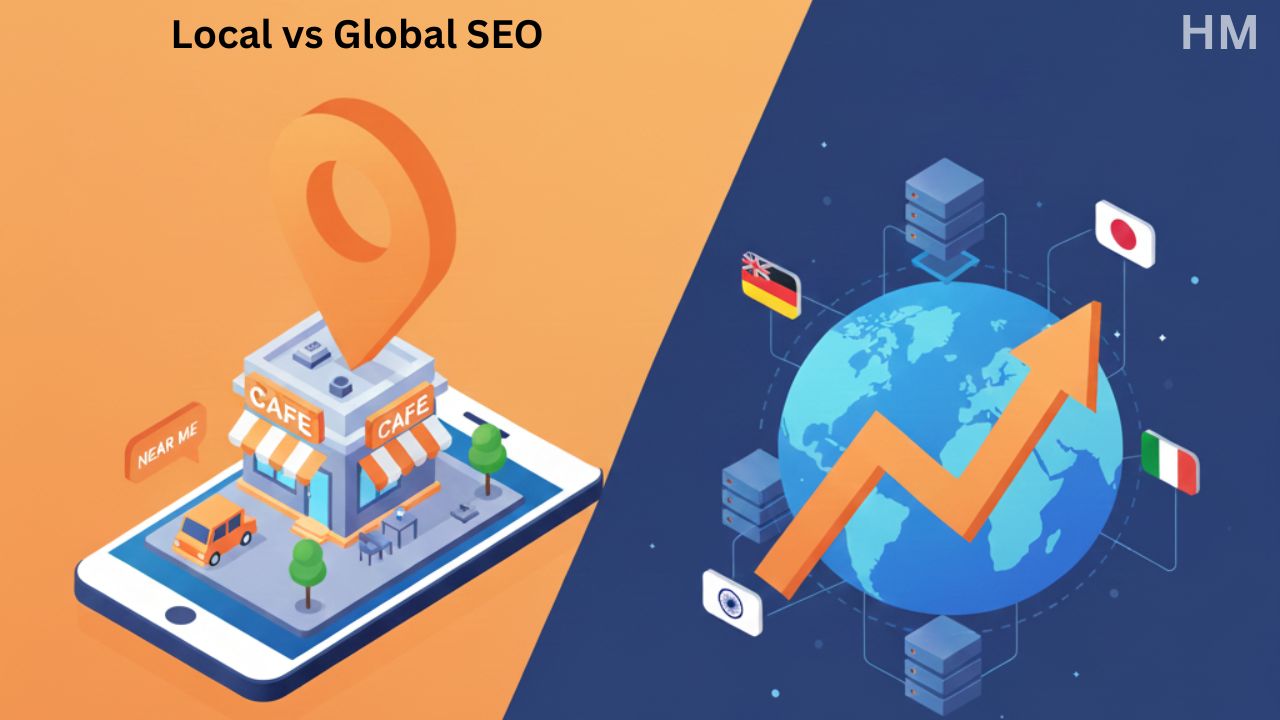
Local SEO vs Global SEO: Which is Right for Your Business in 2026?
Search Engine Optimization (SEO) is the process of optimizing your website to rank higher in search engine results, driving organic traffic. Today, SEO is not just a marketing tactic; it is a foundational pillar for digital survival. The importance of SEO has grown exponentially in recent years due to rapidly evolving search algorithms, the rise of AI-powered search, and increasing online competition.
Businesses are increasingly faced with a critical choice: should they target the customer next door or the potential client across the globe? This decision comes down to understanding the core difference between Local SEO and Global SEO. Local SEO focuses on attracting customers within a specific geographic area, while Global SEO aims for worldwide visibility.
Choosing the right strategy is essential for maximizing marketing ROI and achieving long-term business goals. In this guide, we break down both approaches, compare their elements, and help you confidently choose the right SEO strategy for 2026.
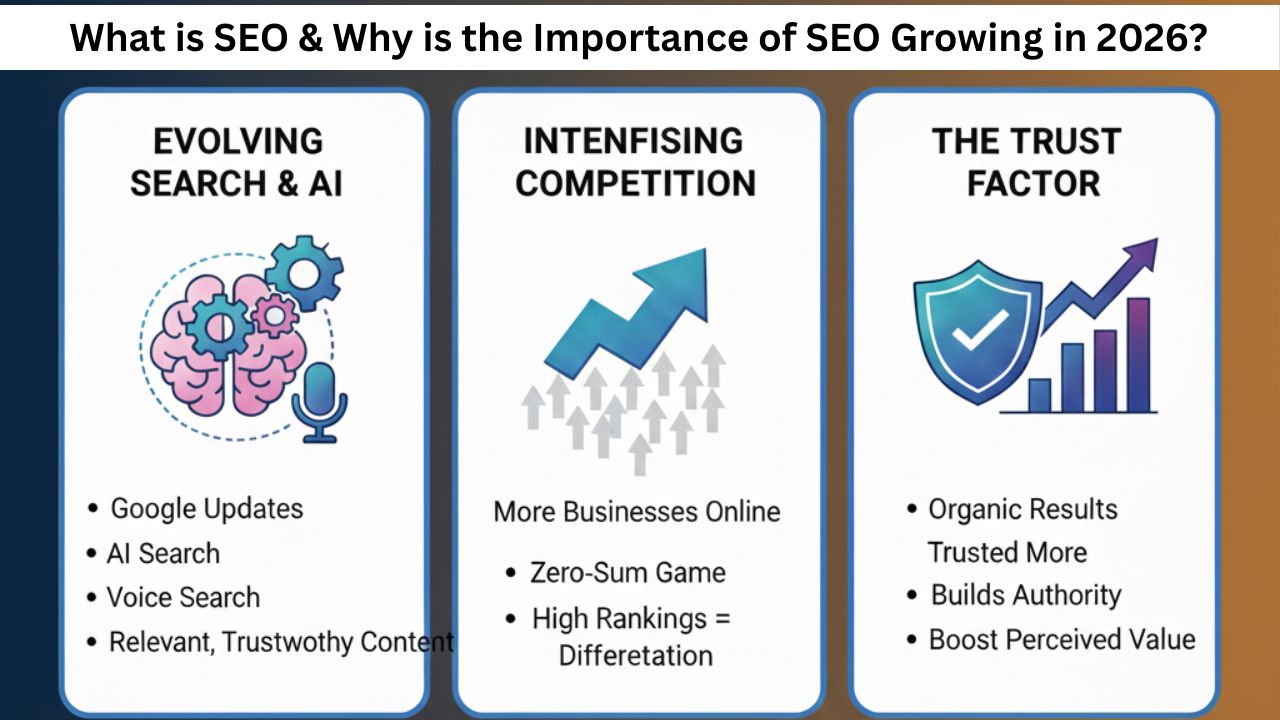
What is SEO & Why Is It More Important Than Ever in 2026?
SEO is the practice of increasing both the quality and quantity of website traffic through organic search results. It involves content optimization, technical improvements, and authority building.
SEO continues to gain importance because:
→ Search engines now rely heavily on AI-driven and conversational search
→ Voice search and zero-click results are growing
→ Online competition is more intense than ever
→ Users trust organic rankings more than paid advertisements
Businesses that ignore SEO risk losing visibility, credibility, and consistent organic leads.
What is Local SEO?
⇒ Definition of Local SEO
Local SEO is a strategy focused on improving a business’s visibility in location-based searches. It helps businesses appear in Google Maps and the local search pack when users search for nearby services.
⇒ Key Elements of Local SEO
→ Google Business Profile optimization
→ Location-based keyword targeting
→ NAP (Name, Address, Phone) consistency
→ Local citations and backlinks
→ Customer reviews and responses
⇒ Benefits of Local SEO
→ Attracts nearby, high-intent customers
→ Higher conversion rates
→ Faster ranking improvements
→ Cost-effective for small and service-based businesses
What is Global SEO?
⇒ Definition of Global SEO
Global SEO focuses on optimizing websites for multiple countries or languages, targeting users across international markets.
⇒ Key Elements of Global SEO
→ International keyword research
→ Hreflang tag implementation
→ Country-specific domains or subfolders
→ Advanced technical SEO
→ High-authority global backlinks
⇒ Benefits of Global SEO
→ Worldwide brand visibility
→ Large traffic potential
→ Scalable international growth
→ Strong industry authority
Local SEO vs Global SEO: Comparison Table
|
Feature |
Local SEO | Global SEO |
| Target Audience |
Local customers |
International users |
|
Competition |
Low to medium |
Very high |
|
Cost |
Lower |
Higher |
| Results Timeline |
Faster (3–6 months) |
Slower (6–12+ months) |
|
Best For |
Local stores, services |
E-commerce, SaaS, global brands |
| Focus Areas | GBP, reviews, citations |
Hreflang, content, technical SEO |
SEO Value for Different Business Sizes
→ Small Businesses: Local SEO helps generate direct leads and nearby customers
→ Medium Businesses: A hybrid approach supports regional dominance and online growth
→ Large Enterprises: Global SEO drives international reach and authority
The second and final use of the keyword:
The long-term importance of SEO lies in building sustainable organic visibility that reduces dependence on paid advertising.
Which SEO Strategy Should You Choose in 2026?
Choosing the right SEO strategy in 2026 depends on how your business operates, where your customers are located, and how quickly you want to see results. Both Local SEO and Global SEO serve different purposes, and selecting the wrong approach can waste time and budget. Below is a detailed explanation to help you make the right decision.
⇒ Choose Local SEO If:
→ You run a physical store or local service
If your business depends on in-person visits or on-site service delivery—such as restaurants, retail shops, clinics, gyms, salons, or repair services—Local SEO is essential. It helps your business appear in Google Maps and local search results when nearby customers search for your services. This directly increases walk-ins, phone calls, and appointment bookings.
→ You serve a specific city or region
Businesses that operate within a defined geographic area benefit the most from Local SEO. By targeting location-based keywords and optimizing your Google Business Profile, you can dominate search results in your city or neighborhood. This ensures your marketing efforts reach only the most relevant audience, improving lead quality and conversion rates.
→ You need faster ROI on a limited budget
Local SEO usually delivers quicker results compared to global strategies. With lower competition and focused targeting, businesses can start seeing improvements in visibility and leads within a few months. This makes Local SEO ideal for startups, small businesses, and service providers that want cost-effective marketing with measurable returns.
⇒ Choose Global SEO If:
→ You sell digital or physical products worldwide
If your products or services are not restricted by location—such as e-commerce stores, SaaS platforms, online courses, or digital tools—Global SEO is the right choice. It allows you to reach customers across different countries and time zones, creating continuous traffic and sales opportunities around the clock.
→ Your audience is international
Businesses with customers in multiple countries require an SEO strategy that accounts for different languages, cultures, and search behaviors. Global SEO ensures your content is properly optimized for international users through multilingual pages, correct regional targeting, and technical elements like hreflang tags.
→ You are planning scalable long-term expansion
Global SEO is a long-term investment designed for growth. While it takes more time and resources, it builds a strong foundation for international expansion. Businesses aiming to become global brands benefit from higher authority, wider reach, and sustainable organic traffic that supports long-term scalability.
Common SEO Mistakes to Avoid in 2026
SEO in 2026 is more competitive and technical than ever. Even small mistakes can significantly impact rankings, traffic, and conversions. Avoiding the following common SEO errors will help you build a stronger and more sustainable search presence.
Targeting Overly Broad or Irrelevant Keywords
One of the biggest SEO mistakes is focusing only on high-volume, generic keywords that do not match user intent. Broad keywords are extremely competitive and often fail to convert. Instead, businesses should target relevant, intent-based, and long-tail keywords that align with what users are actually searching for. Proper keyword research ensures better rankings, qualified traffic, and higher conversion rates.
Ignoring Mobile-First Optimization
Google primarily uses the mobile version of a website for indexing and ranking. If your site is slow, poorly designed, or difficult to navigate on mobile devices, your rankings will suffer. In 2026, mobile optimization is no longer optional. A responsive design, fast loading speed, and mobile-friendly user experience are essential for both SEO performance and user satisfaction.
Publishing Low-Quality or Unhelpful Content
Content that lacks depth, originality, or value will not rank in modern search results. Search engines now prioritize content that demonstrates experience, expertise, authority, and trustworthiness (E-E-A-T). Publishing thin or purely AI-generated content without human insight can harm your visibility. High-quality, informative, and user-focused content is critical for long-term SEO success.
Missing Google Business Profile Optimization
For local businesses, failing to optimize and maintain a Google Business Profile is a major mistake. An incomplete or outdated profile reduces visibility in local search results and Google Maps. Regular updates, accurate business information, photos, posts, and customer review management are essential for improving local rankings and attracting nearby customers.
Neglecting Technical SEO Issues
Technical SEO forms the foundation of search visibility. Problems such as slow page speed, broken links, poor site structure, duplicate content, or improper indexing can prevent search engines from properly crawling and ranking your website. Regular technical audits and fixes ensure your site remains accessible, fast, and search-engine friendly.
Conclusion
Local SEO and Global SEO are both powerful, but they serve different purposes. Local SEO helps businesses dominate regional markets, while Global SEO enables international expansion and scalability.
Your choice should depend on your audience, resources, and growth plans. Start local if your business depends on nearby customers, and think global if your products or services can scale worldwide. A well-planned SEO strategy remains one of the most reliable ways to build trust, visibility, and long-term growth.
Faq
1. Is Local SEO better than Global SEO?
Local SEO is best for businesses that serve customers in a specific geographic area, such as local shops or service providers. Global SEO is more suitable for businesses targeting customers across multiple countries or regions. The better option depends entirely on your business model and audience.
2. Can a business use both Local and Global SEO strategies?
Yes, many businesses use a hybrid approach. They apply Local SEO to dominate their regional market while using Global SEO to expand their online products or services to international audiences.
3. How long does SEO take to show results?
SEO is a long-term strategy. Local SEO typically starts showing results within 3 to 6 months, while Global SEO may take 6 to 12 months or longer due to higher competition and broader targeting.
4. Which businesses benefit the most from Local SEO?
Local SEO proves to be highly effective for brick-and-mortar establishments, service-oriented businesses, and professionals reliant on clientele from a particular city or area, including restaurants, clinics, salons, and local agencies.
5. Is SEO still important in 2026?
Yes, SEO remains one of the most important digital marketing strategies in 2026. With growing online competition, AI-driven search, and changing user behavior, SEO is essential for maintaining visibility, credibility, and long-term business growth.
IF YOU LIKED THIS BLOG, DON’T FORGET TO CHECK OUT: Future of SEO
Tanishka Vats
Lead Content Writer | HM Digital Solutions Results-driven content writer with over five years of experience and a background in Economics (Hons), with expertise in using data-driven storytelling and strategic brand positioning. I have experience managing live projects across Finance, B2B SaaS, Technology, and Healthcare, with content ranging from SEO-driven blogs and website copy to case studies, whitepapers, and corporate communications. Proficient in using SEO tools like Ahrefs and SEMrush, and content management systems like WordPress and Webflow. Experienced content writer with a proven track record of creating audience-centric content that drives significant results on website traffic, engagement rates, and lead conversions. Highly adaptable and effective communicator with the ability to work under deadlines.