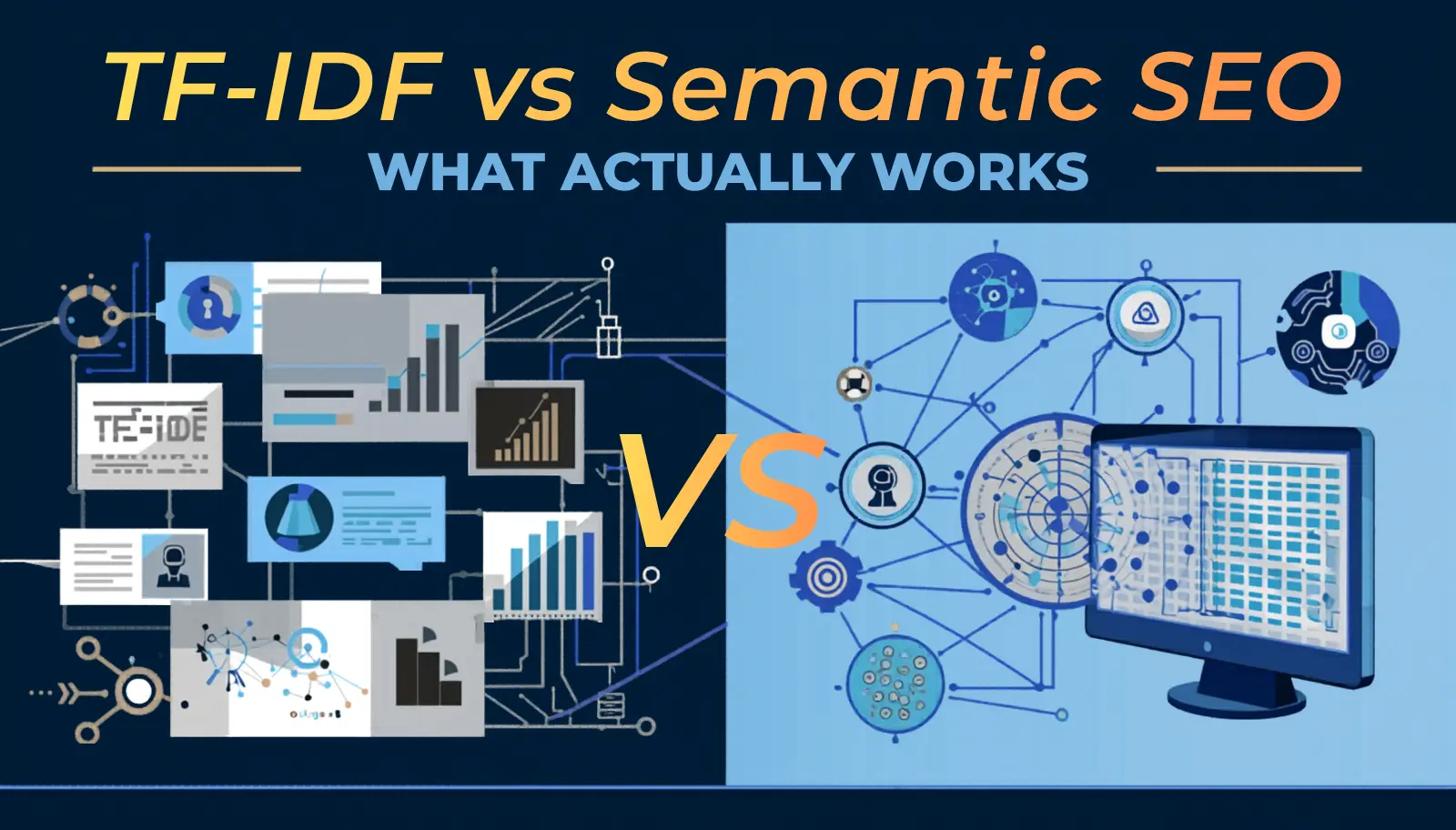
 TF-IDF vs Semantic SEO: What Actually Works in 2026
If you have been in the SEO world for a while, you have probably heard both terms thrown around a lot. TF-IDF was the go-to content optimization method for years. Then semantic SEO came along and changed everything. Now people are confused about which one actually moves rankings in 2026.
Here is the honest answer: it is not really an either/or question. But one of them is doing most of the heavy lifting right now, and the other has shifted into a support role. By the end of this guide, you will know exactly what each method does, where each one fits into your content strategy, and what actually works when you want to outrank competitors in today’s AI-driven search environment.
What You Will Learn in This Guide
→ What TF-IDF actually is and how it works
→ What semantic SEO means in practical terms
→ How Google has shifted from lexical to meaning-based ranking
→ Where TF-IDF still helps and where it falls short
→ What semantic optimization looks like step by step
→ The right way to combine both in 2026
→ Tools that actually help
What Is TF-IDF? (And Why Everyone Used to Love It)
TF-IDF stands for Term Frequency – Inverse Document Frequency. It is a statistical method that measures how important a word is in a specific document compared to how common that word is across a large collection of documents.
The formula works in two parts:
Term Frequency (TF) = How often a word appears in your document divided by the total number of words in that document.
Inverse Document Frequency (IDF) = A measure of how rare or unique that word is across all documents in the corpus.
When you multiply TF and IDF together, you get a score that tells you how significant a term is for a specific piece of content. Common words like “the” or “and” get very low scores because they appear everywhere. A niche term like “entity-based indexing” gets a high score because it is rare and specific.
For SEO, TF-IDF was used to compare your content against top-ranking competitors. If the top 10 pages for your keyword all used the term “search intent” heavily and your page barely mentioned it, that was a gap worth fixing.
It gave SEOs a fast, data-driven way to identify missing vocabulary on a page. And for a long time, it worked reasonably well.
The Problem With TF-IDF in 2026
TF-IDF is a lexical method. It works at the word level. It measures strings of characters, not meaning. This is where it starts to crack under the pressure of modern search.
Here are the specific limitations that matter right now:
It cannot understand context. The word “apple” could refer to a fruit, a tech company, or a person’s name. TF-IDF treats all three as identical. It has no ability to differentiate based on surrounding content.
It does not recognize synonyms or related concepts. If your article talks about “voice search optimization” but the competitor’s article uses “spoken query SEO,” TF-IDF sees these as completely different terms, even though they mean the same thing.
It does not understand search intent. A page could have all the right TF-IDF scores and still be optimized for the wrong type of intent. If someone wants a how-to guide and your page is informational, no amount of keyword balancing fixes that mismatch.
It ignores entities and relationships. Google’s Knowledge Graph contains over 8 billion entities and 800 billion facts about how those entities relate to each other. TF-IDF has no awareness of any of that.
It was built for a different era of search. TF-IDF as a concept dates back to the 1970s. It was designed for information retrieval in static document libraries, not for ranking in AI-driven semantic search engines.
Google’s John Mueller has been clear that TF-IDF is not a ranking signal in the way many SEOs believe. Google does not have an expected TF-IDF score for your content that you need to match. The method is referenced in a few older Google patents for stop-word removal purposes, not for relevance ranking.
What Is Semantic SEO? (The Real Definition)
Semantic SEO is the practice of optimizing your content around meaning, context, entities, and relationships rather than just individual keyword strings.
Instead of asking “how often does my target keyword appear?”, semantic SEO asks “does this content fully cover the topic, address the right intent, and use the vocabulary, entities, and relationships that Google associates with this subject?”
It became the dominant approach after a series of Google algorithm updates changed how search fundamentally works:
Hummingbird (2013) was the first major shift. Google started interpreting the meaning behind a query rather than just matching words.
RankBrain (2015) brought machine learning into ranking. Google started learning from user behavior and making inferences about what searchers actually wanted.
BERT (2019) was the big one. Bidirectional Encoder Representations from Transformers allowed Google to understand words in relation to all the other words around them, not just left to right. A word like “bank” near “river” means something completely different from “bank” near “interest rate.” BERT gets that.
MUM (2021) took things further. It is 1,000 times more powerful than BERT and can process information across text, images, audio, and video simultaneously.
Gemini integration (2025-2026) is where we are now. Google’s AI Overviews and the new AI Mode use Gemini 3 to generate answers dynamically. These systems pull from content that demonstrates genuine topical authority and entity coverage, not just keyword frequency.
The shift is from strings to things. From matching words to understanding meaning.
TF-IDF vs Semantic SEO: A Direct Comparison
| Factor | TF-IDF | Semantic SEO |
|---|---|---|
| Core approach | Word frequency analysis | Meaning, context, and entity relationships |
| Understands synonyms | No | Yes |
| Understands intent | No | Yes |
| Works with Google’s current algorithms | Partially | Strongly aligned |
| Useful for | Finding vocabulary gaps | Building topical authority |
| Risk | Over-optimization, unnatural text | Requires deeper content investment |
| Best combined with | Semantic analysis | Always |
Where TF-IDF Still Has Value in 2026
Despite its limitations, TF-IDF has not become completely useless. It has moved into a support role, and understanding where it still helps can save you time.
Vocabulary gap analysis. Running a TF-IDF comparison against top-ranking competitors can show you which supporting terms and phrases appear consistently across high-ranking content that you have missed. This is not about matching scores. It is about discovering vocabulary that signals topic completeness.
Content auditing. When a page is stuck on page 2 despite having good backlinks and technical health, TF-IDF analysis can reveal missing terms that competitors are consistently using. This is one of the fastest ways to diagnose a content relevance problem.
Anchor text optimization. TF-IDF can help identify the most contextually appropriate terms to use in your internal linking strategy. Instead of generic anchor text like “click here,” TF-IDF analysis helps you find the specific terms that are semantically meaningful for the linked page.
Early retrieval. Google’s ranking system works in layers. The first pass uses lexical relevance checks, essentially looking for vocabulary matches, before deeper semantic systems like BERT evaluate true meaning. TF-IDF mirrors that first-pass logic, which is why content that completely ignores keyword vocabulary can still struggle to get indexed for the right topics.
Think of TF-IDF as the first filter. It helps you check whether your content is even speaking the right language for a topic. Semantic SEO is what decides whether your content actually belongs at the top.
What Semantic Optimization Actually Looks Like
This is where a lot of guides get vague. Let us make it practical.
Step 1: Start With Topic Coverage, Not Keywords
Before writing, map the full topic. What are the main entities associated with this subject? What subtopics does Google consistently surface? What questions appear in People Also Ask?
For example, if you are writing about “email marketing for startups,” the topic map includes entities like email service providers, automation workflows, open rates, deliverability, segmentation, A/B testing, and subscriber growth. Covering these entities comprehensively is more important than repeating the phrase “email marketing for startups.”
Step 2: Match Search Intent Precisely
Google categorizes search intent into four types: informational, navigational, commercial, and transactional. Before optimizing anything, confirm the intent behind your target query. Look at what the top-ranking pages actually are. If they are all how-to guides, your commercial page will struggle regardless of how well optimized it is.
Step 3: Use NLP to Analyze Entity Coverage
Run your content through Google Cloud Natural Language API. Check which entities are being detected and what salience scores they have. Then run the top-ranking competitors through the same tool. The entities that appear consistently across high-ranking pages but are missing from your content are your topical blind spots.
This is the semantic version of TF-IDF gap analysis, and it is significantly more aligned with how Google actually processes content. For a deeper look at this approach, see our guide on how to use NLP APIs for SEO.
Step 4: Build Internal Topic Clusters
Semantic SEO is not just about individual pages. Google evaluates topical authority at the site level. If your website comprehensively covers a subject across multiple interconnected pages, each supporting a central pillar page, that signals authority in ways that a single well-optimized page cannot.
A strong semantic content network means your pages reinforce each other’s relevance. The internal links you build between them are not just navigation tools. They are semantic signals that tell Google which topics your site owns.
Step 5: Validate Category Alignment
One of the most overlooked semantic optimization checks is content category validation. Paste your draft content into Google’s Natural Language demo at cloud.google.com/natural-language and check the Categories tab. If Google categorizes your article about “B2B lead generation tools” as “Computers & Software” rather than “Business & Industrial > Marketing,” you have a topical alignment problem that no amount of keyword optimization will fix.
The Role of Entities in 2026 Rankings
Entities are the foundation of how Google understands the web right now. An entity is anything that is unique, well-defined, and distinguishable. A person, a place, a brand, a concept, a product.
Google’s Knowledge Graph now contains over 8 billion entities and tracks over 800 billion facts about how they relate to each other. When Google reads your content, it is not just counting words. It is identifying which entities are present, how prominently they appear (salience), and how they relate to other entities Google already knows about.
A 2023 Ahrefs study of 1,500 SEO professionals found that 78% considered entity recognition crucial for effective SEO strategies. And the SEMrush longitudinal study from 2024 confirmed that entity-based content significantly outperformed keyword-density-based content across competitive verticals.
This is why how Google uses entities instead of keywords matters so much. The ranking system has fundamentally shifted from matching characters to recognizing concepts.
For practical entity optimization:
→ Use Schema markup (JSON-LD) to explicitly define entities on your page
→ Link to authoritative external sources that Google associates with your topic (Wikipedia, government sites, recognized publications)
→ Ensure your brand has consistent entity signals across social profiles, directories, and authoritative mentions
→ Cover entity attributes, not just the entity name. For “BERT,” cover what it is, who built it, when it launched, what it does, and how it relates to MUM and Gemini
How Vector Search Is Changing Optimization in 2026
This is the advanced layer that most content guides skip over, but it is increasingly relevant for competitive SEO.
Google’s AI Overviews and the new AI Mode do not retrieve documents purely through keyword matching. They use vector embeddings, mathematical representations of meaning, to find semantically similar content.
When you search for something, your query is converted into a vector. Google then finds documents whose vectors are closest to the query vector in high-dimensional space. A document that is topically dense and covers a subject comprehensively will have vectors that are close to more queries than a thin page that only repeats exact keyword phrases.
This is why vector search SEO and embeddings matter now in a way they did not three years ago. TF-IDF uses sparse vectors, counting words. Modern retrieval uses dense vectors that capture meaning. Content that is semantically rich will consistently outperform keyword-heavy content in these newer retrieval systems.
The practical implication: write content that genuinely and thoroughly covers a topic. Not because of some abstract idea of quality, but because topically comprehensive content produces denser, more useful vectors that match more queries.
Common Mistakes SEOs Make With Both Methods
Mistake 1: Treating TF-IDF scores as target numbers to hit. There is no correct TF-IDF score. Forcing terms into content to match a competitor’s score creates unnatural text that hurts readability and trust signals. Use TF-IDF as a discovery tool, not a compliance checklist.
Mistake 2: Using semantic SEO as a reason to write vague, padded content. Semantic SEO does not mean writing long articles about everything. It means covering the right entities and subtopics with genuine depth. Padding word count with loosely related information hurts rather than helps.
Mistake 3: Running TF-IDF only on your own content. The whole point of TF-IDF analysis is comparison. Running it on your content alone tells you nothing useful. Always benchmark against the top-ranking competitors for your target query.
Mistake 4: Ignoring search intent while focusing on entity coverage. You can have perfect entity coverage and still fail if your content format does not match what the searcher needs. A transactional query needs a product page, not a 3,000-word explanation.
Mistake 5: Skipping technical SEO while chasing semantic signals. Semantic optimization and technical SEO work together. If Google cannot crawl, index, or render your content properly, no amount of semantic richness will get you ranked. Fix the technical foundation first.
The Right Way to Use Both in 2026
Here is the practical workflow that combines TF-IDF and semantic SEO in the right order:
Phase 1: Research Use TF-IDF tools (Surfer SEO, Clearscope, or WebSite Auditor) to identify the vocabulary and supporting terms that consistently appear in top-ranking content. This gives you your topic vocabulary baseline.
Phase 2: Entity Mapping Use Google NLP or InLinks to identify the entities Google associates with your target topic. Build an entity map that shows which concepts need to be covered and how they relate to each other. Our entity mapping strategy guide walks through this in detail.
Phase 3: Intent Validation Confirm the search intent for your target keyword by analyzing the format, depth, and angle of current top-ranking pages. Your content needs to match this before anything else matters.
Phase 4: Content Creation Write content that covers all identified entities and subtopics with genuine depth. Use the TF-IDF vocabulary list as a reference to make sure you are not missing important supporting terms, but write naturally. Do not force terms.
Phase 5: Category and Sentiment Check Before publishing, run your draft through Google NLP. Confirm the category is correct. Check the salience of your primary entities. If something important has low salience, it means you have not given it enough prominence in the content.
Phase 6: Internal Linking Connect your new content to related pages across your site using contextually relevant anchor text. This reinforces your topical cluster structure and strengthens the semantic signals around the topic.
Phase 7: Monitor and Iterate Run TF-IDF analysis again after publishing. Track ranking movement and compare entity coverage against any new pages that enter the top results. Semantic optimization is not a one-time task.
Best Tools for TF-IDF and Semantic SEO in 2026
| Tool | Best For | Type |
|---|---|---|
| Surfer SEO | TF-IDF content scoring + NLP | Paid |
| Clearscope | Content grading + topic coverage | Paid |
| Google Cloud NLP API | Entity detection and category analysis | Free tier available |
| InLinks | Entity SEO and internal link optimization | Paid |
| SEO PowerSuite WebSite Auditor | TF-IDF competitive analysis | Freemium |
| Answer The Public | Semantic question mapping | Free/Paid |
| Google Search Console | Semantic performance tracking | Free |
FAQ: TF-IDF vs Semantic SEO
Q: Is TF-IDF dead in 2026?
Not completely. TF-IDF is no longer a direct ranking concept, but it remains a useful practical tool for identifying vocabulary gaps and doing competitive content analysis. It has shifted from being the primary optimization method to being one data input in a broader semantic strategy.
Q: Does Google still use TF-IDF?
Google may use TF-IDF-like logic in the early lexical retrieval stage of its ranking pipeline, but not as a primary ranking signal. Modern ranking depends on BERT, MUM, Gemini, and entity-based systems that go far beyond what TF-IDF can analyze.
Q: What is more important for ranking in 2026, keyword density or semantic coverage?
Semantic coverage wins every time. Keyword density is an outdated metric. Google’s helpful content system actively evaluates whether content genuinely covers a topic for users, not whether it repeats keywords at a certain rate. Semantic depth and entity coverage are what modern ranking systems reward.
Q: How do I know if my content is semantically optimized?
Run it through Google Cloud Natural Language API. Check which entities are detected, their salience scores, and the content category. Then compare against the top-ranking pages for your target query. The gaps in entity coverage and category alignment are your optimization targets.
Q: Can I use TF-IDF tools alongside a semantic SEO strategy?
Yes, and this is exactly how most advanced SEOs use them. TF-IDF tools like Surfer or Clearscope now incorporate NLP analysis alongside traditional term frequency scoring. Use TF-IDF to check vocabulary, use NLP tools to check entity and intent alignment. Together they give a more complete picture than either approach alone.
Q: How often should I run TF-IDF and semantic analysis on my content?
Run both when creating new content, when updating existing pages that have dropped in rankings, and quarterly for your highest-traffic pages. Search results change as competitors update their content, so your semantic gap analysis needs to stay current.
Conclusion: What Actually Works in 2026
TF-IDF and semantic SEO are not opponents. They are tools with different jobs, and understanding that distinction is what separates competitive SEO in 2026 from outdated practice.
TF-IDF is useful for vocabulary analysis and discovering supporting terms that belong in your content. It is a fast, interpretable method that helps you confirm you are speaking the right topic language.
Semantic SEO is the strategy. It is how you build content that Google actually understands, trusts, and surfaces in AI-powered search results. Entity coverage, topical authority, intent alignment, and context-rich writing are what modern ranking systems reward.
If you are still optimizing purely around keyword frequency and TF-IDF scores, you are playing a game that Google moved on from years ago. If you are building content around meaning, entities, and genuine topic depth, you are aligned with where search is going.
The practical path forward is to use TF-IDF as a vocabulary check, and semantic SEO as your core content architecture. Run the information gain score test on your content to make sure you are adding something new to the conversation, not just paraphrasing what already ranks.
Start with your most important pages. Run them through Google NLP. Compare entity coverage against your top competitors. The gap you see is your content roadmap.
Tanishka Vats
Lead Content Writer | HM Digital Solutions Results-driven content writer with over five years of experience and a background in Economics (Hons), with expertise in using data-driven storytelling and strategic brand positioning. I have experience managing live projects across Finance, B2B SaaS, Technology, and Healthcare, with content ranging from SEO-driven blogs and website copy to case studies, whitepapers, and corporate communications. Proficient in using SEO tools like Ahrefs and SEMrush, and content management systems like WordPress and Webflow. Experienced content writer with a proven track record of creating audience-centric content that drives significant results on website traffic, engagement rates, and lead conversions. Highly adaptable and effective communicator with the ability to work under deadlines.