
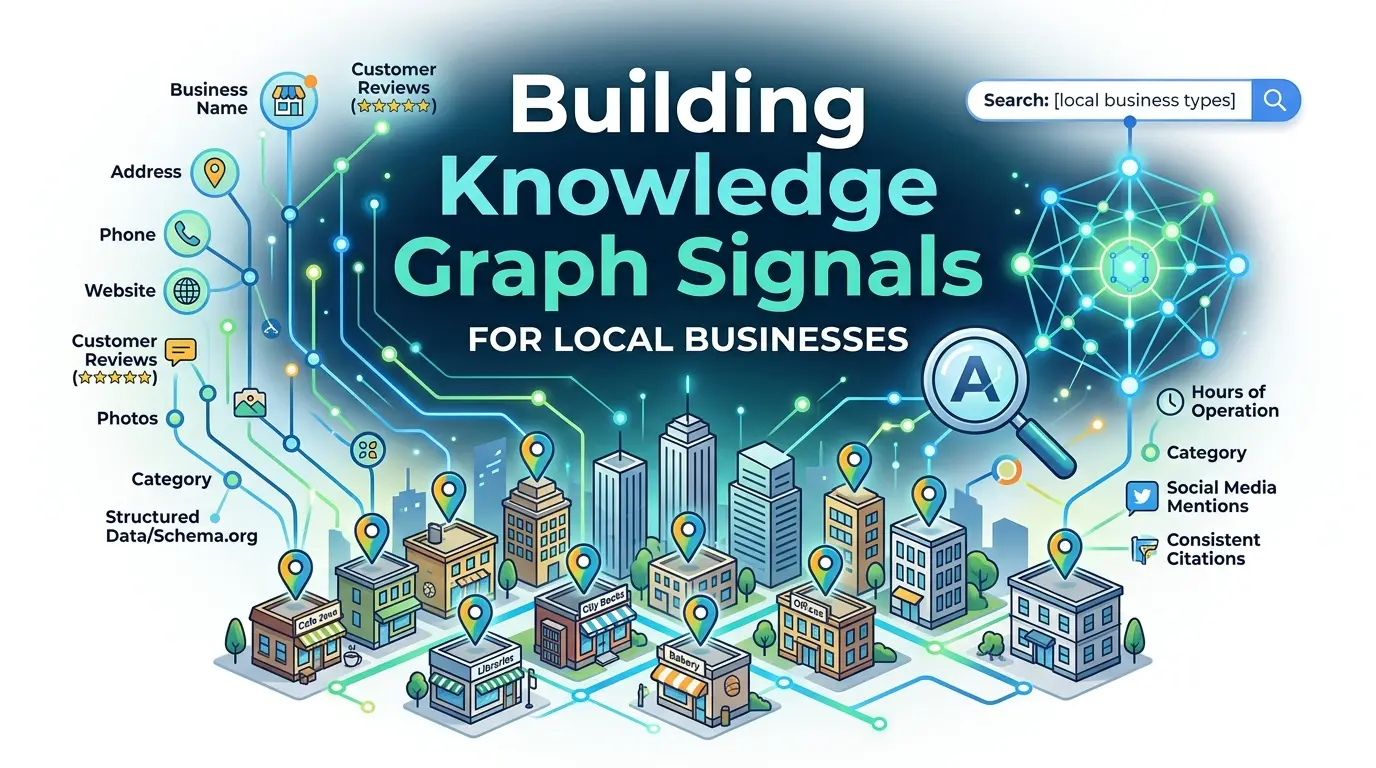
Building Knowledge Graph for Local Businesses
If you run a local business, whether it is a dental clinic in Delhi, a law firm in Mumbai, or a salon in Bangalore, you have probably heard the advice: “get on Google.” But getting on Google in 2026 means something very different from what it meant five years ago.
It is not just about having a website anymore. It is not even just about local SEO basics like citations and reviews. Today, one of the most powerful things you can do for your visibility is build a proper knowledge graph for local businesses, which means sending Google the right entity signals that confirm your business is real, trustworthy, and worth showing in search results.
This guide explains exactly what that means, why it matters, and how you can do it step by step, even if you have never heard the term “knowledge graph” before today.
What You Will Learn
→ What Google’s Knowledge Graph is and why local businesses should care
→ How knowledge graph signals work for local businesses specifically
→ What signals Google uses to build a knowledge panel for your business
→ Step-by-step actions to strengthen your knowledge graph presence
→ Common mistakes local businesses make and how to avoid them
→ Tools that help you track and build these signals
What Is Google’s Knowledge Graph?
Google’s Knowledge Graph is essentially a massive database of real-world entities and the relationships between them. Think of it as Google’s own understanding of the world, not just web pages, but actual things: people, places, businesses, products, concepts, and events.
When Google understands that your business is a real entity, with a specific name, location, category, services, and connections to other trusted entities, it starts treating you differently in search results. You become something Google knows about, not just something Google found on a webpage.
This is why some businesses get that prominent box on the right side of Google search results showing their name, address, phone number, hours, photos, and reviews. That is called a Knowledge Panel, and it is the visible proof that Google has added your business to its Knowledge Graph.
But even if you do not have a full Knowledge Panel yet, building knowledge graph signals still improves how Google understands and ranks your business across all kinds of local searches.
Knowledge Graph vs Knowledge Panel: What Is the Difference?
Many business owners use these two terms interchangeably. They are related but not the same thing.
| Term | What It Is | Who Controls It |
|---|---|---|
| Knowledge Graph | Google’s internal database of entities and their relationships | Google (automated) |
| Knowledge Panel | The visible info box on search results pulled from the Knowledge Graph | Google, with business input via GBP |
| Google Business Profile | Your official listing that feeds into both | You (the business owner) |
| Entity | The real-world thing (your business) that Google recognizes | Established through consistent signals |
Think of it this way: the Knowledge Graph is the database, the Knowledge Panel is the display, and your Google Business Profile is your entry form. Getting into the database comes first. The panel follows naturally once Google has enough confidence in your entity.
Why Knowledge Graph Signals Matter for Local Businesses
Most local businesses focus only on traditional SEO signals: backlinks, on-page keywords, Google Business Profile optimization. These things still matter. But the knowledge graph for local businesses operates at a deeper layer that most business owners are completely missing.
Google has shifted from matching keywords to understanding entities. As we explained in our guide on how Google uses entities instead of keywords, the search engine now tries to understand what your business actually is, what it does, who it serves, and how it connects to the world around it.
When Google has strong entity signals about your business, several things happen:
Better local pack rankings. The local 3-pack results are increasingly driven by how well Google understands your business as an entity, not just how many citations you have.
Knowledge Panel visibility. A strong knowledge graph presence increases the chance of getting a Knowledge Panel, which significantly increases trust and click-through rates.
AI Overview citations. Google’s AI-generated answers are now citing local businesses that have clear, consistent entity signals. If you want your business to appear in these answers, knowledge graph signals are one of the key factors.
Voice search accuracy. When someone asks Google Assistant “find a physiotherapist near me,” the results are pulled from entities Google trusts. Weak entity signals mean you get skipped.
The 6 Core Knowledge Graph Signals Google Looks For
Not all signals are equal. When building the knowledge graph for local businesses, here is a breakdown of the six core signals and how much impact each one carries:
| Signal | Impact Level | Difficulty to Build | Time to See Results |
|---|---|---|---|
| Google Business Profile completeness | Very High | Low | 2 to 4 weeks |
| NAP consistency across the web | Very High | Medium | 1 to 3 months |
| LocalBusiness schema markup | High | Medium | 2 to 6 weeks |
| Citation volume and quality | High | Medium | 2 to 4 months |
| Social media profile consistency | Medium | Low | 1 to 2 months |
| Web mentions and co-occurrence | Medium to High | High | 3 to 6 months |
Start with the high-impact, low-difficulty signals first. GBP and schema markup give you the fastest return for the effort invested.
How Google Builds a Knowledge Graph Entry for Your Business
Google does not randomly decide which businesses to add to its Knowledge Graph. It looks for consistent, corroborating signals from multiple trusted sources. Here is what it is looking at.
NAP Consistency Across the Web
NAP stands for Name, Address, and Phone Number. Google cross-references your business information across dozens of sources: your website, Google Business Profile, Wikipedia, Justdial, Sulekha, IndiaMart, Facebook, LinkedIn, and dozens of other directories and platforms.
If your business name appears slightly differently across these platforms, if your address format changes, or your phone number is listed incorrectly somewhere, Google gets confused. Inconsistency weakens entity recognition. Consistency strengthens it.
This is not just a citation-building exercise. It is about sending Google a clear, unified signal that says: this entity exists, and here is the verified information about it.
Google Business Profile as the Entity Anchor
Your Google Business Profile (formerly Google My Business) is the single most important knowledge graph signal for local businesses. It is essentially your official entity registration with Google.
When you fill out your GBP completely, you are giving Google structured data about your entity: business name, category, subcategories, services, location, hours, photos, Q&A, and reviews. The more complete and accurate this is, the stronger your entity signal.
Many local businesses treat GBP as a listing. Treat it like your entity profile instead. Every field you fill out is another data point that helps Google understand what your business is.
Schema Markup on Your Website
Schema markup is structured data you add to your website’s code that tells search engines exactly what your content is about, in a language they understand natively.
For local businesses, the most important schema types are:
→ LocalBusiness schema: Your business name, address, phone, hours, geo-coordinates, price range, and service areas
→ Organization schema: Your brand information, founding date, social profiles, and logo
→ Service schema: Individual services your business offers
→ Review schema: Customer reviews and ratings
When Google finds schema markup on your site that matches the information in your GBP and across other sources, it gains more confidence in your entity. That confidence is what gets businesses into the Knowledge Graph.
Mentions and Co-occurrence Signals
Google pays attention to where and how your business is mentioned across the web. When authoritative local sources, news sites, business directories, and industry publications mention your business name alongside your location and category, these co-occurrence signals reinforce your entity.
This is part of why getting coverage in local news, being listed in industry directories, and earning mentions in relevant blog content all contribute to knowledge graph strength, not just to traditional link building.
As we explored in our entity mapping strategy guide, understanding how your business connects to other entities in your industry and location is foundational to this kind of visibility.
Social Media Profiles as Entity Verification
Your social media profiles, Facebook, LinkedIn, Instagram, Twitter/X, and others, serve as additional entity verification points. When these profiles consistently use your exact business name, link to your website, and share the same address and contact information, Google treats them as corroborating evidence that your entity is real and trustworthy.
Do not underestimate this. A dental clinic in Pune with consistent profiles across Facebook, LinkedIn, and JustDial sends far stronger entity signals than one with only a website and an incomplete GBP.
Reviews as Entity Reinforcement
Reviews do more than build trust with customers. The volume, frequency, and content of your reviews are entity signals. When customers mention your services, your location, and your business name naturally in reviews, Google reads those mentions as co-occurrence signals that confirm what your business is and where it operates.
Step-by-Step: Building Knowledge Graph Signals for Your Local Business
Step 1: Audit Your Current Entity Footprint
Before you build anything, understand where you stand. Search your exact business name on Google. Look at what comes up. Do you have a Knowledge Panel? Is your information accurate across directories? Are there conflicting versions of your business name, address, or phone number anywhere?
Tools like Moz Local or BrightLocal can scan your citations across hundreds of directories and flag inconsistencies.
Step 2: Establish One Authoritative Version of Your Business Information
Decide on the exact format of your business name, address, and phone number. Write it down. This becomes your NAP standard that you apply everywhere: your website, GBP, every directory, every social profile.
If your business is “Sharma Dental Clinic,” do not let some listings say “Sharma Dentals” or “Dr. Sharma’s Clinic.” One entity, one name, everywhere.
Step 3: Optimize Your Google Business Profile Completely
Go through every single section of your GBP. Add your primary and secondary categories carefully. Write a description that uses natural language to describe what your business does, who you serve, and where you are located. Add every service you offer. Upload high-quality photos. Enable messaging. Post updates regularly.
GBP is your entity anchor. Treat it that way.
Step 4: Implement LocalBusiness Schema on Your Website
Add LocalBusiness schema markup to your homepage and contact page at minimum. Use Google’s Structured Data Markup Helper to generate the code, or ask your developer to implement it using JSON-LD format.
Make sure the information in your schema exactly matches your GBP and your NAP standard. Any mismatch reduces the signal strength.
Step 5: Build Your Entity Mentions Across the Web
Get your business listed on the major local directories relevant to your market. For Indian businesses, this includes JustDial, IndiaMart, Sulekha, Practo (for healthcare), and 99acres (for real estate). For global reach, ensure you are on Yelp, Foursquare, Apple Maps, and Bing Places.
Beyond directories, look for opportunities to get mentioned in local news, industry blogs, and community websites. A feature in a local newspaper’s online edition, a mention in an industry association’s website, a listing in a local chamber of commerce directory, all of these are entity signals.
Step 6: Create Content That Demonstrates Local Entity Connections
Your website content should clearly establish your location, your service area, and your connections to the local community. This means more than just putting your city name in your meta title.
Write content that connects your business to the local entities Google already knows about. Mention local landmarks, neighborhoods, and institutions where relevant. If you are a restaurant in Connaught Place, write content that connects you to that location in a natural, genuine way.
This is where topical authority and entity signals overlap. A well-structured semantic content network on your website, with pages dedicated to your core services, your location, your team, and your community connections, sends much stronger entity signals than a single homepage with a phone number.
Step 7: Build Consistent Social Profiles
Create and maintain profiles on the major social platforms using your exact NAP standard. Link back to your website from every profile. Keep contact information current. Even if you are not actively posting on every platform, having consistent, complete profiles strengthens your entity footprint.
Step 8: Earn Reviews and Respond to Them
Reviews are entity signals. A business with hundreds of consistent, authentic Google reviews is far more real to Google’s Knowledge Graph than a business with none. Encourage satisfied customers to leave reviews. Respond to every review, positive and negative.
The content of your reviews also matters. When customers naturally mention your services, location, and business name in their reviews, those are entity co-occurrence signals that reinforce your Knowledge Graph entry.
Knowledge Graph Signals by Business Type
Different types of local businesses need to prioritize different signals. The knowledge graph for local businesses is not one-size-fits-all. Here is a practical breakdown by business type:
| Business Type | Top Priority Signals | Key Directories to Target | Schema Type |
|---|---|---|---|
| Healthcare (clinics, hospitals) | GBP, Practo listing, doctor profiles, reviews | Practo, Justdial, Sulekha Health | MedicalBusiness, Physician |
| Legal (law firms, advocates) | GBP, bar association listings, authoritative mentions | Bar Council directories, Justdial, LinkedIn | LegalService, Attorney |
| Real Estate | GBP, 99acres/MagicBricks listings, area content | 99acres, MagicBricks, Housing.com | RealEstateAgent, LocalBusiness |
| Restaurants and Cafes | GBP with menu, Zomato/Swiggy, food blogger mentions | Zomato, Swiggy, TripAdvisor | FoodEstablishment, Restaurant |
| Education (coaching, schools) | GBP, Shiksha/Collegedunia listing, alumni mentions | Shiksha, Justdial, local news | EducationalOrganization |
| Salons and Spas | GBP with photos, UrbanClap/Urban Company listing, reviews | Urban Company, Justdial, Facebook | HealthAndBeautyBusiness |
Quick Wins: What You Can Do This Week
You do not need months of work to start sending stronger entity signals. Here are five things any local business can do in under a week:
Day 1: Search your business name on Google and audit what comes up. Note every inconsistency in your NAP across the top results.
Day 2: Log into your Google Business Profile and fill out every incomplete section. Add at least 10 fresh photos. Update your business hours and service list.
Day 3: Check your website for LocalBusiness schema. If it is missing, install a schema plugin (Yoast, Rank Math) or ask your developer to add JSON-LD markup.
Day 4: Claim and update your listings on the top 5 directories for your business type. Make sure your NAP matches exactly.
Day 5: Ask your last 10 satisfied customers to leave a Google review. Send a direct link to your GBP review page to make it easy.
These five actions alone will meaningfully strengthen your knowledge graph presence within 30 to 60 days.
Common Mistakes Local Businesses Make
Using slightly different business names across platforms. This confuses Google’s entity recognition and weakens your Knowledge Graph signals significantly.
Ignoring schema markup. Most local businesses have no structured data on their websites. This is a major missed opportunity because schema is one of the clearest ways to communicate entity information directly to Google.
Treating GBP as a one-time setup. Your GBP needs regular updates, new photos, fresh posts, answered questions, and responded reviews. An active, current profile is a stronger entity signal than a stale one.
Building citations without checking for duplicates. Duplicate listings confuse Google. Before building new citations, audit for and remove any duplicates that exist.
Focusing only on backlinks and ignoring entity signals. As we covered in our analysis of local SEO for small businesses, traditional link building is not enough on its own anymore. Entity signals are what allow Google to understand what those links are actually endorsing.
Not responding to reviews. Unanswered reviews, especially negative ones, are a missed entity reinforcement opportunity. Every response you write is more natural language content that confirms your business identity to Google.
Tools to Help You Build and Track Knowledge Graph Signals
| Tool | What It Does | Best For | Cost |
|---|---|---|---|
| Google Business Profile | Your primary entity anchor with Google | All local businesses | Free |
| Google Search Console | Tracks how Google sees and crawls your site | Website monitoring | Free |
| Google’s Rich Results Test | Tests if your schema markup is valid | Schema validation | Free |
| Google’s Natural Language API | Analyzes which entities your content triggers | Content optimization | Free tier |
| Moz Local | Citation audit, cleanup, and management | Citation building | Paid |
| BrightLocal | Local SEO tracking, rank monitoring, citation building | Full local SEO | Paid |
| Yoast SEO / Rank Math | Schema markup implementation for WordPress sites | Schema automation | Free/Paid |
| Schema Markup Validator | Validates structured data on any page | Technical SEO check | Free |
What a Strong Knowledge Graph Presence Actually Looks Like
Imagine searching for “best physiotherapist in Noida” on Google. The business that appears in the Knowledge Panel at the top right has:
→ A fully optimized GBP with correct categories, services, photos, and 200+ reviews
→ LocalBusiness schema markup on their website
→ Consistent NAP across 40+ directories
→ Mentions in local health publications and Practo
→ Active social profiles on Facebook and LinkedIn linking to their website
→ Blog content that discusses physiotherapy in Noida, connecting local neighborhoods and common patient concerns
That is not an accident. That is a deliberate knowledge graph signals strategy.
The competing clinics with similar or even higher domain authority are invisible in that panel because Google does not have enough entity confidence in them to feature them.
The Connection to Topical Authority
Knowledge graph signals and topical authority are not separate strategies. They reinforce each other.
When your website has a strong content cluster around your core services, structured with clear internal linking, it helps Google understand not just that your business exists, but what it is genuinely expert in. This is exactly the kind of entity-level expertise that gets local businesses featured in Knowledge Panels, local packs, and AI Overviews.
If you want to go deeper on how content structure supports entity recognition, our guide on entity mapping strategy for service businesses walks through exactly how to map your services and content to Google’s entity understanding.
Knowledge Graph for Local Businesses: Complete Building Checklist
Use this checklist to track your progress. Every item you complete adds to your entity strength.
Foundation (Do these first)
→ Business name standardized across all platforms
→ Google Business Profile 100% complete
→ LocalBusiness schema added to website
→ NAP consistent on homepage and contact page
→ Website linked from all social profiles
Citation Building
→ Listed on top 10 relevant directories for your business type
→ No duplicate listings exist across major platforms
→ Address format identical everywhere
→ Phone number format identical everywhere
Content and Entity Signals
→ At least one service page per core offering
→ Location and area mentioned naturally in website content
→ Internal links connecting service pages and blog content
→ At least one piece of content mentioning local landmarks or community
Reviews and Social Proof
→ Active review request process in place
→ All Google reviews responded to
→ Minimum 25 reviews on Google Business Profile
→ Reviews mention your services and location naturally
Ongoing Maintenance
→ GBP updated at least twice a month with new posts or photos
→ Schema markup validated every quarter
→ Citation audit done every 6 months
→ New content published consistently to build topical depth
FAQ: Knowledge Graph for Local Businesses
Q: What exactly is a knowledge graph signal?
A knowledge graph signal is any piece of information that helps Google confirm your business is a real, trustworthy entity. This includes your Google Business Profile data, your NAP information across directories, schema markup on your website, social media profiles, web mentions, and reviews. Each consistent signal adds to Google’s confidence in your business as an entity it can recognize and trust.
Q: How long does it take to get a Knowledge Panel for my local business?
There is no fixed timeline. Most businesses with a fully optimized GBP, consistent NAP across 20 to 30+ directories, and LocalBusiness schema on their website start seeing Knowledge Panel appearances within 3 to 6 months. Businesses in less competitive local markets can see it faster. The key is consistency across all signals, not the number of citations alone.
Q: Does my business need to be on Wikipedia to get into the Knowledge Graph?
No. Wikipedia was one of the original sources Google used to build its Knowledge Graph, but today Google draws from hundreds of sources. For local businesses, your GBP, authoritative directory listings, schema markup, and web mentions are far more practically important than Wikipedia, which is also difficult to get a listing on for most small businesses.
Q: Can I build knowledge graph signals if I do not have a website?
You can build some signals without a website, primarily through your GBP and directory listings. But a website with schema markup is one of the strongest entity signals available to local businesses. Without it, you are leaving a major signal source unused. Even a simple, well-structured website with correct schema adds significant entity strength.
Q: My business information changed (new address, new phone). What should I do?
Update your GBP first, then systematically update every directory and social profile where your old information appears. Do this as quickly as possible. Conflicting information, especially when one version is more recent, actively confuses Google’s entity recognition. Use a tool like Moz Local or BrightLocal to find all the places where your old information is still live.
Q: Is building a knowledge graph signals the same as local SEO?
They overlap significantly but are not identical. Local SEO is the broader practice of improving your visibility for location-based searches. Building knowledge graph signals is a specific layer within local SEO that focuses on helping Google recognize and trust your business as a verified entity. It is one of the most powerful and most overlooked aspects of local SEO in 2026.
Q: Does having a Knowledge Panel mean I will rank number one in local search?
Not automatically. A Knowledge Panel means Google has strong entity confidence in your business, which is a significant advantage. But rankings in the local pack and organic results also depend on relevance signals, proximity, review quality, and your overall content depth. Think of a Knowledge Panel as evidence that your entity foundation is strong, not a guarantee of top rankings on its own.
Q: How do reviews help with knowledge graph signals specifically?
Reviews contribute in two ways. First, the volume and frequency of reviews signals to Google that your business is active and genuinely serving customers. Second, the text content of reviews often contains natural language mentions of your services, location, and business name. These mentions act as co-occurrence signals, the same kind Google reads from directory listings and web mentions, but with the added credibility of being user-generated and associated with your GBP entity.
Final Thoughts – knowledge graph for local businesses
Building knowledge graph signals for your local business is not a one-time task. It is an ongoing process of establishing, verifying, and reinforcing your business as a trusted entity in Google’s understanding of the world.
The good news is that most of your local competitors are not doing this. They are focused on keywords and backlinks while ignoring the entity layer entirely. That is your opportunity.
Start with the basics: consistent NAP, a fully optimized GBP, and LocalBusiness schema on your website. Then build outward: citations, mentions, social profiles, and content that connects your business to your local community.
The businesses that dominate local search in 2026 are not the ones with the most backlinks. They are the ones that Google understands most clearly. A well-built knowledge graph for local businesses is exactly how you make that happen.

(1) Comment