
Future of SEO – EEAT, AI Content & Real Experience Matter More
Search Engine Optimization is moving into a fundamentally different phase—one where shortcuts, keyword stuffing, and outdated ranking tactics no longer work. Google’s algorithms have become more sophisticated, capable of evaluating quality, credibility, and usefulness at a much deeper level. At the same time, AI-generated information is exploding across the web, misinformation is spreading faster, and users expect accurate answers instantly. As a result, Google is redefining what “high-quality content” truly means.
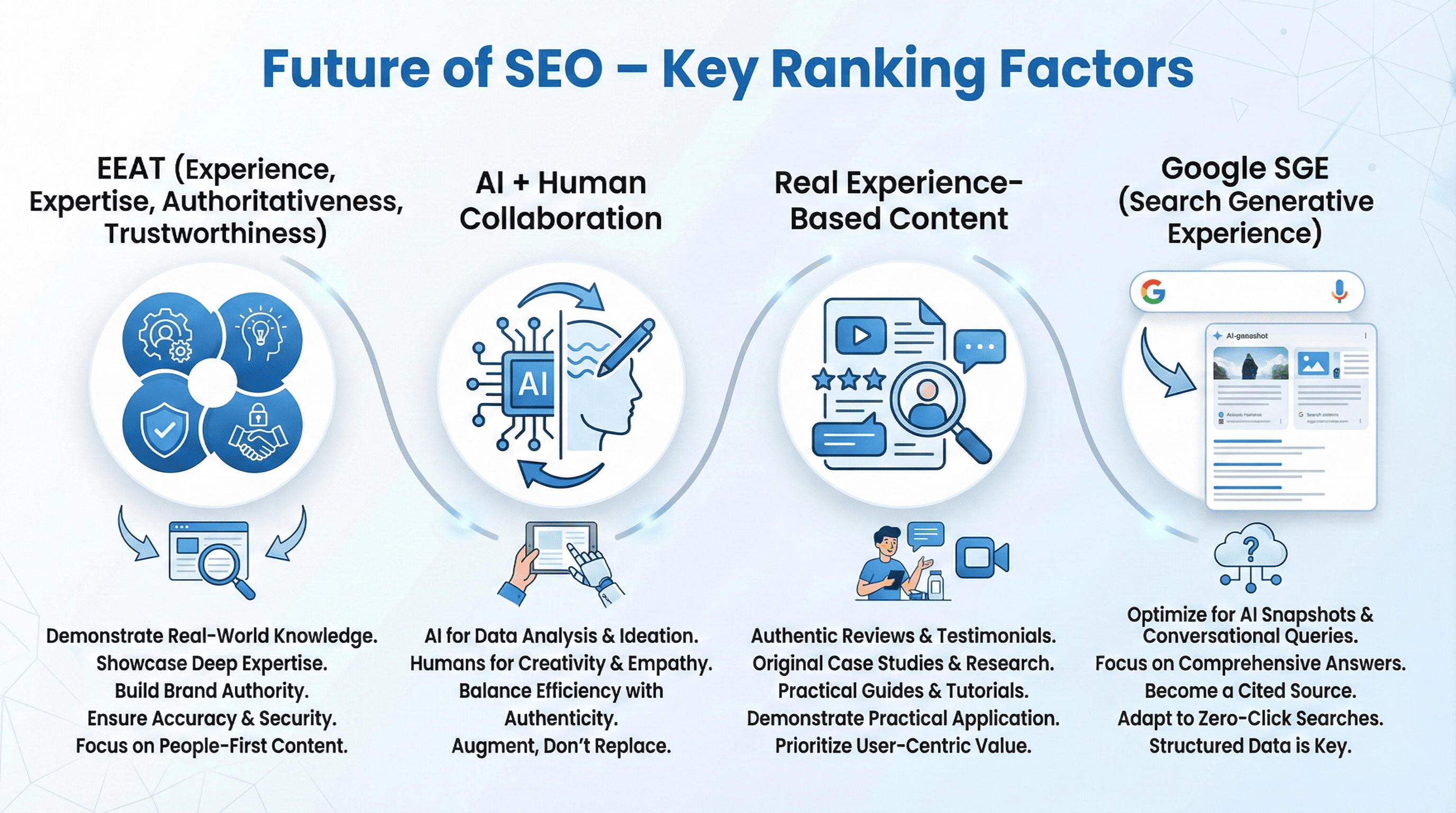
The Future of SEO is centered on credibility, originality, depth, expertise, and trust. Instead of rewarding content that simply rephrases existing articles, Google now prioritizes content built on real-world experience, expert understanding, and genuine value for users. This transformation is driven by two major developments:
→ The rise of AI-generated content
→ The introduction of Google’s Search Generative Experience (SGE)
This comprehensive guide explains the future of SEO, why EEAT has become critical, how AI content can succeed or fail, the real impact of SGE, key SEO trends, and detailed FAQs to help you understand exactly where search is heading.
1. The Future of SEO: What Truly Matters Now and Going Forward
The future of SEO is no longer about manipulating rankings. It is about proving why your content deserves visibility in the first place. Google aims to surface the most helpful, accurate, and experience-backed answers—not content that simply follows keyword formulas.
Below are the key pillars shaping the future of SEO:
1. Real Experience Over Theory
Google has clearly shifted toward valuing content grounded in firsthand experience. When creators demonstrate real involvement, their content naturally appears more credible and trustworthy.
Experience-driven content includes:
→ Real case studies
→ Actual step-by-step breakdowns
→ Your own results
→ Personal reviews
→ Practical examples
→ Insights based on action, not assumptions
This type of content is extremely difficult for AI to replicate authentically, which is why Google increasingly favors it.
2. AI + Human Expertise Will Dominate Content Creation
AI is powerful for speed, research assistance, and idea generation—but it cannot replace expert-level understanding on its own.
The future belongs to hybrid content where:
→ AI supports structure, drafts, and brainstorming
→ Humans add expertise, accuracy, and context
→ Real experience enhances depth and value
Google ranks content that clearly reflects human judgment, originality, and professional insight.
3. Google SGE is Changing Search Behavior
Google’s Search Generative Experience (SGE) delivers AI-generated summaries directly at the top of search results, fundamentally changing how users interact with search.
SGE impacts SEO in three key ways:
→ It reduces clicks on shallow, surface-level content
→ It prioritizes detailed, expert-backed information
→ It favors websites with strong EEAT signals
If your content is generic, repetitive, or lightly rewritten, SGE will ignore it.
If your content is in-depth, structured, and insight-driven, SGE may reference or rely on it indirectly.
4. EEAT is Now a Major Ranking Requirement
EEAT—Experience, Expertise, Authoritativeness, Trustworthiness—is now a central framework Google uses to decide which content deserves visibility.
Today, EEAT is one of the most critical ranking considerations across industries.
5. Topical Authority is the New SEO Power
Websites that deeply cover a single niche outperform sites that publish scattered, general content.
Topical authority involves:
→ Covering every important subtopic in your niche
→ Building pillar pages with supporting clusters
→ Using smart internal linking
→ Becoming a complete resource within your field
Generalist websites decline; focused specialists grow.
2. EEAT in SEO: Why Google Focuses on Trust
Trust is the foundation of modern SEO.
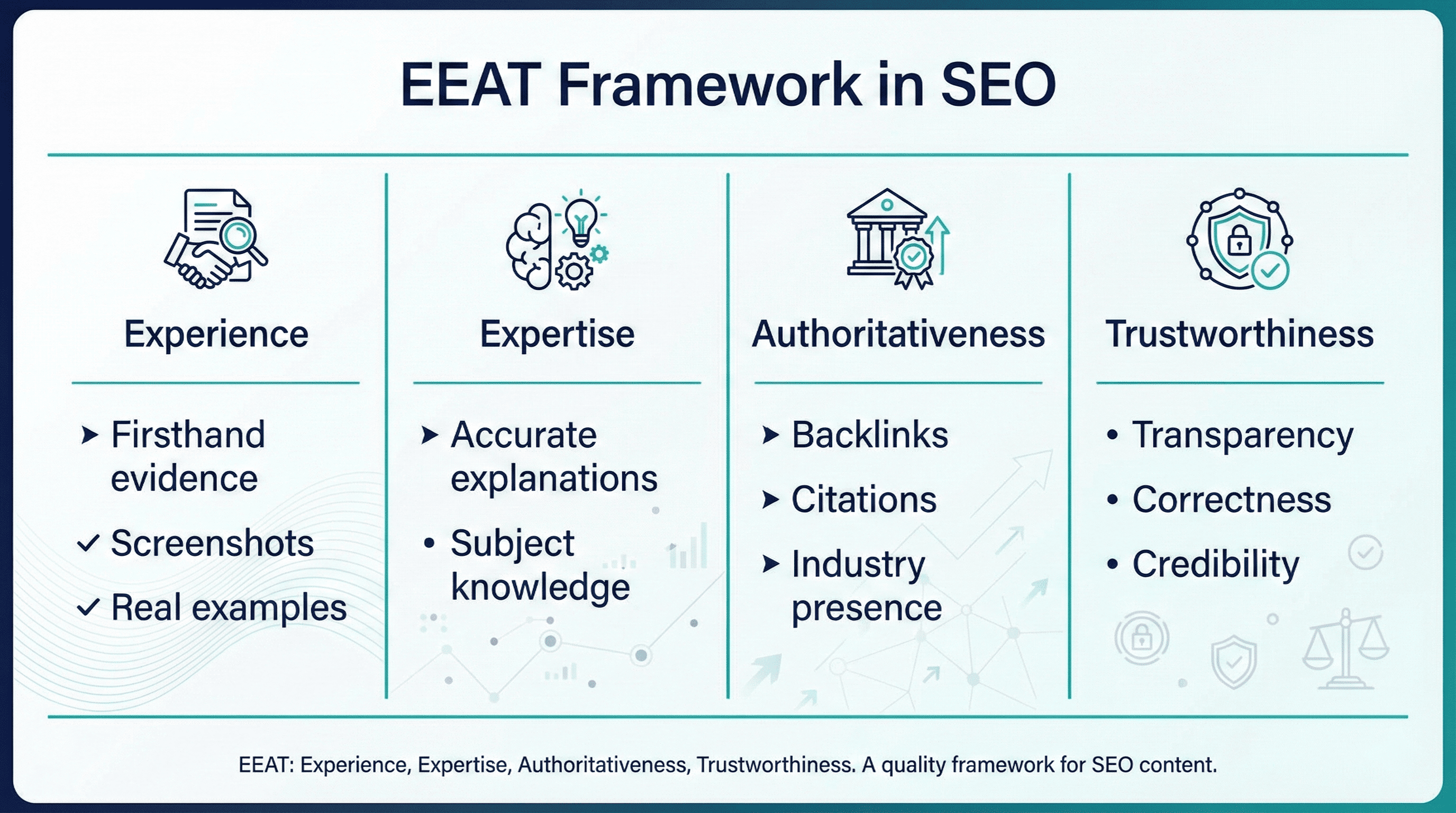
Google’s biggest challenge is separating expert-created content from the massive volume of low-quality AI-generated text flooding the internet. To protect users, Google evaluates content through the EEAT framework.
1. Experience: Proven, Firsthand Knowledge
“Experience” means the creator has personally worked with or used what they are explaining. Google favors content written by people who have actually lived the topic—not those who simply rewrite information.
Why Google values experience:
→ It creates unique insights
→ It minimizes misinformation
→ It builds reader confidence
→ It demonstrates authenticity
→ It is difficult for AI to fake
Signals of experience Google can recognize include:
→ Screenshots
→ Original images
→ Personal opinions
→ Real stories
→ Case studies
→ Practical outcomes
Experience has become a strong ranking signal.
2. Expertise: Deep, Accurate Understanding
Expertise goes beyond personal experience. It reflects how deeply and accurately a topic is understood and explained.
Google looks for:
→ Correct terminology
→ Clear and accurate explanations
→ Fact-based statements
→ Advanced insights where required
→ Logical structure
→ The ability to simplify complex ideas
Expertise is especially critical in YMYL (Your Money Your Life) niches such as finance, health, law, and safety.
3. Authoritativeness: External Recognition and Reputation
Authoritativeness measures how others perceive your knowledge and credibility.
Authority is built through:
→ Backlinks from reputable websites
→ Citations and mentions
→ Being referenced by experts
→ Consistent high-quality publishing
→ Visible industry presence
]→ A recognizable brand identity
When others trust you, Google follows.
4. Trustworthiness: The Core of All Rankings
Trust is the most important EEAT component.
Google evaluates trust through:
→ Clear authorship
→ Accurate and honest information
→ Proper sourcing
→ Regular content updates
→ Secure websites (HTTPS)
→ Transparent reviews
→ No misleading claims
Without trust, no content can sustain rankings.
3. AI-Generated Content SEO: What Will Actually Rank?
AI-generated content is effective only when refined by humans. Google can detect AI-only writing through patterns, tone, and lack of depth.
Future-ranking content must:
→ Be reviewed and verified by humans
→ Offer unique perspectives
→ Fully satisfy search intent
→ Provide detailed explanations
→ Include real-world examples
AI assists the process—but ranking requires AI + Human + Experience.
4. Experience-Based Content Ranking: Why Real Stories Rank Higher
Google can recognize content created through real-life involvement.
Experience-based content includes:
→ Step-by-step tutorials with screenshots
→ Honest reviews with pros and cons
→ Data-backed case studies
→ Tested methods
→ Personal outcomes
Because this content is difficult to mass-produce using AI, Google values it more highly.
5. Google SGE Impact on SEO
SGE has transformed both search behavior and traffic distribution.
Where traffic may decrease:
→ Short informational queries
→ One-line definitions
→ Generic content
Where traffic may increase:
→ Expert advice
→ Reviews
→ Comparisons
→ Tutorials
→ In-depth guides
→ Professional insights
How to rank in the SGE era:
→ Publish long, structured content
→ Use logical explanations and examples
→ Strengthen EEAT
→ Add real experience
→ Build topical authority
→ Improve internal linking
SGE rewards expertise—not shortcuts.
6. SEO Trends You Must Focus On
1. Topic Clusters and Pillar Pages
Create interconnected content ecosystems within one niche.
2. Strong Author Pages
Clearly show who wrote the content and why they are qualified.
3. Mixed Formats (Text + Video)
Multiple formats improve engagement and user satisfaction.
4. User Intent Optimization
Answer exactly what users are searching for.
5. Firsthand Experience Over Link Quantity
Authenticity matters more than aggressive link building.
FAQs
1. What is the Future of SEO?
The future of SEO is built on credibility, depth, and trust. Google prioritizes content that delivers genuine insights, complete explanations, and real expertise. Websites relying on rewritten or AI-only content will lose visibility. The future rewards creators who:
→ Share real experience
→ Build topical authority
→ Strengthen EEAT
→ Provide actionable knowledge
SEO is becoming a trust-driven ecosystem.
2. Will AI-generated content rank?
AI-generated content can rank only when improved by humans. Google does not reward content that is generic, repetitive, or inaccurate. AI content must be:
→ Fact-checked
→ Updated
→ Enhanced with real examples
→ Clearly edited
→ Reviewed by experts
AI is a tool—not a substitute for expertise.
3. Does Google SGE reduce website traffic?
SGE reduces traffic for basic queries but creates more opportunities for expert-level content. Shallow websites may lose visibility, while sites with strong EEAT and deep insights benefit. SGE highlights content that:
→ Demonstrates expertise
→ Provides depth
→ Offers clarity
→ Shows real experience
SGE redistributes traffic toward experts.
4. Why is EEAT important for SEO?
EEAT helps Google identify safe, reliable, and high-quality content. It protects users by prioritizing expert-created, trustworthy, and accurate information. EEAT is now one of the most influential ranking signals across industries.
5. What is the most important SEO factor today?
The most important factor is experience-based content supported by strong topical authority. Google prefers content created by practitioners rather than generic writers. The more authentic your insights, the stronger your rankings.
Conclusion
The Future of SEO is defined by credibility, trust, and expertise. Google is increasingly rewarding creators who publish content based on real experience and deep understanding. AI will continue to support content creation, but genuine human expertise remains irreplaceable.
To succeed in the evolving search landscape:
→ Build topical authority
→ Demonstrate real experience
→ Strengthen EEAT
→ Use AI strategically
→ Match search intent accurately
→ Publish content that genuinely helps users
By following these principles, you can thrive—even as AI and SGE continue to reshape SEO.
IF YOU LIKED THIS BLOG, DON’T FORGET TO CHECK OUT: Technical SEO for Website Performance: Make or Break Guide (2026)

(2) Comments