
How SEO Psychology Can Boost Your Website Clicks & Rankings
Most people think SEO is just keywords, backlinks, and technical tweaks. But the truth is simple: users decide whether to click your result long before your content even loads. They glance at a few words, skim the SERP layout, and their brain instantly decides “click” or “scroll.”
That decision is psychological not technical.
This is where SEO psychology enters the picture. It’s the science of understanding how users think, behave, and react when they see your webpage in search results. And if you know how to use these behavioral triggers properly, you can dramatically increase website clicks, improve CTR, and create ranking signals that search engines reward.
Let’s break down how SEO psychology works and the exact methods you can apply to boost your visibility in search results.

1. Understand User Behavior in SEO
Users don’t behave logically or patiently. They behave predictably.
Study after study shows that people scan search results in an F-pattern, looking for signals that match what they want:
→ keywords
→ numbers
→ visual elements
→ credibility markers
→ emotional or benefit-driven words
When these signals appear in the right places, users’ brains “pause,” and that pause increases the chance of a click.
How to leverage user behavior effectively:
✔ Highlight important keywords naturally
Place keywords in titles and meta descriptions where the user’s eye naturally lands usually the first 40–50 characters.
✔ Use numbers and power phrases
Words like “proven,” “simple,” “step-by-step,” “fast,” “best,” “avoid,” or “secret” improve decision-making speed.
✔ Use trust indicators
Rich snippets, stars, reviews, dates, and schema add credibility at a glance.
Why this matters:
When searchers feel your result “understands” what they want, they click.
Higher CTR → stronger user signals → improved search engine rankings.
2. Optimize Titles & Meta Descriptions Using Psychology
Most SEO mistakes happen here: the title and meta description.
This is your “digital first impression.”
Google looks at CTR as a signal, and users look at your phrasing as a cue.
A psychologically optimized title does 3 things:
1. Matches search intent
2. Creates curiosity
3. Communicates benefit
If your title fails even one of these, your CTR tanks no matter how good your content is.
Strong Psychological Practices for Higher CTR
✔ Use curiosity-driven phrases
Not clickbait but strategic curiosity.
Examples:
→ “Why This Happens to Most Websites…”
→ “7 Secrets Google’s Top Pages Use…”
→ “The Real Reason Your CTR Is Low…”
✔ Use clear, strong action verbs
Boost, Increase, Improve, Discover, Learn, Fix these turn passive users into active clickers.
✔ Keep your promise realistic
Users punish over-promising instantly.
If your title exaggerates, they bounce which hurts rankings.
✔ Mirror the user’s intent
Informational intent? Use clarity.
Commercial intent? Show value.
Transactional intent? Highlight benefits or urgency.
When your title matches the user’s mental expectation, you win the click.
3. Leverage On-Page SEO Tips That Support Psychological Triggers
SEO psychology doesn’t stop at the SERP.
After the click, the user’s brain continues evaluating:
→ Is this easy to read?
→ Am I getting what I came for?
→ Can I skim this quickly?
→ Will this help me solve something now?
This is exactly why on-page SEO tips combined with psychological cues are so powerful.
Use these methods to keep users engaged:
✔ Front-load your primary keyword
Your H1, first paragraph, and subheadings should immediately reinforce the topic in the user’s mind.
✔ Use lists, bullet points, and short paragraphs
Readers skim, they don’t read.
Formatting that supports skimming keeps users on the page longer.
✔ Place CTAs naturally
Instead of “Buy Now,” use benefit-based commands like:
→ “See how this improves your performance”
→ “Try the optimized version here”
→ “Download the checklist”
These don’t feel pushy and psychologically guide the user toward the next step.
✔ Keep your layout clean
Clutter increases cognitive load.
The easier your content looks, the longer users stay.
All of this directly affects engagement metrics which influence Google’s view of your content’s quality.
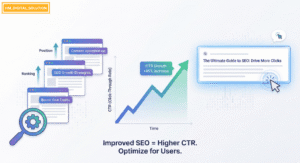
4. Use Visuals and Interactive Elements to Influence Clicks & Engagement
Humans process visuals 60,000x faster than text.
So when your content uses the right visuals, it becomes instantly more engaging and easier to understand.
Eye-tracking research proves users focus more on:
→ images
→ charts
→ highlighted elements
→ structured blocks
→ contrasting colors
These elements act as anchors that guide where the user looks.
Powerful ways to use visuals in SEO psychology
✔ Add relevant, informative visuals
Images should explain or support not just decorate.
✔ Use infographics for complex ideas
People trust visual explanations more than long paragraphs.
✔ Use charts to show improvements or data
Visual proof is far more persuasive than text claims.
✔ Optimize visual elements with alt text
Not only for SEO but for clarity and accessibility.
✔ Make CTAs visually distinct
Buttons, highlights, and color contrast enhance click behavior.
Remember:
The longer a user stays, the stronger your engagement signals.
Better engagement boosts rankings.
5. A/B Testing & Continuous Improvement Based on User Behavior
SEO psychology isn’t a “set once and forget” strategy.
User behavior evolves with trends, devices, intent shifts, and SERP layout changes.
To stay ahead, you need continuous testing.
A/B Tests That Improve CTR & Rankings
✔ Test multiple title styles
Curiosity vs benefit-driven vs question-based, see which wins.
✔ Test meta descriptions
Different tones (direct, emotional, concise) perform differently.
✔ Test visuals
Images, placement, and formatting impact engagement.
✔ Track user patterns from heatmaps
Scroll depth, clicks, and attention spots reveal what’s working.
✔ Adjust based on performance
If users bounce early, change intros.
If they scroll halfway, add visual anchors.
If CTR drops, rewrite the snippet.
The brands that continuously evolve always outrank those that rely on static SEO.
FAQs
1. What is SEO psychology?
SEO psychology studies how users think, behave, and make decisions on search results. It helps you create titles, snippets, visuals, and on-page content that instantly attract attention, increase clicks, and guide users to take the next action.
2. How can SEO psychology increase website clicks?
By aligning your content with how users naturally scan, decide, and engage.
SEO psychology helps you write titles that match intent, trigger curiosity, use benefits, and visually stand out all of which push more users toward choosing your page over others.
3. Are visuals important in SEO psychology?
Absolutely.
Visuals reduce cognitive load, increase clarity, and make content more engaging. Charts, infographics, and screenshots keep users on the page longer which improves engagement signals and indirectly helps rankings.
4. Can applying SEO psychology improve rankings?
Yes, indirectly.
When CTR increases, engagement improves, and bounce rates drop, Google sees your page as more relevant. These behavioral signals contribute to better search engine rankings over time.
5. How do I combine SEO psychology with traditional SEO?
Simple:
Use technical SEO to make your content discoverable.
Use SEO psychology to make it irresistible.
Match search intent, optimize titles and meta descriptions, improve UX, use visuals, keep formatting skimmable, and deliver exactly what the snippet promises.
This makes both search engines and humans prefer your content.
Conclusion
SEO psychology is one of the most underrated yet powerful ways to increase clicks, improve CTR, and boost search rankings. When you truly understand how users think—how they scan a page, what captures their attention, and what motivates them to click—you gain an advantage that technical SEO alone can’t match.
By applying user-behavior insights, optimizing titles and meta descriptions, using strategic on-page elements, leveraging visuals, and constantly testing variations, you create content that both users and search engines respond to.
And if you want these psychological principles applied to your business in a measurable, results-focused way, HM Digital Solution can help you implement a data-driven SEO strategy that improves engagement, increases clicks, and strengthens your rankings sustainably.
IF YOU LIKED THIS BLOG, DON’T FORGET TO CHECK OUT: Why Social Media Marketing Is Important for Local Businesses

(1) Comment