
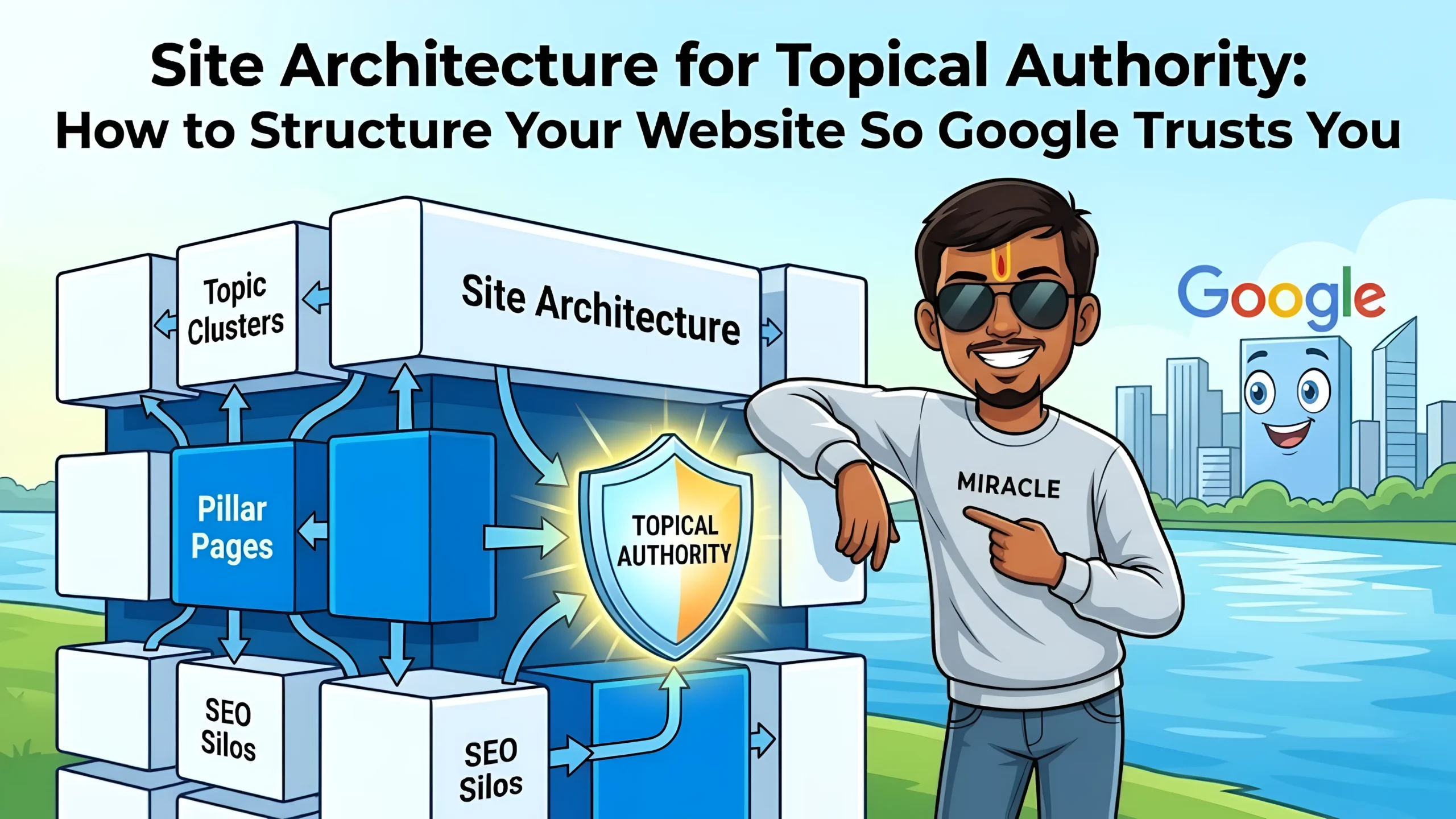
Site Architecture for Topical Authority: How to Structure Your Website So Google Trusts You
If you are building topical authority but your site architecture is a mess, you are leaving rankings on the table. Most SEO professionals focus on content quality, keyword research, and backlinks. But the structural layer underneath all of that, how your pages are organized, connected, and crawled, is what determines whether Google reads your expertise as scattered content or as a trusted authority on a subject.
Site architecture for topical authority is not about technical SEO alone. It is the system that makes your content strategy legible to search engines. Without it, even well-written, in-depth content fails to generate the topical signals that drive sustained ranking improvements.
This guide covers the exact architectural framework used to build and validate topical authority, from hub and spoke design to entity coverage, crawl optimization, and AI visibility.
What You Will Learn in This Guide
→ What site architecture actually means in the context of topical authority
→ How the hub and spoke model works and why SILO architecture never really died
→ A step-by-step process to design your topic cluster structure
→ The entity layer that most architecture guides completely ignore
→ Common architectural mistakes that silently kill topical authority
→ How to apply this framework across different business types
→ How to measure whether your architecture is actually working
→ How site architecture connects to AI Overview visibility in 2026 and beyond
What Is Site Architecture for Topical Authority?
Site architecture refers to how your pages are organized, how they link to each other, and how search engines navigate and interpret that structure. In the context of topical authority, your architecture is the physical map of your expertise. It is how you signal to Google that your content does not just mention a topic but genuinely covers it from every meaningful angle.
Topical authority itself is not a metric you can pull from Search Console. It is an assessment Google builds over time based on your content depth, internal linking patterns, crawl behavior, and entity coverage across a subject area.
The relationship between the two is direct. A well-designed site architecture acts as the filing system for your expertise. A brilliant professional with disorganized files looks less capable than a moderately skilled one with a perfectly organized system. The same logic applies to how Google evaluates your site.
| Without Architecture | With Architecture |
|---|---|
| Content exists in isolation | Pages are grouped into topical clusters |
| Google cannot infer relationships | Internal links signal topical connections |
| Strong pages do not lift weaker ones | Cluster pages share authority signals |
| Topical coverage looks scattered | Coverage reads as comprehensive expertise |
| Rankings fluctuate with each update | Authority compounds over time |
The Hub and Spoke Model: Still the Foundation
The most effective architecture for building topical authority is the hub and spoke model. SEO professionals also call it topic clusters or pillar and cluster architecture. The label has changed several times since SEOs were calling it SILO architecture in the early 2010s. The fundamentals have not.
The Hub (Pillar Page): A broad, comprehensive page that introduces the core topic and links out to all major cluster pages. Its job is not to cover every subtopic in depth but to establish the topic and create a clear navigation path to supporting content.
The Spokes (Cluster Pages): Detailed pages that go deep on specific subtopics. Each one covers a narrower slice of the broader topic and links back to the hub. Cluster pages are where you capture the long-tail and mid-tail queries surrounding your core topic.
Internal Links: The connections between hub and spokes are what create the topical signal. Google’s crawlers follow these links, map the relationships, and build an understanding of your site’s topical scope.
What has changed since the original SILO approach is that strict separation between topic clusters is no longer necessary. Cross-cluster linking, where contextually relevant, actually strengthens topical signals. If your technical SEO cluster has a page on crawl budget and your content strategy cluster has a page on content audits, linking between those two pages when the context warrants it serves both users and crawlers.
Step-by-Step: How to Design Your Site Architecture for Topical Authority
Step 1: Define Your Core Topics Before Anything Else
Before you touch URL structures or internal links, establish which topics you are trying to own. This is a strategic decision, not a keyword research task.
Pick topics where your site can realistically become a comprehensive resource. A local SEO agency cannot compete with major publications on a broad topic like “SEO,” but it can absolutely dominate “local SEO for healthcare practices” in its region. For each core topic, ask yourself: can I create 10 to 20 substantive pages covering different angles of this subject? If not, the topic may be too narrow or your authority play is too thin.
Step 2: Map Your Hub Pages
Each core topic gets one hub page. This page should cover the topic broadly with genuine depth, contain internal links to every major cluster page, and be reachable within two clicks from the homepage. The hub page is not a table of contents. It should stand alone as a genuinely useful resource. Links to cluster pages should feel natural and contextually relevant, not forced.
Step 3: Build Cluster Pages Around Intent Patterns
Cluster pages are where you capture the queries surrounding your core topic. Think in terms of intent patterns, not just keywords:
| Intent Type | Query Examples | Cluster Page Goal |
|---|---|---|
| Informational | How does X work, what is X, why does X matter | Build foundational authority |
| Comparison | X vs Y, best tools for X, how to choose between X and Y | Capture decision-stage queries |
| Process | How to do X, step-by-step guide to X, X checklist | Target how-to and tutorial intent |
| Problem-solving | Why is X not working, common X mistakes, X troubleshooting | Capture troubleshooting queries |
| Definition | What is X, X explained, X glossary | Establish baseline entity coverage |
A topically authoritative site covers all intent types for its core topic. If your cluster only has informational content, you are signaling incomplete coverage to Google, regardless of how good those pages individually are.
Step 4: Design Your Internal Linking Architecture
Internal linking is where most SEO professionals either over-engineer or completely neglect site architecture. Here is a practical framework:
Bidirectional linking between hub and cluster: Every cluster page links back to its hub. The hub links to all cluster pages. This creates the topical grouping that crawlers map.
Contextual cross-cluster linking: When a cluster page under one topic genuinely relates to a page under another topic, link between them. Only add links where the content context makes the link useful for a reader who wants to go deeper.
No orphan pages: Any page with no internal links pointing to it is essentially invisible from a topical authority standpoint. Every page you publish should be linked from at least one relevant page on your site.
Anchor text precision: Use descriptive anchor text that matches the target page’s topic. Generic anchors like “click here” add no topical signal. Anchors like “local SEO audit process” or “entity mapping for content strategy” tell Google exactly what the target page is about.
Step 5: Structure URLs to Reinforce Topical Clusters
URL structure is a supporting signal, not the most critical factor. The traditional SILO approach used strict hierarchies like /topic/subtopic/page-name/. This still works and visually reinforces the topical cluster structure. Flat URL structures can work equally well if your internal linking is strong. What matters more than the specific structure is consistency. Pick an approach and apply it across your site.
If you are reviewing an existing site, a URL restructure is usually not worth the risk of redirect chains unless the current structure is creating real canonicalization problems.
The Entity Layer: What Most Site Architecture Guides Miss
Traditional site architecture guidance focuses on URLs, internal links, and crawl depth. That is necessary but not sufficient for topical authority in 2026 and beyond.
Google’s understanding of topical authority is increasingly entity-based. Entities are the concepts, tools, processes, people, and organizations that define a topic space. Google’s Knowledge Graph connects these entities and uses them to evaluate whether your content genuinely covers a topic or just mentions relevant keywords.
This means your architecture needs to account for entity coverage, not just keyword coverage.
| Entity Type | Examples in SEO Niche | What It Signals to Google |
|---|---|---|
| Concepts | Crawl budget, E-E-A-T, topical authority, semantic search | Depth of topic understanding |
| Tools | Ahrefs, Semrush, Screaming Frog, Google Search Console | Practical, real-world expertise |
| Processes | Technical audit, keyword clustering, internal linking | Procedural knowledge coverage |
| Metrics | CTR, impressions, crawl frequency, domain authority | Data literacy within the topic |
| Related topics | Schema markup, Core Web Vitals, structured data | Semantic neighborhood coverage |
When you map out your cluster pages, check what entities appear consistently across top-ranking content in your niche. Tools like Google’s Natural Language API or Surfer SEO can show you which entities are expected in a topic area. If those entities appear in your cluster pages but not your hub page, add them. If high-salience entities have no dedicated page on your site at all, those are architectural gaps, not just content gaps.
For a deeper look at how to build this entity layer across your content, see our guide on how to build a semantic content network.
Site Architecture by Business Type
The same architectural principles apply across different business types, but implementation priorities vary.
| Business Type | Hub Page | Cluster Focus | Key Cross-Linking Opportunity |
|---|---|---|---|
| Local Service | Primary service category | Services, locations, FAQs, process pages | Service pages link to geo-specific cluster pages |
| SaaS / B2B | Core use-case or product category | Integrations, comparisons, how-to, feature guides | Feature pages link to comparison and use-case content |
| Content / Media | Comprehensive guide or topic definition | Angles, news, analysis, how-to content | Topic clusters interlink around shared entities |
| E-Commerce | Category or buying guide page | Product comparisons, use-case guides, buyer education | Product pages link to educational cluster content |
Local Service Example: An HVAC company’s hub is the main services page. Clusters cover AC repair, heating services, emergency HVAC, and indoor air quality. A page about air filtration under the AC cluster links to the indoor air quality cluster because user intent overlaps. That cross-cluster link serves the reader and strengthens topical coverage signals across both clusters.
SaaS Example: A project management tool’s hub is the core product overview. Clusters cover resource management, integrations, team collaboration, and reporting. Comparison pages link to feature pages. The architecture creates a web of topical connections that signals comprehensive coverage of the product category.
Common Mistakes That Kill Topical Authority
Shallow cluster pages: Creating 15 cluster pages with 400-word posts does not build topical authority. Each cluster page needs genuine informational depth. Google evaluates individual page quality as part of its cluster assessment. Thin pages weaken the entire cluster’s authority signal, not just their own rankings.
Hub pages that do not link to clusters: Some sites have well-written pillar pages with no internal links to supporting content. The topical signal never gets created because the structural connection is missing. A hub page that does not link out is just a good article, not an authority node.
Too many topics, too little depth: Trying to build topical authority across five or six unrelated topics at once is a common mistake. Google rewards depth of coverage within a topic much more than breadth across topics. Build two or three core topic clusters completely before expanding.
Ignoring crawl depth: If your cluster pages are buried four or five levels deep in your site structure, crawlers may not visit them frequently enough to pass topical signals efficiently. Important cluster pages should be reachable within two to three clicks from the homepage.
Stale hub pages: Hub pages that are never updated lose relevance signals over time. If your cluster content is regularly updated but your hub page still references outdated information, the topical signal weakens. Review and refresh hub pages at least once a year.
No entity coverage mapping: Publishing cluster pages based purely on keyword research without checking entity gaps means you will consistently miss the semantic relationships Google expects to see across a comprehensively covered topic. This is where most keyword-first content strategies fall short architecturally.
How to Measure Whether Your Architecture Is Working
There is no single metric that tells you your site architecture is producing topical authority. You read the signals across multiple data points.
| Metric | What to Look For | Tool |
|---|---|---|
| Cluster ranking movement | Multiple cluster pages rising together for related queries | Google Search Console, Ahrefs |
| Crawl frequency | Increased crawl rate on cluster pages after linking improvements | GSC Crawl Stats, Log File Analysis |
| Impression growth for non-targeted queries | Appearing for queries you did not specifically optimize for | Google Search Console |
| Featured snippet ownership | Multiple cluster pages earning snippets in the same topic area | GSC, Semrush |
| Index speed for new content | New cluster pages indexing within hours or days | GSC URL Inspection |
| Branded topic searches | Users searching your brand combined with your core topic | GSC Search Queries |
When you launch a new topic cluster, watch whether the hub page and multiple cluster pages begin ranking for related queries together. Coordinated upward movement across a cluster is a strong signal that Google is recognizing the topical group. Isolated ranking improvements suggest keyword-level wins, not topical authority building.
Site Architecture and AI Overview Visibility
The same architectural principles that help you rank in traditional search also determine how your content surfaces in AI Overviews, ChatGPT, Perplexity, and similar tools.
AI systems generating answers from web content look for sources that demonstrate comprehensive, organized coverage of a topic. A well-structured topic cluster with clear internal linking makes it easier for these systems to understand your site as an authoritative source and pull from multiple pages when generating answers.
Structured data amplifies this effect significantly. Adding BreadcrumbList schema to your pages reinforces the hierarchical structure you have built architecturally. Article schema with speakable sections, FAQ schema on appropriate pages, and Organization schema to establish entity relationships all help both traditional search and AI-based retrieval systems understand your site’s structure and authority.
| Schema Type | What It Does for Topical Architecture | Best Used On |
|---|---|---|
| BreadcrumbList | Reinforces topical hierarchy to crawlers and AI systems | All cluster and hub pages |
| FAQPage | Captures question-intent queries, boosts AI citation chances | Cluster pages with Q&A sections |
| Article + Speakable | Flags key sentences for AI summaries and voice search | In-depth hub and cluster content |
| Organization | Establishes brand entity relationships | Homepage, About page |
| HowTo | Signals process-intent content to AI retrieval systems | Step-by-step cluster pages |
For a deeper look at how entity signals feed into AI visibility, see our guide on how Google uses entities instead of keywords. And if you want to validate your entity coverage before publishing, our guide on NLP APIs for SEO walks through exactly how to use Google’s Natural Language API to audit your cluster pages against top-ranking competitors.
Topical Authority Architecture Audit Checklist
Use this before publishing a new cluster or reviewing an existing one:
| Audit Question | Action If Answer Is No |
|---|---|
| Is there a clear hub page for each core topic? | Create a comprehensive pillar page |
| Does the hub link to all major cluster pages? | Add internal links from hub to clusters |
| Does every cluster page link back to the hub? | Add a contextual backlink to the hub on each cluster page |
| Are there any orphan pages with no internal links pointing to them? | Add at least one contextual internal link from a relevant page |
| Are hub and cluster pages within 3 clicks of the homepage? | Improve navigation or add links from higher-level pages |
| Do cluster pages cover all major intent types for the topic? | Identify missing intent types and plan new cluster pages |
| Are high-salience entities in the topic covered on the site? | Run entity gap analysis against top-ranking content |
| Are hub pages updated within the last 12 months? | Schedule a hub page review and content refresh |
Frequently Asked Questions
Q.1 How many cluster pages do I need to build topical authority?
There is no fixed number, but a cluster with fewer than eight to ten substantive pages is unlikely to signal comprehensive coverage for a competitive topic. For less competitive niches, smaller clusters can work. The measure is whether you have covered the major intent types and entity relationships within the topic, not a specific page count.
Q.2 Does changing my URL structure hurt topical authority?
A URL restructure with proper 301 redirects should not permanently damage topical authority, but there is typically a temporary disruption as Google re-crawls and reassociates your content. Only restructure URLs if the current structure is creating real canonicalization problems or topical confusion.
Q.3 Can a new site build topical authority?
Yes, but it takes longer. New sites can build topical authority by focusing on a narrow topic area from day one, publishing comprehensive cluster content consistently, and earning initial links to hub pages. The structural signals work the same way on new sites. The difference is that Google needs more data before extending strong authority recognition.
Q.4 Should every page on the site belong to a topic cluster?
Most content pages should. Standalone pages like About, Contact, and general service overview pages do not necessarily fit into a content cluster, but they should still link to relevant hub pages where appropriate. The goal is to avoid orphan pages and ensure Google can navigate from any page toward your topical authority structure.
Q.5 How does Core Web Vitals performance affect topical authority architecture?
Site speed affects crawl efficiency. A slow site gets crawled less frequently and less completely, which means your internal linking signals take longer to be processed. Optimizing Core Web Vitals is not directly a topical authority factor, but it supports the crawl conditions that allow your architecture to work as intended.
Conclusion
Site architecture for topical authority is not a one-time setup task. It is an ongoing structural discipline. As you add content, your architecture needs to evolve. New cluster pages need to be linked into the existing structure. Entity gaps need to be filled. Hub pages need to be updated as the topic develops.
The SEO professionals and agencies who consistently build lasting rankings treat site architecture as a living system, not a launch checklist. Google does not rank individual pages in isolation. It ranks sites that demonstrate organized, comprehensive expertise across a clearly defined topic space.
Strong content without strong architecture is expertise without a filing system. Build the structure first, keep it maintained, and your content’s quality finally has somewhere to land.
Tanishka Vats
Lead Content Writer | HM Digital Solutions Results-driven content writer with over five years of experience and a background in Economics (Hons), with expertise in using data-driven storytelling and strategic brand positioning. I have experience managing live projects across Finance, B2B SaaS, Technology, and Healthcare, with content ranging from SEO-driven blogs and website copy to case studies, whitepapers, and corporate communications. Proficient in using SEO tools like Ahrefs and SEMrush, and content management systems like WordPress and Webflow. Experienced content writer with a proven track record of creating audience-centric content that drives significant results on website traffic, engagement rates, and lead conversions. Highly adaptable and effective communicator with the ability to work under deadlines.