
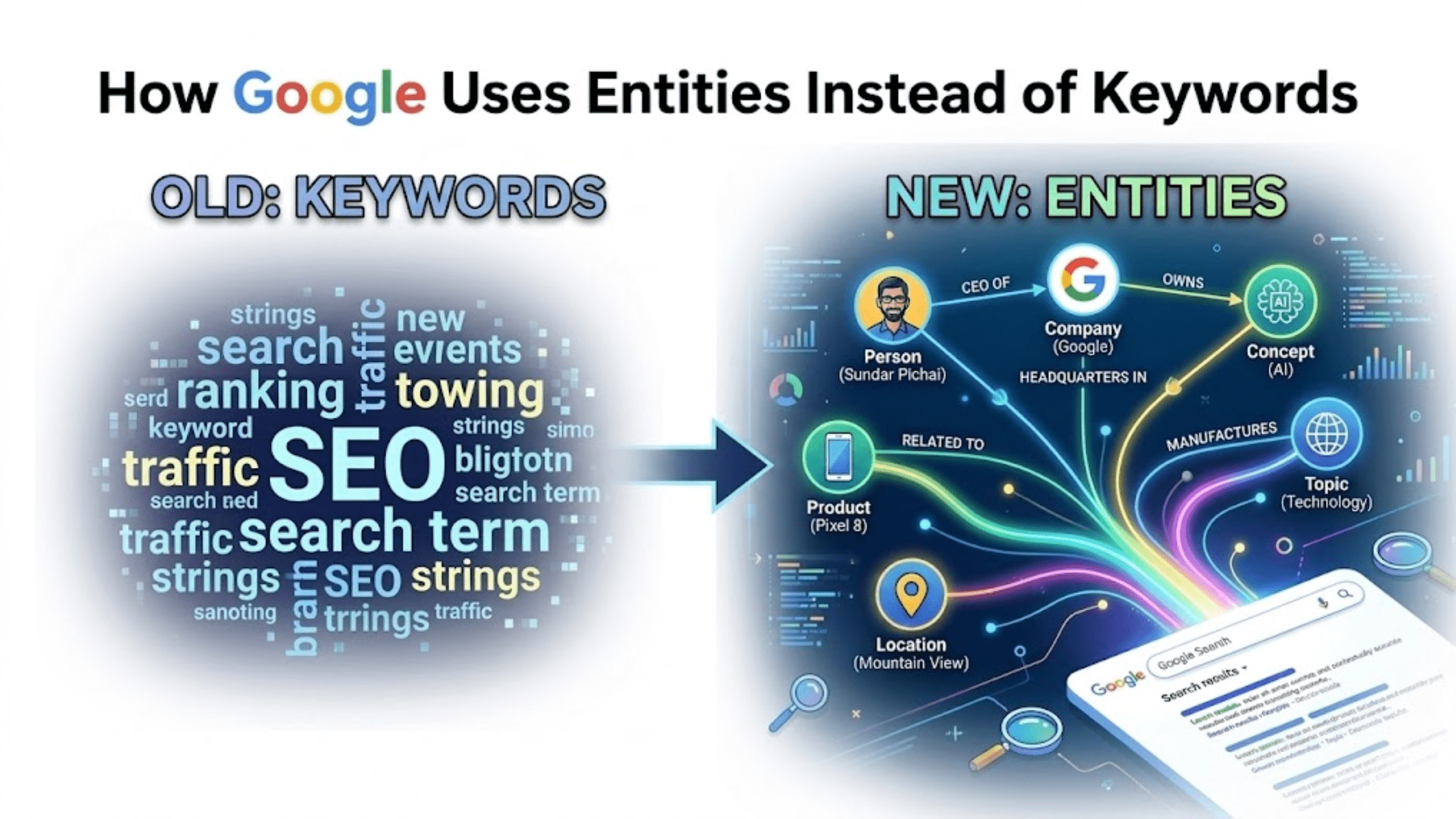
How Google Uses Entities Instead of Keywords
Let’s be direct: if your SEO strategy in 2026 still revolves around keyword density and exact-match optimization, you’re optimizing for a version of Google that no longer exists.
Google doesn’t match text strings anymore. It identifies real-world things – entities – understands the relationships between them, and uses that structured knowledge to decide which content deserves to rank. This is Google Entities SEO, and it’s not a trend you can afford to ignore.
This isn’t a beginner’s introduction to semantic search. This guide is for SEO professionals who already understand keyword research and want to understand how entity-based ranking actually works under the hood – and more importantly, what it means for your strategy right now.
We’ll cover named entity recognition, the Knowledge Graph, how Gemini’s AI Overviews pull citations, and a concrete optimization framework you can execute today.
The shift from keywords to entities is not cosmetic. It changes what you optimize, how you measure authority, and which signals Google actually uses to rank your content.
What Exactly Is an Entity in Google’s Framework?
In Google’s model, an entity is any object or concept that is distinct, well-defined, and uniquely identifiable. Not a word – the thing the word refers to.
When Google’s systems encounter the word “Mercury,” they don’t see a string of letters. They identify a set of possible entities: the planet, the Roman god, the car brand, the chemical element, or the music legend. Context – surrounding words, query structure, user history – determines which entity is meant. This process is named entity recognition (NER), and it runs on every piece of content Google crawls.
How NER Works in Practice
Google’s NLP models tag each noun phrase in your content with an entity type and attempt to resolve it to a specific Knowledge Graph node. You can test this yourself using Google’s Natural Language API demo – paste any piece of content and see exactly which entities Google extracts and how it classifies them.
For example: a page that mentions “Freddie Mercury” alongside “Queen,” “Bohemian Rhapsody,” and “rock music” gives Google enough signal to resolve confidently to the musician entity – not the planet, not the car brand.
This is why topically rich, semantically dense content outperforms keyword-stuffed content even when the latter has more exact matches. Google is resolving entities, not counting occurrences.
Keywords SEO vs Google Entities SEO – Core Differences
|
Factor |
Keyword SEO |
Google Entities SEO |
| What Google reads | Text strings | Real-world objects & concepts |
| Ranking signal | Keyword frequency & placement | Entity associations & relationships |
| Authority model | Domain authority via backlinks | Topical authority + entity credibility |
| Content strategy | Target one keyword per page | Build semantic coverage around a topic entity |
| AI Overviews impact | Low – keywords don’t earn citations | High – strong entities get cited by Gemini |
| Measurement | Keyword rankings | Knowledge Panel, brand mentions, AIO citations |
Google Knowledge Graph SEO: The Database Behind Entity Rankings
The Knowledge Graph is Google’s structured database of entities and their relationships. Launched in 2012 with Google’s famous declaration – “Things, not strings” – it now contains hundreds of billions of facts organized as a massive semantic network. You can explore how Google documents this system directly on Google Search Central.
Think of it as a graph where every node is an entity and every edge is a relationship. “Sundar Pichai” (entity) is connected to “CEO” (relationship) to “Google” (entity), which is connected to “Alphabet” (parent company), which is connected to “Mountain View, California” (headquarters location), and so on infinitely.
How Your Brand Enters the Knowledge Graph
This is the critical question most SEOs don’t ask. Your brand doesn’t automatically exist in Google’s Knowledge Graph just because you have a website. Google needs enough corroborating signals from trusted sources to create and confirm your entity node.
The sources Google uses to populate entity data include:
→ Wikipedia and Wikidata – highest-weight sources for entity confirmation
→ Google Business Profile – primary signal for local and business entities
→ LinkedIn company pages – treated as authoritative for professional entity verification
→ Crunchbase, industry directories, and trade publications
→ Consistent NAP (Name, Address, Phone) data across the web
→ Schema markup on your own site – especially Organization and SameAs properties
If Google can’t resolve your brand to a single, confident entity node, your content starts from zero credibility on every crawl. Entity establishment is the foundation everything else builds on.
The SameAs schema property is the most direct way to tell Google that your brand on this page, your LinkedIn profile, your Wikipedia entry, and your Google Business Profile are all the same entity. Most sites skip it entirely. Full documentation: schema.org/sameAs
The Evolution to Semantic Search Optimization: A Technical Timeline
Understanding how we got here matters because each update reveals a layer of how entity-based ranking actually works.
Knowledge Graph (2012) – Entities Enter the Index
Google’s first explicit acknowledgment that it was indexing things, not strings. The Knowledge Graph was initially a search feature (Knowledge Panels, entity carousels) rather than a core ranking signal. But it seeded the infrastructure that everything since has built on.
Hummingbird (2013) – Search Intent Becomes Parseable
Hummingbird rewrote Google’s core query processing to understand full sentence meaning instead of isolated keywords. For the first time, semantic search optimization meant writing for intent – not just inserting keywords. The algorithm could now tell the difference between someone searching “buy iPhone” versus “compare iPhone models” even if both queries contained the word “iPhone.”
RankBrain (2015) – Machine Learning Joins Entity Resolution
RankBrain introduced real-time machine learning to query interpretation. It specifically helped Google handle novel queries – searches it had never seen before – by inferring entity relationships from context. It also introduced implicit personalization: your entity associations became partially shaped by aggregate user behavior on similar queries.
BERT (2019) – Bidirectional Context for Deeper NER
BERT allowed Google to read every word in a query in context of every other word simultaneously, rather than left-to-right. This dramatically improved named entity recognition accuracy, especially for conversational and long-tail queries where entity resolution depends on subtle contextual cues.
MUM (2021) – Multimodal Entity Understanding
MUM extended entity understanding across 75 languages and multiple content formats (text, images, video). An entity could now be recognized and associated across languages and formats without requiring separate optimization for each.
AI Overviews / Gemini (2024–Present) – Entity Credibility Determines Visibility
This is the update that changed the economics of SEO. Gemini, which powers AI Overviews, has direct read access to Google’s Knowledge Graph. When generating an AI Overview answer, it doesn’t just retrieve the top-ranked page – it queries its entity graph to find which entities are most credible and authoritative on the topic, then pulls from their associated content.
The implication: you can rank #1 for a keyword and still be invisible if Gemini doesn’t recognize your brand as a credible entity in that topic space. Organic click-through rates for informational queries dropped sharply post-AIO rollout as the AI answer absorbs the intent before the user reaches organic results.
Entity Based SEO Strategy: A 5-Step Framework
Here’s how to systematically build entity authority. These steps are ordered intentionally – each one compounds the one before it.
Step 1 – Establish Your Core Entity
Before you optimize content for entities, your brand needs to exist as a recognized entity in Google’s graph. This requires creating consistent, corroborating signals across authoritative sources.
→ Complete your Google Business Profile with accurate category, description, and contact data
→ Create or claim a Wikidata entry – this is the most direct path into the Knowledge Graph for brands without a Wikipedia page
→ Ensure your LinkedIn company page, Crunchbase profile, and major directory listings all use identical brand name and URL
→ Implement Organization schema on your homepage with the SameAs array linking all authoritative profiles
→ For key authors and spokespeople, create Person schema with sameAs linking to their LinkedIn, Twitter/X, and any verified profiles
Consistency is entity verification. Every inconsistency in how your brand name, URL, or description appears across the web creates ambiguity that weakens your entity node.
Step 2 – Build Topical Authority Through Content Clusters
Topical authority is what happens when Google’s Knowledge Graph associates your entity with a topic domain. It’s not built by one strong page – it’s built by consistent, interconnected coverage that signals deep expertise across a topic.
Structure your content architecture as clusters:
→ Pillar page: Comprehensive coverage of the main topic entity (e.g., “The Complete Guide to Technical SEO”)
→ Cluster pages: Deep-dives into each sub-entity related to the pillar (e.g., Core Web Vitals, crawl budget, structured data, log file analysis)
→ Internal links: Every cluster page must link to the pillar and to related cluster pages. This is how Google maps your entity relationships in your site architecture.
The metric that matters here isn’t keyword density – it’s semantic coverage. Does your content mention all the entities, sub-concepts, and related terms that a genuinely authoritative source would cover? Google’s NLP models evaluate this gap.
A common mistake: building content clusters but forgetting the internal links. Without them, Google can’t map the relationship structure. The cluster only works as a connected graph.
Step 3 – Schema Markup Entity SEO: Structured Data as a Direct Signal
Schema markup is your most direct communication channel with Google’s entity resolution system. It doesn’t rely on Google interpreting your prose – it explicitly declares entity types, attributes, and relationships in a machine-readable format.
Priority schema types for entity SEO:
→ [object Object]Brand name, logo, URL, founding date, social profiles, and the SameAs array – full reference at schema.org/Organization
→ Person: For every author and subject-matter expert – credentials, affiliation, sameAs links to verified profiles
→ Article / BlogPosting: Connects your content entity to your author entity with datePublished, dateModified, and about properties
→ FAQPage: Directly feeds Google’s People Also Ask and AI Overviews. Each Q&A pair is extracted as an entity relationship.
→ BreadcrumbList: Maps your site hierarchy, reinforcing topical cluster relationships
→ SpeakableSpecification: Marks content sections appropriate for voice search and AI assistant responses
The about and mentions properties deserve special attention. Using about to link your article to the primary entity it discusses, and mentions to list every entity referenced, turns your content into a structured knowledge document rather than an unstructured text page.
Step 4 – Digital PR for Brand Mentions and Entity Association
LLMs and Knowledge Graph algorithms both use co-citation analysis: how frequently is your entity mentioned alongside other entities in relevant contexts on trusted sources? A brand mention on a high-authority industry publication – even without a backlink – contributes to your entity’s credibility score.
Effective entity-building PR tactics:
→ Original data studies: Commission or conduct proprietary research that journalists will cite. Each citation is a co-occurrence of your brand entity with your topic domain.
→ Expert commentary placements: Get your spokespeople quoted as named experts in industry coverage. These named citations directly strengthen the Person and Organization entity connection.
→ Podcast appearances: Audio content increasingly gets transcribed and indexed. Named entity mentions in podcast transcripts are crawlable entity signals.
→ Community authority: Consistent, high-quality contributions to Reddit, LinkedIn, and niche forums build entity associations that Google’s systems now index more aggressively than they did three years ago.
Step 5 – E-E-A-T Entity SEO: Making Trust Signals Machine-Readable
Google’s E-E-A-T framework maps directly onto entity signals. Each dimension of E-E-A-T is essentially an entity attribute that Google evaluates.
→ [object Object]First-hand, original content that demonstrates lived engagement with the topic. Case studies, original data, and documented processes signal experiential authority.
→ [object Object]Credentials linked to author entities. Degrees, certifications, and professional affiliations should appear in schema and be linked to verifiable profiles.
→ [object Object]Third-party entity associations – awards, media coverage, citations from established entities in your space.
→ [object Object]Site security, transparent authorship, accurate sourcing, privacy policy, and contact accessibility. These reduce entity ambiguity signals.
AI Overviews Entity Optimization: Getting Cited by Gemini
AI Overviews don’t work like organic rankings. Gemini isn’t looking for the page that best matches the query – it’s looking for the entity that is most credible on the topic and pulling the most citable content from that entity’s associated pages.
What Gemini Evaluates When Selecting Sources
→ Entity credibility score in the Knowledge Graph for the query topic
→ Content that directly answers the question in the first 40-60 words of a section
→ FAQPage schema that provides machine-readable Q&A pairs
→ E-E-A-T signals that confirm the author entity’s authority
→ Freshness – dateModified schema with genuinely updated content
→ Semantic HTML structure – proper heading hierarchy, paragraph tags, and list markup
How to Format Content for AI Citability
The structural pattern that maximizes AI Overview citation probability is simple: every H2 should be a question or a direct topic statement, and the first paragraph beneath it should contain the complete answer in concise form. Supporting detail, examples, and nuance follow – but the extractable answer must come first.
This isn’t dumbing down your content. It’s structuring it so that both human readers and AI systems can extract value at different depths. Advanced readers will read the full section. AI systems will extract the first-paragraph answer. Both are served.
Additional formatting signals that improve AIO citability:
→ Use H3 subheadings to break complex sections into distinct entity relationships
→ Keep definition sentences under 25 words – these are most likely to be directly extracted
→ Include a FAQ section with FAQPage schema at the end of every major content piece
→ Use speakable schema to mark the most citable passages in your content
One structural audit to run today: look at your most important pages and check whether the first paragraph under each H2 directly answers the implicit question of that heading. If it doesn’t – if it’s context-setting or introductory – you’re burying your citable content.
Measuring Google Entities SEO Progress
Entity authority doesn’t have a single ranking number. You track it through a constellation of signals that together indicate how well Google has resolved and strengthened your entity.
Knowledge Panel Status
A Knowledge Panel for your brand or key authors is the clearest signal that Google has created a confident entity node for you in its graph. If you don’t have one, that’s the first diagnostic – your entity signals are likely insufficient or inconsistent. Claim and verify it through Google’s official process once it appears.
AI Overview Appearance Rate
Track target queries manually or through tools like SE Ranking’s AIO tracker. The rate at which your content is cited in AI Overviews is the most direct measure of entity SEO effectiveness in 2026. Improving citation rate on high-volume informational queries is the metric that replaces obsessing over position 1 rankings.
Brand Mention Velocity and Co-occurrence Quality
Use Brand24, Mention, or Google Alerts to track unlinked brand mentions. More important than volume is co-occurrence quality: are you being mentioned alongside the entities and topics you want to be associated with? A mention of your brand next to “enterprise SEO” on Search Engine Journal is a stronger entity signal than fifty mentions in low-relevance contexts.
Branded Search Volume Growth
Rising branded search volume in Google Search Console indicates that your entity is gaining direct recognition among your target audience. It also signals to Google that your entity is actively searched for – a behavioral confirmation of entity relevance.
Common Google Entities SEO Mistakes (Advanced Edition)
→ Treating schema as optional: Schema markup is not a ranking factor in the traditional sense, but it’s a direct entity signal. Sites without Organization and Person schema are forcing Google to infer entity data from unstructured text. That introduces ambiguity. Ambiguity reduces confidence scores.
→ Ignoring the SameAs property: This is the single most impactful schema property most sites aren’t using. Without SameAs, Google can’t confidently unify your Knowledge Graph entry with your LinkedIn, Wikipedia, and GBP. Your entity appears fragmented.
→ Building topical clusters without internal link architecture: Content clusters that aren’t properly interlinked are just individual pages. The entity relationship mapping only happens when Google can traverse the graph structure through links.
→ Optimizing for keywords on pages that lack entity context: A page targeting “best project management software” that doesn’t mention related entities (Asana, Monday.com, Jira, agile methodology) lacks the semantic density Google expects from an authoritative source on that topic.
→ Confusing brand mentions with entity building: Not all mentions are equal. A mention of your brand on a site that Google hasn’t associated with your topic domain has little entity-building value. Target publications and communities that are already strong entities in your niche.
→ Neglecting author entities: In YMYL and competitive niches, author entity strength directly affects page credibility. Anonymous content or content attributed to authors with no verifiable entity profile is a meaningful E-E-A-T liability.
The Bottom Line
Google Entities SEO is not a future trend. It’s the current architecture of how Google determines what to rank, what to feature in AI Overviews, and whose content deserves to be cited as authoritative.
The brands winning in search right now have done three things: they’ve established a clear, consistent entity in Google’s Knowledge Graph; they’ve built topical authority through structured content clusters; and they’ve earned entity associations through legitimate brand mentions and digital PR.
None of this is technically complex. But it requires shifting your mental model from “what keywords should I rank for” to “what entity do I want Google to recognize me as, and what evidence am I providing to support that recognition.”
That shift is the whole game.
Start with your Organization schema today. Add SameAs. Then audit your top 10 pages for semantic entity coverage. Those three actions alone will move your entity profile further than most keyword optimizations.
FAQ – Google Entities SEO
Q1. What is the difference between a keyword and an entity in SEO?
A keyword is a text string – a sequence of characters. An entity is the real-world thing that string refers to. “Apple” is a keyword. Apple Inc. (the company) and apple (the fruit) are two different entities. Google’s ranking systems operate on entities and their relationships, not on keyword frequency. This is why two pages can target the same keyword but receive very different treatment from Google based on which entity associations they carry.
Q2. How do I check if my brand has a Google Knowledge Graph entry?
Search your brand name directly on Google. If a Knowledge Panel appears on the right side of the results, your entity has a confirmed Knowledge Graph node. You can also use the Google Knowledge Graph Search API to query entity data programmatically. If no panel appears, your entity signals are likely insufficient – start with Wikidata, complete your GBP, and implement Organization schema with SameAs.
Q3. Does entity SEO replace keyword research?
No – keyword research remains necessary for understanding what your audience searches for and how to structure your content. Entity SEO operates on top of keyword strategy, not instead of it. Keywords tell you what topics to cover and how to phrase your headings. Entity optimization determines whether Google considers you credible enough to rank for those topics in the first place.
Q4. How does schema markup help with entity recognition?
Schema markup translates your content into structured data that Google can read without interpretation. Instead of Google inferring that your company is an Organization by reading your About page, Organization schema explicitly declares it – along with your name, logo, URL, founding date, and all related entity profiles via SameAs. This removes ambiguity from entity resolution and directly strengthens your Knowledge Graph confidence score.
Q5. Why is topical authority more important than domain authority for entity SEO?
Domain authority is a third-party metric that approximates link-based credibility across an entire site. Topical authority is Google’s internal measure of how strongly your entity is associated with a specific topic domain. Because Google’s Knowledge Graph evaluates entities within topic contexts – not globally – a site with deep topical authority in a niche can outrank a high-DA site that covers that topic superficially. Entity SEO is inherently topical.
Q6. How do AI Overviews decide which sources to cite?
Gemini, which powers AI Overviews, queries Google’s Knowledge Graph to identify entities with strong credibility associations for the query topic. It then evaluates content from those entities for citability: direct answers in opening paragraphs, FAQPage schema, proper semantic HTML structure, and E-E-A-T signals. High keyword rankings help but don’t guarantee citation. Entity credibility is the primary filter.
Q7. What is named entity recognition and why does it matter for SEO?
Named entity recognition (NER) is the process by which Google’s NLP models identify and classify entities in text – tagging “Elon Musk” as a Person entity, “Tesla” as an Organization, “2024” as a Date, and so on. It matters for SEO because Google uses NER to build the semantic context of your content. Pages with rich, accurate entity coverage signal topical depth. Pages with sparse or ambiguous entity references appear thin even if they’re long.

(14) Comments