
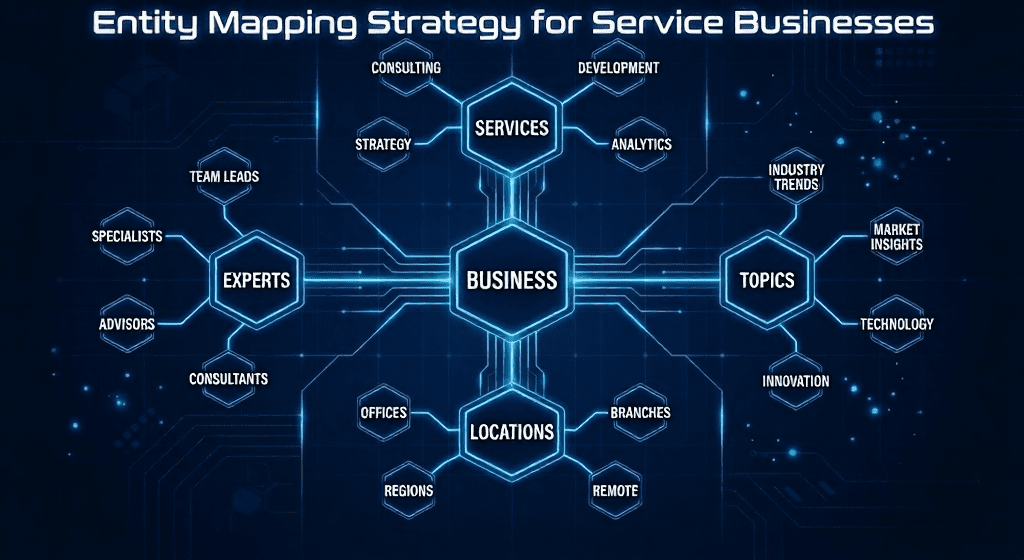
Entity Mapping Strategy for Service Businesses
Most service businesses are still fighting an SEO battle that was relevant five years ago. They research keywords, stuff them into pages, and wonder why rankings keep shifting with every Google update. The problem is not how hard they are working. The problem is what they are optimizing for.
Google does not read your pages the way a human does. It identifies real-world entities such as your business, your services, your locations, and your experts, and then maps the relationships between them. When those relationships are clear, Google ranks you with confidence. When they are unclear, you get unstable rankings no matter how much content you publish.
This guide gives you a complete, step-by-step framework for entity mapping for service businesses. By the end, you will know exactly what to build, in what order, and how to measure whether it is working.
1. What Is Entity Mapping and Why Keywords Are Not Enough Anymore
For years, SEO meant one thing: find the keywords people search for and put those words on your pages. That strategy worked in 2012. Today it is increasingly fragile.
Google has moved from a text-matching system to a meaning-understanding system. It uses something called the Knowledge Graph, which is a massive database of real-world entities and the relationships between them, to decide which pages best answer any given search query.
Entity mapping is the process of systematically defining and connecting all the real-world things your business represents, so Google can understand you as clearly as your best customer does. This is different from keyword optimization in almost every way.
Keyword SEO vs. Entity SEO: The Key Differences
|
Dimension |
Keyword-Based SEO |
Entity-Based SEO |
| Focus | Match text strings | Build semantic understanding |
| Unit of work | Individual page | Connected content ecosystem |
| Ranking signal | Keyword density + backlinks | Entity clarity + topical depth |
| Algorithm risk | High, any update can hurt | Low, meaning is stable |
| Content strategy | Volume-driven | Structure-driven |
| AI search visibility | Often excluded | Cited in AI Overviews |
The core shift is this. Keyword SEO asks what words should this page contain. Entity SEO asks what does Google need to understand about our business, and how do we make that clear across every page and platform. Understanding this shift is the foundation of any modern SEO strategy worth investing in.
2. The 5 Entity Types Every Service Business Must Map
Not all entities carry the same weight. For service businesses, there are five core entity types. Build all five and Google’s picture of your business becomes complete.
Entity Type 1: Your Business Entity
This is your company itself. Think of it as the anchor that everything else connects to. Your business entity includes your exact legal name, your business category, your description, and your contact information.
The most critical rule here is consistency. Your business name must appear identically on your website, Google Business Profile, Yelp, BBB, and every other platform. Even small variations, like adding or removing LLC or changing punctuation, create what Google calls entity confusion, and it directly hurts your local search rankings.
Entity Type 2: Service Entities
Each service you offer is a separate sub-entity connected to your business. This is where most service businesses make their first major mistake. Putting all services on one page dilutes every service entity. Google cannot tell which service you are the true expert in.
Think of it like a tree. Your business entity is the trunk. Each service is a main branch. Sub-services hang off those branches.
For example, a plumbing company would structure their service entities like this:
→ Water Heater Services (main branch)
→ Water Heater Installation (sub-branch)
→ Water Heater Repair (sub-branch)
→ Tankless Water Heater Conversion (sub-branch)
→ Emergency Plumbing (separate main branch)
→ Drain Cleaning (separate main branch)
Each of these needs its own dedicated page. The on-page SEO structure of each service page, its headings, internal links, and schema markup, should all reinforce that single service entity and nothing else.
Entity Type 3: Location Entities
For local service businesses, geographic entities often produce the fastest SEO results when handled correctly. Google needs to understand not just that you serve a city, but the precise relationship between your business and every location you work in.
The trap most businesses fall into is creating dozens of identical location pages that simply swap out the city name. This does not build location entities. It dilutes your whole website and can trigger a thin content penalty.
Strong location entities come from genuinely unique content. Reference local neighborhoods, common issues in that area, specific landmarks near your service zone, and reviews from local customers. A plumber saying they serve the Karol Bagh area and mentioning older pipe infrastructure common in that neighborhood builds a real location entity. This is also why technical SEO matters here, because location pages must be crawlable and correctly structured for Google to process them as distinct entities.
Entity Type 4: Person and Expert Entities
The people behind your service are a major trust signal in Google’s E-E-A-T framework, which stands for Experience, Expertise, Authoritativeness, and Trustworthiness. Named experts with credentials and authored content tell Google that real, qualified people are behind the information on your site.
This matters most in high-stakes industries. Healthcare, law, finance, and any field where the wrong information could harm someone. Google actively looks for named, verifiable human expertise in these categories.
Create proper team pages for every key staff member. Include their qualifications, years of experience, certifications, and a link to their professional profiles where applicable. Then attribute your blog content to these real people rather than publishing under a generic author name.
Entity Type 5: Topic and Problem Entities
These are the questions, problems, and situations that lead your customers to search for your services in the first place. Building content around these topics positions your site as the authoritative source on the problems your services solve.
A dental clinic would build topic entities around things like causes of tooth sensitivity, what to expect from a root canal, and how often adults need dental X-rays. Each of these connects back to specific service pages, which connect back to the business entity. This is the foundation of a semantic content network that compounds in authority over time.
3. How to Build Your Entity Map: A Step-by-Step Process
Most guides talk about entity mapping in theory. This section is pure execution.
Step 1: Run an Entity Audit
Before you build anything, understand where you currently stand. Work through these diagnostic questions honestly:
1. Business Name Check: Search your exact business name on Google. Does a Knowledge Panel appear? Is the information accurate and consistent with your website?
2. Service Coverage Check: List every service you offer. Does each one have its own dedicated page, or are multiple services lumped together?
3. Location Coverage Check: List every area you serve. Do you have dedicated, unique content for each important location?
4. Schema Check: Run your homepage through Google’s Rich Results Test. Is any structured data present? Is it valid?
5. Content Gap Check: What are the top five questions your customers ask before hiring you? Does your website answer all of them?
Step 2: Document Your Entity Map
Create a simple spreadsheet that lists every entity your business needs to own. For each entity, record the entity type, its name, which other entities it connects to, and what content page represents it. This becomes your master SEO blueprint.
|
Entity Type |
Entity Name | Connected To | Content Asset |
Schema Type |
| Business | Green Shield Plumbing | All services, locations | Homepage + About | LocalBusiness |
| Service | Water Heater Installation | Business, Austin, Emergency | Service page | Service |
| Service | Emergency Plumbing | Business, all locations | Service page | Service |
| Location | Austin, TX | Business, all services | Location page | LocalBusiness |
| Location | Round Rock, TX | Business, Austin, services | Location page | LocalBusiness |
| Person | Mike Torres (Owner) | Business, blog posts | Team page + bios | Person |
| Topic | Why Water Heaters Fail | Water Heater Install, Mike | Blog post | Article + FAQ |
Step 3: Build Your Content Architecture
One entity equals one primary page. This is the fundamental rule. Your page on Water Heater Installation and your page on Emergency Plumbing should be completely separate URLs with completely unique content.
Every page you create must connect to at least two related entity pages through internal links. A service page for roof replacement should link to related service pages like gutter installation and roof inspection, to the location pages where you offer it, and to blog posts covering problems like signs you need a new roof. Good content writing means building these connections naturally into the text rather than adding links mechanically at the bottom.
Step 4: Implement Schema Markup
Schema markup is structured data code that tells Google’s systems exactly what your entities are. It does not change how your page looks to visitors. It adds a machine-readable layer that Google parses directly.
For service businesses, three schema types are essential:
→ LocalBusiness Schema on your homepage defines your core business entity including name, address, phone, service area, and business category.
→ Service Schema on each service page explicitly connects that service to your business entity and specifies what it covers, who provides it, and where.
→ Person Schema on team pages connects named experts to your business entity and their verified credentials.
Understanding how schema markup works is important before implementation, because incorrect schema can confuse Google’s entity parser rather than helping it.
Step 5: Validate Your Off-Site Signals
Your website alone is not enough. Google cross-references your entity signals across multiple platforms before deciding how much authority to assign you.
→ Google Business Profile: For local service businesses this is your most powerful entity anchor. Keep it fully complete, update it weekly, and respond to every review.
→ Citation Consistency: Your NAP, meaning name, address, and phone, must be identical across Yelp, BBB, JustDial, Sulekha, and every other directory you appear on.
→ Industry Directories: A lawyer listed in Bar Council directories, a doctor listed on Practo, or a contractor listed on Urban Company carries significantly stronger entity signals than generic directories.
→ Review Content: Reviews that mention specific service names and locations organically reinforce your service and location entity signals in natural language.
4. Industry-Specific Entity Mapping Examples
The framework stays the same, but the specific entities you need to build differ by industry. Here is how entity mapping looks across four of the most competitive service business categories.
Healthcare and Medical Practices
Healthcare is one of the most demanding categories for entity mapping because Google’s quality standards are extremely strict. Every piece of content on a healthcare website needs to be tied to a named, credentialed expert. Anonymous content in this space is a serious liability.
|
Entity Type |
What to Map |
Key Signals |
| Business | Practice name, specialty, accreditations, insurance accepted | Practo, Healthgrades, hospital affiliations |
| Providers | Each doctor with medical school, residency, board certifications | Person schema, NPI listing, authored content |
| Conditions | Each condition treated with symptoms, causes, when to see a doctor | MedicalCondition schema, patient education pages |
| Procedures | Each treatment with process, recovery, what to expect | MedicalProcedure schema, FAQ schema |
| Locations | Each office with unique content and specific services offered there | Separate GBP per location, location-specific reviews |
Note on YMYL: Healthcare, law, and finance are YMYL categories, meaning Your Money or Your Life. Google applies its strictest E-E-A-T standards here. Every content piece must be authored or reviewed by a named, credentialed expert.
Real Estate Agencies and Brokers
Real estate is heavily location-dependent, which makes location entities the highest-priority investment for most real estate businesses in this space. Each locality you operate in should be treated as a distinct entity with its own dedicated content.
|
Entity Type |
What to Map |
Key Signals |
| Business | Agency name, specialization, RERA registration, years active | MagicBricks, 99acres, Housing.com listings |
| Agents | Named agents with transaction history, certifications, areas covered | Person schema, LinkedIn, authored market reports |
| Property Types | Residential, commercial, luxury, affordable each as service entities | Service schema with price ranges and area served |
| Locations | Every locality and neighborhood as a distinct location entity | Neighborhood guides, local property market data |
| Topics | Market reports, buying guides, investment analysis | Blog content attributed to named agents |
Law Firms
|
Entity Type |
What to Map |
Key Signals |
| Firm | Firm name, legal specialties, jurisdictions, Bar Council registration | Bar directory listings, Vakilsearch, LawRato profiles |
| Practice Areas | Criminal, Family, Corporate, Property each as separate entities | Service schema, case type pages |
| Attorneys | Each lawyer with bar admissions, law school, case outcomes | Person schema, authored legal guides |
| Locations | Courts and districts served, office locations | GBP per office, court-area content |
| Topics | Rights guides, process explanations, common legal questions by topic | FAQ schema, HowTo schema |
Home Services and Contractors
|
Entity Type |
What to Map |
Key Signals |
| Business | Company name, license numbers, years in operation, bonded or insured | BBB, Urban Company, JustDial profiles |
| Services | Installation, repair, maintenance, emergency as separate entities | Service schema with price range per service |
| Equipment Brands | Brand authorizations like authorized Carrier dealer add entity signals | Brand-specific pages, authorized dealer listings |
| Service Areas | Every city and neighborhood with unique page content | Location schema, area-specific reviews |
| Technicians | Named techs with certifications and specializations | Person schema, team page bios |
5. Seven Entity Mapping Mistakes That Are Hurting Your Rankings
Most service businesses are making at least three of these. Go through each one honestly and check your own site.
Mistake 1: One Page for All Services
Putting HVAC, plumbing, and electrical services on a single page dilutes every service entity. Google cannot confidently determine which service you are actually the expert in.
Fix: Give every core service its own dedicated page. Even a 400-word focused page builds stronger entity signals than a 2,000-word mixed-service page.
Mistake 2: City-Stuffed Location Pages
Creating 50 location pages that only swap out the city name does not build location entities. It dilutes your entire site and may trigger a thin content penalty.
Fix: Create fewer, genuinely unique location pages. Reference local specifics such as neighborhoods, common local problems, and area-specific customer reviews. Quality over quantity, every time.
Mistake 3: Anonymous Content
Content published without a named author tells Google nothing about who is behind the expertise. For healthcare, law, and finance, this is a serious ranking liability. Google’s quality rater guidelines specifically look for identified authorship as a trust signal.
Fix: Create author profiles for every team member who writes content. Connect them to certifications, professional profiles, and your service pages through internal links.
Mistake 4: Orphaned Content
A blog post without internal links to related service and location pages is an entity island. It earns traffic but contributes nothing to your core entity authority.
Fix: Every piece of content must link to at least two hub pages. Every hub page must link back to relevant supporting content. Entity networks only work when everything is connected.
Mistake 5: Same Schema on Every Page
Copying your LocalBusiness schema to every page with identical information is a missed opportunity. It tells Google nothing unique about individual services or locations.
Fix: Use page-specific schema. Service pages use Service schema. Team pages use Person schema. FAQ sections use FAQPage schema. Blog posts use Article schema. Let every page contribute a unique entity signal.
Mistake 6: NAP Inconsistency
Green Shield Plumbing Ltd on your website, Green Shield Plumbing on Google, and Greenshield Plmbing on JustDial creates three competing entity signals. Google gets confused and your local rankings suffer for it. This is one of the most common SEO mistakes that businesses overlook for years.
Fix: Choose one exact business name format and enforce it on every platform without exception. Run a citation audit at least once per year.
Mistake 7: Treating Google Business Profile as a Static Listing
For local service businesses, your GBP is the most powerful entity anchor you have. An incomplete, outdated, or silent profile directly weakens your entity strength in local search.
Fix: Treat your GBP as a live content channel. Post weekly updates, add new photos monthly, respond to every review within 48 hours, and keep your services list complete and detailed.
6. How to Measure Entity Strength
Entity mapping is not complete when you publish pages. It is complete when you see signals of Google’s growing confidence in your business. Here is what to watch for.
| Signal | What It Means |
How to Check |
| Knowledge Panel appears | Google has confirmed your entity with high confidence | Search your exact business name on Google |
| Related searches alignment | Google associates you with the right services and competitors | Check bottom of SERP after clicking your listing |
| Topic entity rankings | You rank for problem-based queries, not just service keywords | Google Search Console, queries tab |
| Algorithm update stability | Rankings hold through core updates | Compare positions before and after confirmed update dates |
| AI Overview citations | Your content appears in Google AI Overviews | Search target queries and check AI Overview source links |
| Map pack visibility | You appear in local 3-pack for service queries | Search service + city in incognito from your service area |
Your 90-Day Entity Building Checklist
Days 1 to 30: Foundation
1. Standardize your business name, address, and phone across all platforms
2. Complete your Google Business Profile fully including services, photos, and description
3. Implement LocalBusiness schema on homepage and validate it with Google’s Rich Results Test
4. Create your entity map document listing all service, location, and person entities
5. Run a citation audit and fix all inconsistencies
Days 31 to 60: Content Architecture
1. Create or improve dedicated pages for your top 3 to 5 core services
2. Create or improve pages for your most important service locations
3. Build or update team pages with named experts and professional bios
4. Add Service schema to each service page
5. Conduct internal link audit and connect every page to its related entity pages
Days 61 to 90: Authority and Expansion
1. Publish 4 topic entity blog posts targeting your customers’ top questions
2. Build citations in 10 authoritative industry directories relevant to your field
3. Start a review request process and ask satisfied clients to mention specific services
4. Identify and close your 3 biggest topical gaps with new content
5. Measure: check Knowledge Panel status, ranking stability, and new query coverage
7. Frequently Asked Questions
Is entity mapping only useful for big businesses with large websites?
Not at all. Smaller service businesses often see faster results from entity mapping because their content is easier to organize and their local entity signals are more concentrated. A solo HVAC technician with a clear entity map can outrank large competitors with bloated, poorly organized sites. Entity clarity is available to any business willing to apply the framework. Size is not the deciding factor.
How long does it take to see results?
Schema markup and NAP consistency fixes can show results within 4 to 8 weeks, especially for local map pack rankings. Content architecture improvements typically take 3 to 6 months to build meaningful topical authority. A Knowledge Panel, which signals Google’s highest confidence in your entity, can take 6 to 12 months of consistent signals. Entity SEO is one of the few strategies that genuinely compounds over time, which is why it consistently outperforms short-term tactics in the long run.
Do I still need keyword research if I am doing entity mapping?
Yes, but the relationship changes. Keywords become the input that tells you which entities your customers care about, not the output that determines what text to repeat on a page. You use keyword research to identify which services, problems, and locations matter most. Then you use that to decide which entities to prioritize in your map. Entity mapping without keyword research is blind. Keyword research without entity mapping is fragile.
What is the single highest-impact action for a service business starting today?
Fully optimize your Google Business Profile. For local service businesses, it is your primary entity anchor. A complete, active GBP with detailed services, accurate categories, regular photos, a keyword-rich description, and consistent review responses sends more entity signals per hour of work than almost anything else. If your GBP is not 100% complete and active, start there before touching your website.
How does entity mapping help with AI search and Google’s AI Overviews?
AI search systems rely heavily on entity signals to decide which sources to cite in answers. When your business is a well-defined entity with clear relationships to services, locations, and topics, AI systems can confidently attribute answers to your content. This is closely tied to the concept of information gain, which is Google’s way of measuring whether your content adds something genuinely useful that other pages do not already cover. Businesses with strong entity signals and high information gain appear in AI Overview citations at much higher rates.
What is the difference between entity mapping and a topic cluster strategy?
Topic clusters are one component of entity mapping, not a replacement for it. A topic cluster organizes your content around a central pillar topic with supporting pieces. Entity mapping is the broader framework that includes topic clusters but also covers business entity definition, service and location entities, person entities, schema markup, off-site citation signals, and Google Business Profile optimization. Think of entity mapping as the complete SEO architecture. Topic clusters are one important room within it.
Conclusion: Entity Mapping Is Infrastructure, Not Just a Tactic
Service businesses that treat SEO as a keyword game will always be fighting for fragile rankings that shift with every algorithm update. Entity mapping is fundamentally different. It is about becoming the business that Google’s ranking system understands and trusts completely in your service category.
When your entity signals are strong, rankings become a natural consequence of clarity rather than a constant chase for position. The content you publish performs better. The reviews you earn carry more weight. The links you attract reinforce what you have already built. Most importantly, when Google rolls out its next major core update, you will be one of the sites that barely moves while your competitors scramble.
Start with the audit. Map your five entity types. Build the content architecture. Implement schema markup. Validate your off-site consistency. Then measure, iterate, and let the authority compound.

(2) Comments