
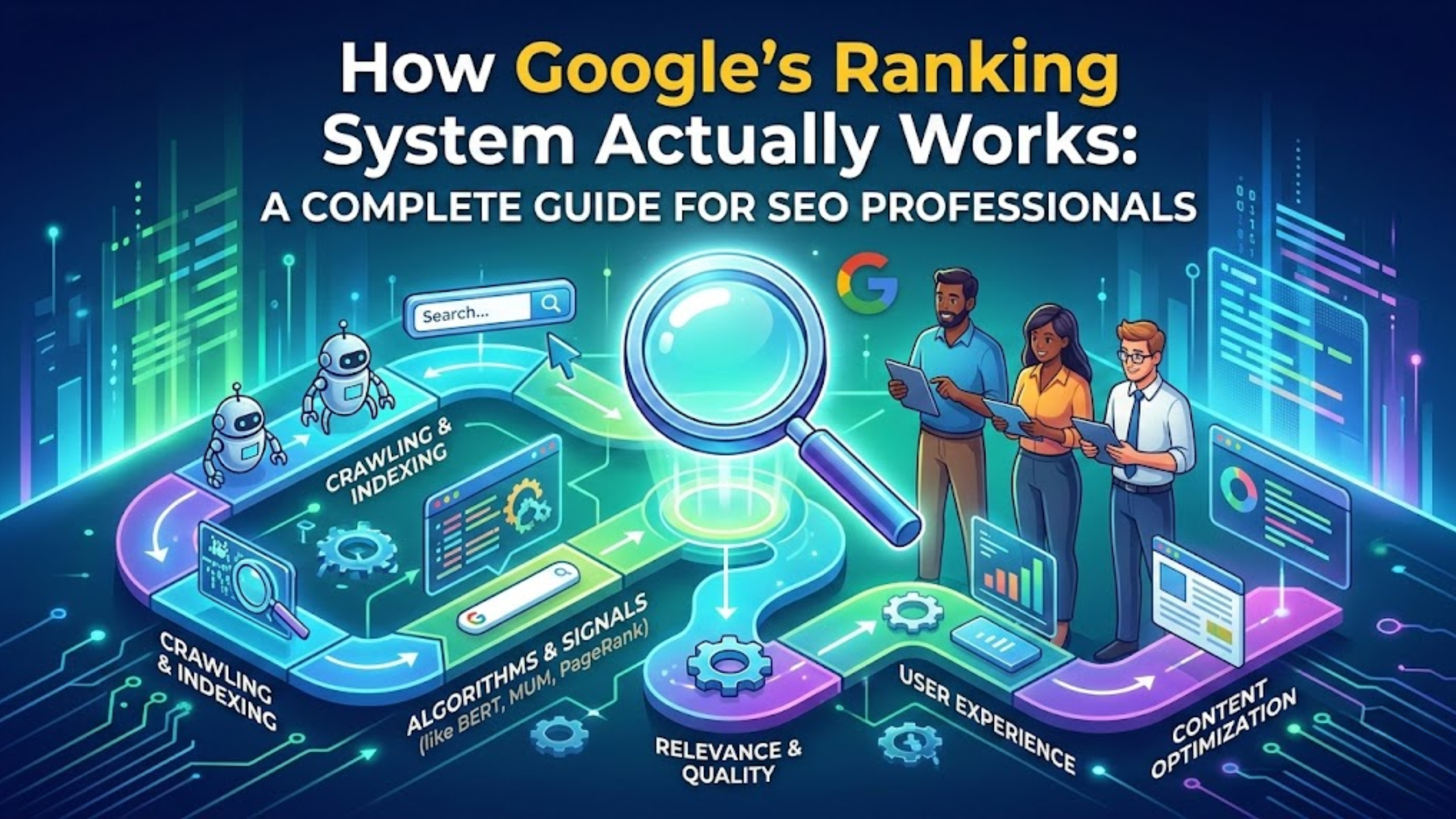
 How Google’s Ranking System Actually Works: A Complete Guide for SEO Professionals
You’ve optimized your title tags, built backlinks, and published content consistently, yet your pages still don’t rank where you want them to.
The reason? Most SEO professionals focus on individual tactics without fully understanding the Google ranking system as a whole.
Google processes over 8.5 billion searches every day. Behind every result is a sophisticated, multi-layered ranking system that evaluates hundreds of signals simultaneously. If you want to consistently rank higher, you need to understand the system, not just the tricks.
This guide breaks down exactly how Google’s ranking system works, what signals matter most in 2026, and what you can do to align your strategy with how Google actually thinks.
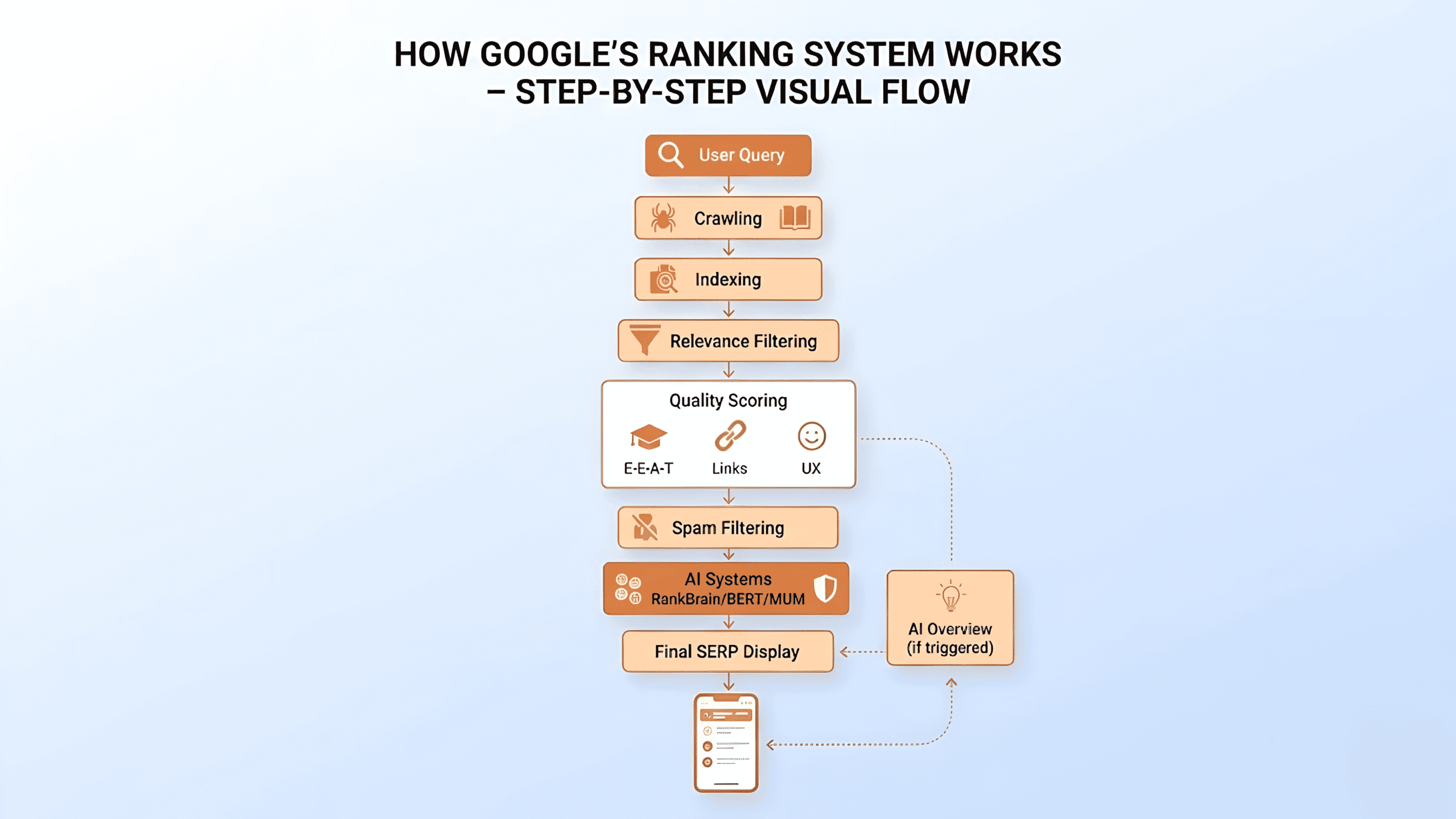
What Is the Google Ranking System?
The Google ranking system is not a single algorithm. It is a collection of algorithms, machine learning models, and automated systems that work together to return the most relevant, trustworthy, and useful results for any given search query.
Google itself has confirmed that its ranking system uses hundreds of ranking signals. These signals are processed in real time and weighted differently depending on the query type, user context, and content category.
| Component | What It Does |
|---|---|
| Crawling | Discovers new and updated pages across the web |
| Indexing | Stores and organizes page content in Google’s database |
| Ranking Algorithms | Scores and orders pages based on relevance and quality |
| Spam Systems | Filters out low-quality and manipulative content |
| Machine Learning (RankBrain, BERT, MUM) | Understands context, intent, and language nuance |
🔗 External Reference: How Google Search Works – Google Official Documentation
Step 1: Crawling – How Google Finds Your Content
Before any page can rank, Google needs to find it. This is done through Googlebot, an automated web crawler that continuously browses the internet following links from page to page.
How crawling works:
→ Googlebot starts from a known set of URLs (seed pages)
→ It follows all internal and external links on those pages
→ New URLs are added to the crawl queue
→ Pages are re-crawled periodically based on crawl frequency signals
What affects crawl efficiency:
→ Crawl budget: Large sites with poor internal linking waste crawl budget on low-value pages
→ Robots.txt: Incorrectly blocked pages won’t be crawled
→ Site speed: Slow servers reduce crawl frequency
→ XML Sitemaps: Help Googlebot discover pages faster
💡 Pro Tip: Use Google Search Console’s Crawl Stats report to monitor how often Googlebot visits your site. If important pages aren’t being crawled, check for crawl budget issues and internal linking gaps.
Step 2: Indexing – How Google Stores Your Content
Once Googlebot crawls a page, it processes the content and stores it in Google’s Search Index, a massive database of hundreds of billions of web pages.
During indexing, Google analyzes text content, structured data and Schema markup, canonicalization, meta tags (noindex, nofollow), and page experience signals like Core Web Vitals.
Common indexing issues SEO professionals face:
| Issue | Cause | Fix |
|---|---|---|
| Page not indexed | noindex tag, crawl block | Audit robots.txt and meta robots |
| Duplicate content | Multiple URLs for same content | Implement canonical tags |
| Thin content ignored | Too little substantive content | Expand content depth |
| Slow indexing | Low domain authority, poor linking | Build internal links, earn backlinks |
💡Pro Tip: Use the URL Inspection Tool in Google Search Console to check the exact indexed version of any page. The “Last crawl” date tells you how fresh Google’s copy is, which is critical for time-sensitive content.
Step 3: Ranking – How Google Orders Search Results
This is where the Google ranking system gets complex. Once Google has a pool of indexed pages relevant to a query, it ranks them using multiple algorithms applied in layers.
Relevance Matching
Google first filters pages that are topically relevant. This involves keyword matching, semantic understanding, and most importantly, search intent alignment. Does your page format match what users actually expect: informational, transactional, or navigational?
Quality Scoring
After relevance filtering, Google scores page quality using its E-E-A-T framework and hundreds of additional signals.
🔗 External Reference: Google’s Ranking Systems Guide
Google E-E-A-T: The Quality Foundation
E-E-A-T stands for Experience, Expertise, Authoritativeness, and Trustworthiness. It is not a direct ranking signal but a framework Google’s quality raters use to evaluate content, and it heavily influences how algorithms score your pages.
| E-E-A-T Signal | What Google Looks For |
|---|---|
| Experience | First-hand experience: reviews, case studies, personal insights |
| Expertise | Demonstrated knowledge: credentials, author bios, content depth |
| Authoritativeness | Recognition from authoritative sources: backlinks, citations |
| Trustworthiness | Accurate info, transparent authorship, HTTPS, clear policies |
E-E-A-T is especially critical for YMYL (Your Money Your Life) topics including health, finance, legal, and safety content where Google applies stricter quality standards.
💡 Pro Tip: Add detailed author bios with credentials to every post. Link author profiles to their LinkedIn, published works, or industry mentions. This directly strengthens Experience and Expertise signals.
🔗 External Reference: Google’s Search Quality Evaluator Guidelines
Top Google Ranking Factors in 2026
| Ranking Factor | Importance | What to Focus On |
|---|---|---|
| Content Quality and Relevance | ⭐⭐⭐⭐⭐ | Depth, accuracy, search intent match |
| Backlinks and Domain Authority | ⭐⭐⭐⭐⭐ | Quality over quantity, relevant linking domains |
| Search Intent Alignment | ⭐⭐⭐⭐⭐ | Content format matching user expectation |
| Core Web Vitals | ⭐⭐⭐⭐ | LCP, INP, CLS scores |
| Mobile-Friendliness | ⭐⭐⭐⭐ | Responsive design, mobile UX |
| E-E-A-T Signals | ⭐⭐⭐⭐ | Author credibility, site reputation |
| Page Speed | ⭐⭐⭐⭐ | TTFB, server response, asset optimization |
| Internal Linking | ⭐⭐⭐ | Topical authority, crawlability |
| Schema Markup | ⭐⭐⭐ | Rich results eligibility |
| User Engagement Signals | ⭐⭐⭐ | CTR, dwell time, bounce rate |
Google’s Core Algorithm Updates: What SEO Pros Need to Know
| Update | Year | Primary Focus |
|---|---|---|
| Panda | 2011 | Penalized thin, duplicate, low-quality content |
| Penguin | 2012 | Targeted spammy, manipulative backlink profiles |
| Hummingbird | 2013 | Introduced semantic search and query understanding |
| RankBrain | 2015 | ML-based interpretation of ambiguous queries |
| BERT | 2019 | Deep language understanding (NLP) |
| Page Experience | 2021 | Core Web Vitals as ranking signals |
| Helpful Content | 2022-2023 | Penalized AI-generated, unhelpful content at scale |
| Core Updates | Ongoing | Broad quality reassessment across all content |
💡 Pro Tip: After every core update, don’t make immediate reactive changes. Wait 2-3 weeks for the rollout to stabilize, then analyze Search Console data systematically. Look for patterns across page types, not just individual URLs.
🔗 External Reference: Google’s explanation of core updates
Machine Learning in Google’s Ranking System
Three ML systems are most critical for SEO professionals to understand:
RankBrain interprets queries Google has never seen before, which accounts for roughly 15% of all daily searches. It maps unfamiliar queries to the most conceptually similar known queries.
BERT (Bidirectional Encoder Representations from Transformers) helps Google understand the full context of words in a query, especially prepositions and nuanced language that significantly changes meaning.
MUM (Multitask Unified Model) is Google’s most advanced model, capable of processing text, images, and video simultaneously across 75+ languages for complex, multi-step queries.
💡 Pro Tip: Stop writing content for keywords and start writing for topics and questions. BERT and MUM reward content that comprehensively addresses user intent, not content that mechanically repeats exact-match keywords.
Core Web Vitals and Page Experience Ranking
Since 2021, Core Web Vitals have been official Google ranking signals that measure real-world user experience.
| Metric | What It Measures | Good Score |
|---|---|---|
| LCP (Largest Contentful Paint) | Loading speed of main content | Under 2.5 seconds |
| INP (Interaction to Next Paint) | Responsiveness to user interactions | Under 200ms |
| CLS (Cumulative Layout Shift) | Visual stability during load | Under 0.1 |
💡 Pro Tip: Use PageSpeed Insights combined with CrUX data in Search Console. Lab data shows what is technically wrong while field data shows what real users experience. Always prioritize field data for ranking decisions.
🔗 External Reference: Core Web Vitals – web.dev by Google
How Google’s Ranking System Works for AI Overviews in 2026
AI Overviews, previously known as Search Generative Experience (SGE), have fundamentally changed how visibility works inside the Google ranking system. In 2026, appearing in an AI Overview can deliver more impressions than a traditional Page 1 ranking because the answer is surfaced directly at the top of the SERP before any blue links appear.
Understanding how Google selects content for AI Overviews is now a core competency for SEO professionals.
How Google Picks Sources for AI Overviews
Google does not randomly pull content into AI Overviews. It selects sources based on the same quality signals that drive traditional rankings, but with stronger emphasis on a few specific factors.
| AI Overview Signal | Why It Matters |
|---|---|
| Clear, direct answers | Google pulls content that answers the query in the first 1-2 sentences of a section |
| Structured headings | H2 and H3 tags help Google identify specific answer blocks within your content |
| Factual accuracy | AI Overviews prioritize verifiable, well-sourced information |
| E-E-A-T strength | High-trust sources are significantly more likely to be cited |
| Concise summaries | Content with clear TL;DR-style summaries gets extracted more frequently |
What This Means for Your Content Strategy
Traditional SEO rewarded comprehensive long-form content. AI Overviews reward precision within comprehensiveness. Your page needs to be both deep and extractable.
The most effective approach in 2026 is to write in a format Google can easily parse. Each major section of your blog should open with a 2-3 sentence direct answer to the implicit question that heading raises. Supporting detail follows, but the direct answer must come first.
For example, if your H2 is “How does Google crawl websites,” the first two sentences of that section should answer exactly that before expanding into detail. This structure makes your content machine-readable for AI Overview extraction while still satisfying human readers who want depth.
Tracking AI Overview Appearances
Google Search Console now shows impressions and clicks from AI Overview citations separately from traditional organic results in some reporting views. SEO professionals should monitor this data to identify which pages are being pulled into AI responses and optimize those pages further for extraction.
💡 Pro Tip: Use the “cited in AI Overview” filter in Search Console (where available) to find your highest-potential pages. Then audit whether those pages open each section with a direct, extractable answer. Even minor rewrites to section openings can meaningfully increase how often your content appears in AI-generated responses.
🔗 External Reference: Google’s overview of AI in Search
How to Check Your Google Ranking
| Tool | Type | Best For |
|---|---|---|
| Google Search Console | Free | Official ranking data, impressions, CTR |
| Ahrefs | Paid | Competitor analysis, keyword tracking |
| SEMrush | Paid | SERP tracking, ranking history |
| Moz Pro | Paid | Domain authority tracking |
| Ubersuggest | Freemium | Basic rank tracking for small sites |
💡 Pro Tip: Never rely on manual Google searches to check rankings. Results are heavily personalized by location, search history, and device. Always use a dedicated rank tracking tool with geo-specific settings.
FAQ: Google Ranking System
Q1. How does the Google ranking system actually work?
Google’s ranking system works in three main stages: crawling (finding pages), indexing (storing content), and ranking (ordering results based on relevance, quality, and hundreds of signals including E-E-A-T, backlinks, and Core Web Vitals).
Q2. How long does it take to rank on Google?
For new pages, ranking can take anywhere from a few weeks to 6+ months depending on domain authority, content quality, competition level, and Googlebot crawl frequency. Established sites with strong backlink profiles rank faster.
Q3. Are backlinks still important for Google ranking in 2026?
Yes, backlinks remain one of Google’s strongest ranking signals. Quality and relevance now matter far more than quantity. A single backlink from a high-authority, topically relevant domain outweighs dozens of low-quality links.
Q4. What is E-E-A-T and how does it affect ranking?
E-E-A-T (Experience, Expertise, Authoritativeness, Trustworthiness) is Google’s content quality framework. While not a direct ranking signal, it influences how algorithms score your content, especially for YMYL topics like health and finance.
Q5. Does social media activity affect Google ranking?
Social media signals are not direct Google ranking factors. However, social media indirectly helps ranking by increasing content visibility, driving traffic, and generating backlinks as more people discover and cite your content.
Q6. Why does ranking drop after a Google core update?
Core updates reassess content quality across the web. If your content lacks depth, has poor E-E-A-T signals, or is misaligned with search intent, a core update may recalibrate your rankings downward.
Q7. How can I check my Google ranking for free?
Google Search Console is the most accurate free tool. Go to Performance > Search Results to see your average position for any keyword your pages currently appear for.
Q8. Does appearing in AI Overviews affect traditional rankings?
Appearing in an AI Overview does not directly boost your traditional organic ranking position. However, it significantly increases your overall SERP visibility and brand impressions, which can indirectly improve click-through rates and engagement signals over time.
Conclusion
Understanding the Google ranking system at a deeper level separates average SEO practitioners from those who consistently deliver results.
Google’s system is not a black box. It is a logical, multi-layered process that rewards relevance, quality, and genuine user value. From crawling and indexing to E-E-A-T scoring, Core Web Vitals, and AI Overviews, every component has a clear purpose.
For SEO professionals, the key takeaway is this: stop chasing individual ranking factors and start building pages that genuinely serve user intent at the highest quality level. That is what Google’s ranking system is ultimately designed to surface.
Apply the technical fundamentals, earn authoritative backlinks, maintain strong E-E-A-T signals, structure your content for AI Overview extraction, and ensure your site delivers a fast, stable user experience, and the rankings will follow.
Tanishka Vats
Lead Content Writer | HM Digital Solutions Results-driven content writer with over five years of experience and a background in Economics (Hons), with expertise in using data-driven storytelling and strategic brand positioning. I have experience managing live projects across Finance, B2B SaaS, Technology, and Healthcare, with content ranging from SEO-driven blogs and website copy to case studies, whitepapers, and corporate communications. Proficient in using SEO tools like Ahrefs and SEMrush, and content management systems like WordPress and Webflow. Experienced content writer with a proven track record of creating audience-centric content that drives significant results on website traffic, engagement rates, and lead conversions. Highly adaptable and effective communicator with the ability to work under deadlines.