
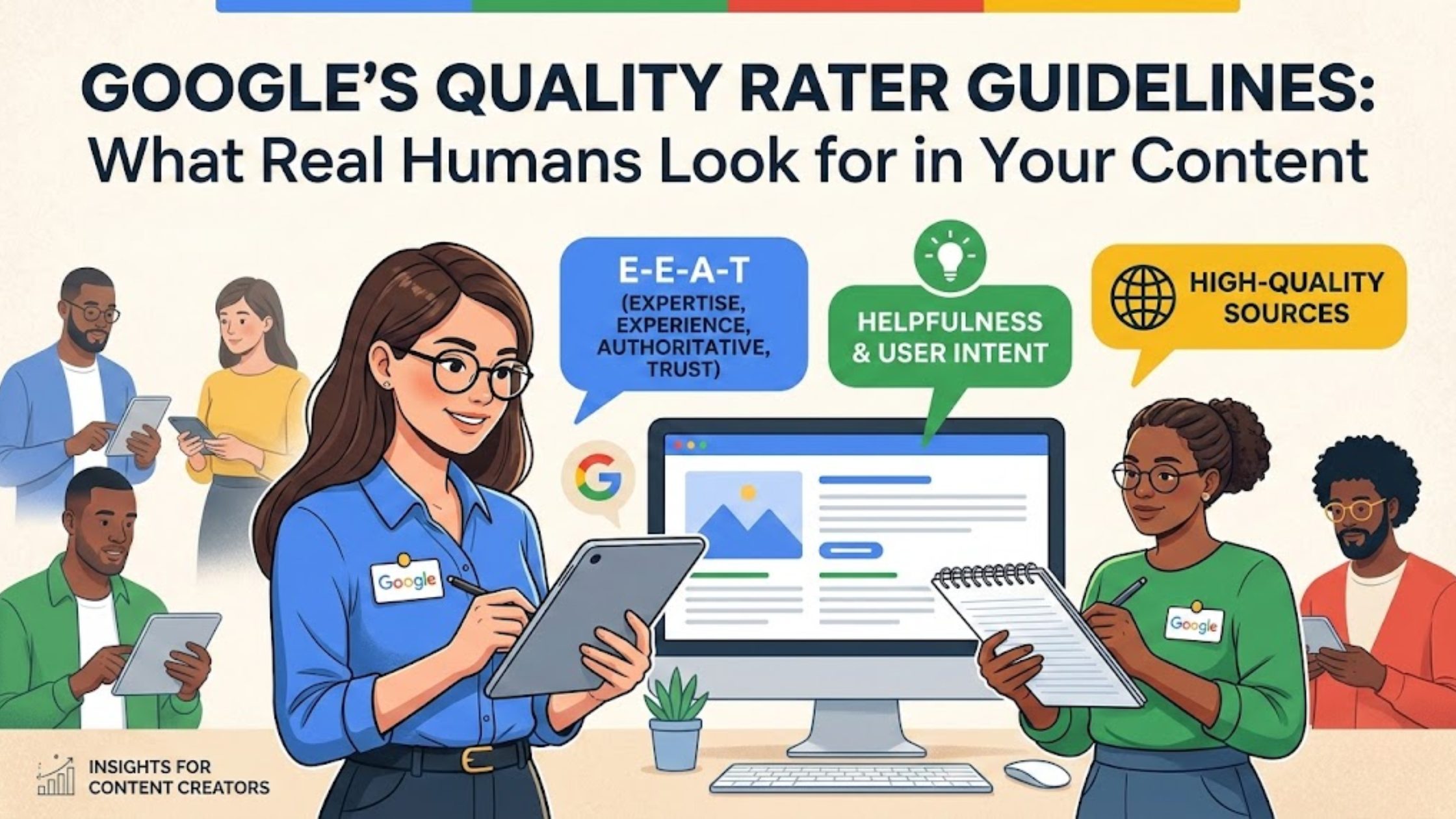
Google Quality Rater Guidelines: What Real Humans Look for in Your Content
Most SEOs spend their time obsessing over algorithms, backlinks, and technical audits. And while all of that matters, there is one part of Google’s evaluation system that very few people talk about: real human beings who manually review websites and judge their quality.
These humans are called Google Quality Raters. They do not directly change your rankings, but they play a critical role in shaping how Google’s algorithm learns what good content actually looks like. If your site impresses them, it means your site is on the right track. If it does not, you have some serious work to do.
In this guide, we are going to break down the Google Quality Rater Guidelines from top to bottom. You will learn what raters look for, how they score pages, what E-E-A-T really means in practice, and most importantly, how you can use this knowledge to make your content genuinely better.
Whether you run a blog, an ecommerce store, or a B2B website, this guide applies to you. Let us get started.
1. What Are Google Quality Rater Guidelines?
The Google Quality Rater Guidelines (officially called the Search Quality Evaluator Guidelines) is a detailed document that Google provides to thousands of human contractors around the world. These contractors, called Search Quality Raters or Search Quality Evaluators, use this document as their instruction manual when reviewing web pages.
The document itself is publicly available and runs over 160 pages. It covers everything from how to evaluate page quality to how to judge whether a page matches what a user was actually searching for.
The first version of these guidelines has been around since the early 2000s, but Google officially released a public version in 2015. Since then, the document has been updated multiple times. One of the biggest changes came in 2022 when Google added the extra E to E-A-T, making it E-E-A-T to account for lived Experience as a quality signal.
| Quick Fact
The Google Quality Rater Guidelines is a publicly available document. You can download the latest PDF directly from Google’s website and read it yourself. It is long, but incredibly valuable for any serious SEO. |
Do Quality Raters Directly Affect Your Rankings?
This is the most common question, and the answer is: not directly.
Quality Raters do not have the power to manually boost or penalize any specific website. Their job is to evaluate pages and provide feedback on whether Google’s algorithm is returning high quality results. Think of them as a feedback mechanism. Google uses their scores in aggregate to train and refine its algorithms over time.
So while a rater judging your page cannot flip a switch that drops your rankings, the standards they use to evaluate pages are the same standards Google’s algorithm has been trained to replicate. If your site would score poorly with a human rater, it is very likely struggling with algorithmic signals too.
2. Who Are Google Quality Raters?
Google works with thousands of Quality Raters worldwide through third-party staffing agencies. These are real people, typically working part-time or as contractors, who are paid to evaluate search results and web pages based on the guidelines.
Raters come from all kinds of backgrounds. They are not all SEO experts or tech professionals. In fact, Google intentionally recruits a diverse group of people to reflect the diversity of actual search users. A rater evaluating a recipe blog might be someone who genuinely loves cooking. Someone evaluating a medical advice page might be an everyday person who has dealt with a health issue.
This diversity is important because Google does not want these evaluations to be purely technical. They want to understand how a regular person, not just an SEO professional, experiences a webpage.
Raters typically work on tasks that involve:
→ Rating the overall quality of a web page
→ Judging how well a page satisfies a specific search query
→ Evaluating the reputation of a website or author
→ Comparing different search results for the same query
3. The Purpose of the Google Quality Rater Guidelines
At its core, the purpose of the guidelines is to help Google understand what a high-quality page looks like from a human perspective. Algorithms can measure a lot of things, but they struggle to fully understand nuance, trust, and genuine helpfulness. Human raters fill that gap.
The guidelines also help Google maintain consistency. With thousands of raters in dozens of countries evaluating millions of pages, you need a standardized framework. The guidelines provide that framework, ensuring that a rater in India and a rater in Germany are using the same criteria when they evaluate a page.
Beyond that, the guidelines signal what Google actually values. Reading through them is like getting a direct line into Google’s thinking. Every SEO and content creator should be familiar with the core principles, even if they never read the full 160-page document.
4. Understanding E-E-A-T: The Heart of the Guidelines
If there is one concept that defines the Google Quality Rater Guidelines, it is E-E-A-T. It stands for Experience, Expertise, Authoritativeness, and Trustworthiness. Understanding what each of these means, and how raters evaluate them, is essential for any content creator.
Experience
Experience is the newest addition to the E-E-A-T framework, added by Google in December 2022. It refers to whether the author of a piece of content has first-hand, lived experience with the topic they are writing about.
Think about it this way: who would you trust more for a review of a hiking trail? Someone who actually hiked it and can describe the terrain, the views, and the challenges, or someone who compiled information from other reviews without ever setting foot on the trail? Google wants to reward the former.
Experience signals can include:
→ Personal anecdotes and first-person storytelling
→ Original photos or videos from the author
→ Specific, detailed observations that only come from direct involvement
→ Author bios that mention relevant real-world activities
Expertise
Expertise refers to the depth of knowledge a content creator has in a given field. For some topics, especially professional ones like medicine, law, or finance, formal credentials matter. For other topics, practical knowledge and demonstrated skill are enough.
Google distinguishes between what it calls everyday expertise and formal expertise. A person who has managed their own chronic illness for years has everyday expertise on the topic even if they do not have a medical degree. A licensed surgeon has formal expertise. Both can create valuable content, but the standards are different.
For YMYL topics (more on those soon), formal expertise is weighted much more heavily. For lifestyle, hobby, or entertainment topics, demonstrated practical knowledge is usually sufficient.
Authoritativeness
Authoritativeness is about reputation, both for the author and the website itself. It is not just what you say about yourself, but what others say about you. Raters are trained to look beyond the content on a page and consider the broader web presence of the site and its authors.
Signals of authoritativeness include:
→ Being cited or linked to by respected websites in your niche
→ Media mentions, interviews, or press coverage
→ Active and recognized presence in your industry community
→ Author profiles on respected external platforms
Trustworthiness
Trustworthiness is the most important element of E-E-A-T, according to Google. In fact, the guidelines explicitly state that a page with low trust cannot be considered high quality regardless of how experienced or expert the author is.
Trust is evaluated at both the page level and the site level. At the page level, raters look for things like accurate information, proper sourcing, and transparency. At the site level, they look for things like clear contact information, an honest About Us page, and a positive reputation online.
Common trustworthiness signals include:
→ A clear, honest About page that explains who runs the site
→ Author bios with verifiable credentials or experience
→ Proper citations and links to credible sources
→ Up-to-date content with visible publication and revision dates
→ Legitimate contact information and privacy policies
→ Positive reviews and lack of scam complaints
| Key Insight
Google’s guidelines explicitly say that Trustworthiness is the most important part of E-E-A-T. A page can have high expertise and great experience signals, but if it feels untrustworthy, it will still be rated poorly. |
5. Page Quality Rating: How Raters Actually Score Your Page
When a rater evaluates a page, they assign it a Page Quality (PQ) rating. This rating exists on a five-point scale, ranging from Lowest to Highest. Understanding what separates a Lowest-rated page from a Highest-rated page is extremely useful for any content creator.
| PQ Rating | What It Means |
| Highest | Outstanding E-E-A-T, highly satisfying content, excellent reputation |
| High | Strong E-E-A-T, clear expertise, good reputation, very helpful content |
| Medium | Adequate E-E-A-T, nothing particularly impressive, decent content |
| Low | Weak E-E-A-T, thin or shallow content, poor reputation signals |
| Lowest | Harmful, deceptive, or completely untrustworthy content |
What Makes a Page Score Highest?
To receive the highest page quality rating, a page needs to demonstrate all of the following:
→ Very high E-E-A-T across all four dimensions
→ A satisfying amount of high-quality main content
→ Positive website reputation with a clearly beneficial purpose
→ Full transparency about who created the content and why
Highest-rated pages are rare and represent genuinely exceptional content. Think of a comprehensive medical guide written by a team of specialist doctors, or an in-depth financial analysis published by a respected research institution.
What Gets a Page Rated Lowest?
According to the guidelines, certain things automatically place a page in the Lowest category, regardless of other quality signals:
→ Content designed to harm users, such as malware or phishing
→ Deliberately deceptive content or fake news
→ Extremely offensive, hateful, or violent content
→ Content that exploits or harms children
→ Pages with an extremely negative reputation across the web
6. Needs Met Rating: Does Your Page Answer What Users Actually Want?
Alongside the Page Quality rating, raters also assign a Needs Met (NM) rating. While Page Quality evaluates the content itself, Needs Met evaluates how well a specific page answers the specific query that was searched.
This is a crucial distinction. A page can be high quality in general terms but still fail to meet the needs of a particular searcher. For example, a detailed guide on the history of coffee might be excellent content, but if someone searched for ‘how to make coffee at home,’ it does not fully meet their need.
The Needs Met Scale
The Needs Met rating uses a similar sliding scale:
→ Fully Meets: The result perfectly and completely satisfies the user’s need. No further searching required.
→ Highly Meets: The result is very helpful for most users searching for that query.
→ Moderately Meets: The result is helpful for some users but not all.
→ Slightly Meets: The result is only marginally helpful.
→ Fails to Meet: The result is completely unhelpful or off-topic.
How to Think About Needs Met for Your Content
To score well on Needs Met, you need to deeply understand search intent. Google classifies user intent into four main categories:
→ Informational: The user wants to learn something. Example: ‘what is SEO’
→ Navigational: The user wants to find a specific website or page. Example: ‘Google Search Console login’
→ Transactional: The user wants to complete an action or buy something. Example: ‘buy running shoes online’
→ Commercial Investigation: The user is researching before making a decision. Example: ‘best SEO tools 2025’
Before you write a piece of content, ask yourself what the user actually needs. Then make sure your content delivers that, completely and clearly. A page that tangentially addresses the topic but buries the answer the user needs will not score well on Needs Met, regardless of how well-written it is.
7. YMYL Pages: Where the Stakes Are Highest
YMYL stands for Your Money or Your Life. This is a category of web pages that Google holds to a significantly higher standard because the content on these pages can directly impact a person’s health, financial stability, safety, or wellbeing.
If your content falls into a YMYL category, every single element of E-E-A-T becomes critical. A YMYL page with weak expertise or trustworthiness signals is not just a content problem; it is a potential safety issue, and Google treats it accordingly.
YMYL Categories
The guidelines identify several main YMYL categories:
→ Health and medical advice (symptoms, treatments, medications, mental health)
→ Financial advice (investments, taxes, loans, retirement planning)
→ Legal topics (laws, rights, contracts, immigration)
→ News and current events (especially civic or safety-related)
→ Safety information (emergency procedures, product safety)
→ Content aimed at children or young people
What You Should Do If Your Site Is YMYL
If your website falls into any YMYL category, you need to take the following steps seriously:
→ Every piece of content should be written by or reviewed by a credentialed expert in that field
→ Author bios must clearly state professional qualifications and credentials
→ Content must be regularly reviewed and updated to ensure accuracy
→ Sources and references should be cited from recognized, authoritative institutions
→ Your About page must be thorough and transparent about your organization
Failing to meet these standards on a YMYL site is one of the fastest ways to be downranked in Google search. Google simply cannot afford to rank low-quality health or financial content prominently when the consequences for users could be serious.
8. Real Examples: Good Content vs. Bad Content
One of the most useful sections of the Google Quality Rater Guidelines is where it provides real-world examples of good and bad content. Let us walk through some practical comparisons that illustrate what raters are looking for.
Example 1: Medical Article
| Good Content | Bad Content |
| Written by a board-certified doctor with credentials listed | Written by anonymous author with no credentials |
| Cites clinical studies and medical institutions | No sources cited, vague claims |
| Includes publication date and last reviewed date | No date, could be years old |
| Recommends consulting a doctor for personal advice | Makes absolute medical claims without caveats |
| Clean, professional site with clear About page | Cluttered with ads, hard to identify the publisher |
Example 2: Product Review Blog
| Good Content | Bad Content |
| Reviewer shows original photos of the product | Stock photos only, no original visuals |
| Discusses specific pros, cons, and personal observations | Generic description that could apply to any product |
| Discloses affiliate relationships transparently | No disclosure, clearly monetized but hidden |
| Has other reviews from verified purchasers | Only positive reviews, no balance |
| Compares similar products with honest recommendations | Pushes one product regardless of user needs |
Example 3: Financial Advice Page
| Good Content | Bad Content |
| Written by a licensed financial advisor | No author mentioned at all |
| Explains risks clearly and recommends professional consultation | Promises guaranteed returns with no risk mentioned |
| Breaks down complex concepts simply and accurately | Uses jargon to sound authoritative without substance |
| Updated regularly to reflect current regulations | Has outdated tax laws and figures from years ago |
| Part of a reputable financial media publication | New website with no history or reputation |
9. Practical SEO Action Steps Based on the Guidelines
Reading the guidelines is useful. Applying them is what actually moves the needle. Here are concrete action steps you can take right now to align your website with what Google Quality Raters are looking for.
Step 1: Build Strong Author Profiles
Every piece of content on your site should have a clearly identified author. That author should have a bio that communicates relevant experience, expertise, and credentials. For YMYL topics, this is non-negotiable.
Your author bio should include:
→ Full name and professional title
→ Relevant credentials, certifications, or degrees
→ Years of experience in the relevant field
→ Links to external profiles (LinkedIn, industry publications)
→ A professional photo
Step 2: Upgrade Your About Page
Your About page is one of the first places a rater looks when evaluating site trustworthiness. It should clearly explain who runs the site, what the site is about, and why users should trust it. A one-paragraph About page is not enough.
Step 3: Cite Your Sources
For any factual claims, especially in health, finance, or legal content, always link to your sources. Reference reputable institutions like government websites, academic journals, and recognized industry organizations. This signals to both raters and Google’s algorithms that your content is grounded in credible information.
Step 4: Show Dates and Update Content Regularly
Content that is clearly outdated raises red flags for raters. Always display when your content was published and when it was last updated. Then actually update it. Set a schedule to review older content at least once a year, and more frequently for fast-moving topics.
Step 5: Make Contact Information Easily Accessible
Legitimate websites have clear ways to get in touch. At a minimum, you should have a Contact page with an email address or contact form. For businesses, a physical address adds even more trustworthiness. This signals that there is a real organization behind the content, not an anonymous content farm.
Step 6: Earn Mentions and Links From Authoritative Sources
Remember that Authoritativeness is partly about what others say about you. Work on building genuine relationships in your industry. Get your content referenced by respected publications. Contribute guest posts to authoritative sites. Speak at industry events. All of these activities build your off-page reputation over time.
Step 7: Remove or Improve Low-Quality Content
One piece of very thin, untrustworthy content can drag down the perceived quality of your entire site. Audit your content regularly and either delete, consolidate, or substantially improve any pages that would score poorly on the Page Quality scale.
10. Common Mistakes That Flag Your Site to Quality Raters
Just as important as doing the right things is avoiding the wrong ones. Here are the most common mistakes that raise red flags for Google Quality Raters.
Anonymous Content
Publishing content with no identified author is one of the biggest trust killers. Even if you have a valid reason for not naming authors (for example, a company blog where content represents the organization), you need to clearly identify who the organization is and why they are qualified to speak on the topic.
Clickbait Titles With Misleading Content
If your title promises something your content does not deliver, raters will notice immediately. Misleading titles are a direct violation of trustworthiness. Your title should accurately represent what your content actually covers, every single time.
Thin or Padded Content
Content that is either too shallow to be genuinely useful, or padded with filler to seem longer than it is, scores poorly on Page Quality. Every section of your content should add real value. If a paragraph does not help the reader, cut it.
Excessive or Intrusive Advertising
Google’s guidelines specifically mention that excessive ads, especially those that interfere with the main content, are a negative quality signal. If your page has more ads than content, or if pop-ups make it difficult to read, raters will mark down the user experience.
No Clear Website Purpose
Every high-quality website has a clearly defined purpose and audience. If a rater cannot quickly understand what your site is about and who it is for, that is a problem. Your homepage, About page, and site structure should communicate your purpose immediately.
Copied or Aggregated Content
Content that is simply copied from other sources, even with minor rewrites, is considered low quality. Similarly, content that merely aggregates information from other pages without adding any original analysis, perspective, or value will not score well. Google wants original content that adds something new to the conversation.
Conclusion
The Google Quality Rater Guidelines are one of the most transparent windows into what Google actually values in web content. While quality raters do not directly control your rankings, the standards they use have been baked into Google’s algorithms. A page that scores well with a human rater is a page that Google’s algorithm is designed to reward.
The core message of the guidelines is straightforward: create content that genuinely helps real people, be transparent about who you are and why you are qualified to speak on a topic, and build a reputation that others can verify independently.
Focus on Experience, Expertise, Authoritativeness, and Trustworthiness. Understand user intent and make sure your content fully satisfies what people are actually searching for. Be especially rigorous if your content falls into YMYL categories where real harm can occur from bad information.
The good news is that following these guidelines is not about gaming a system. It is about building something that is genuinely good. And genuinely good content, created by trustworthy authors for a clearly defined audience, is exactly what Google has always been trying to reward.
If you found this guide helpful, check out our earlier posts on how Google’s Ranking System actually works and our deep analysis of the Google Helpful Content System. Together, these three guides give you a complete picture of how Google evaluates and rewards content in 2026.
Frequently Asked Questions (FAQs)
Q. What are Google Quality Rater Guidelines?
The Google Quality Rater Guidelines is an official document that Google provides to thousands of human contractors called Search Quality Raters or Search Quality Evaluators. These contractors use the document to evaluate the quality of web pages and search results. The guidelines are publicly available and cover topics like E-E-A-T, Page Quality ratings, and Needs Met ratings.
Q. Do quality raters affect my website’s rankings?
Quality raters do not directly change individual website rankings. They cannot manually penalize or boost specific pages. However, their evaluations are used in aggregate to help Google train and refine its search algorithms. The standards raters use are the same ones Google’s algorithm has learned to replicate, so a site that performs poorly with human raters is likely struggling with algorithmic signals too.
Q. What is E-E-A-T in SEO?
E-E-A-T stands for Experience, Expertise, Authoritativeness, and Trustworthiness. It is a framework that Google Quality Raters use to evaluate the credibility and quality of web pages and their authors. Google added the first E for Experience in December 2022, recognizing that first-hand, lived experience with a topic is a valuable quality signal. Trustworthiness is considered the most important element.
Q. What is YMYL in SEO?
YMYL stands for Your Money or Your Life. It refers to categories of content that can directly impact a person’s health, financial wellbeing, safety, or happiness. Examples include medical advice, financial guidance, legal information, and news about important civic matters. Google holds YMYL pages to a significantly higher E-E-A-T standard because the consequences of low-quality information in these areas can be serious.
Q. How do I improve my E-E-A-T score?
There is no single numerical E-E-A-T score that you can look up, but you can strengthen your E-E-A-T signals by: building detailed author profiles with verifiable credentials, creating an in-depth and transparent About page, citing credible sources throughout your content, keeping content updated with clear dates, earning mentions and links from authoritative websites, and actively maintaining a positive reputation across the web.
Q. Where can I download the Google Quality Rater Guidelines?
The Google Quality Rater Guidelines are publicly available. You can find the latest version by searching for ‘Google Search Quality Evaluator Guidelines PDF’ on Google. Google typically updates the document every year or two, so always make sure you are reading the most recent version.
Q. How often does Google update its Quality Rater Guidelines?
Google updates the guidelines periodically, typically once or twice a year, though the timing varies. Major updates often coincide with significant algorithm changes. The most notable recent update was in December 2022 when Google added Experience to create the current E-E-A-T framework. It is a good practice to check for updates at least once a year if you are seriously working on content quality.
Tanishka Vats
Lead Content Writer | HM Digital Solutions Results-driven content writer with over five years of experience and a background in Economics (Hons), with expertise in using data-driven storytelling and strategic brand positioning. I have experience managing live projects across Finance, B2B SaaS, Technology, and Healthcare, with content ranging from SEO-driven blogs and website copy to case studies, whitepapers, and corporate communications. Proficient in using SEO tools like Ahrefs and SEMrush, and content management systems like WordPress and Webflow. Experienced content writer with a proven track record of creating audience-centric content that drives significant results on website traffic, engagement rates, and lead conversions. Highly adaptable and effective communicator with the ability to work under deadlines.