
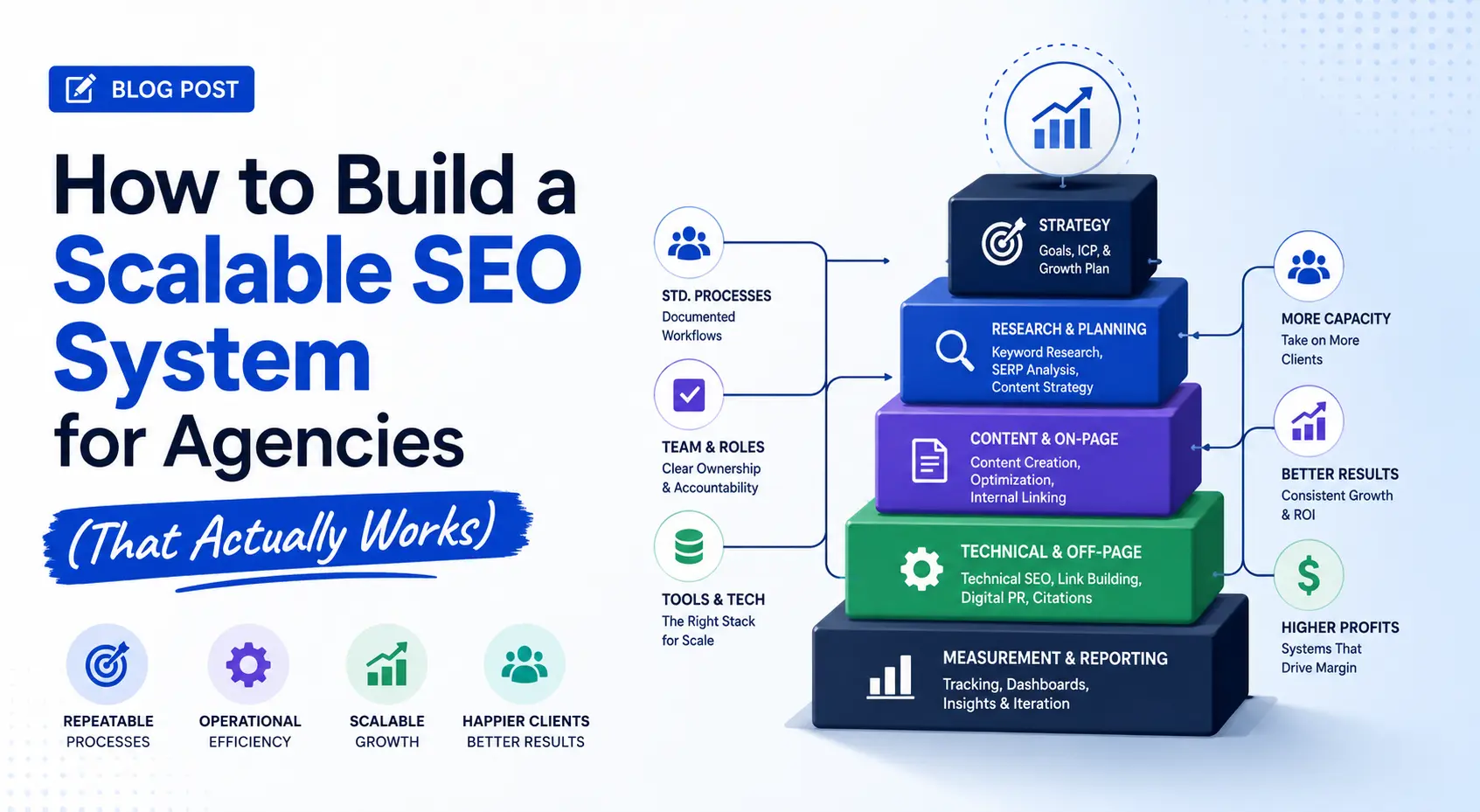
How to Build a Scalable SEO System for Agencies (That Actually Works)
Most SEO agencies grow fast at first. You land 3 clients, then 5, then 10. But somewhere around client 8 or 9, things start breaking. Deadlines get missed. Reports are inconsistent. Team members repeat work that someone else already did. Quality drops.
That is not a people problem. That is a systems problem.
The difference between an agency that plateaus at 10 clients and one that scales to 50+ is not talent. It is whether they have built a scalable SEO system a repeatable, process-driven engine that delivers consistent results without chaos.
In this guide, I will walk you through exactly how to build that system from scratch: from client onboarding to content workflows, technical audits to reporting. No fluff, just the framework.
What Is a Scalable SEO System?
A scalable SEO system is a set of documented processes, templates, and workflows that allow your agency to deliver the same quality of SEO work across 5 clients or 50 without proportionally increasing your team size or working hours.
Think of it like this: if removing one team member brings your entire operation to a halt, you do not have a system. You have individual expertise. Expertise cannot scale. Systems can.
A properly built scalable SEO system covers:
→ Standardized onboarding so every client starts on the same foundation
→ Repeatable audit frameworks that can be executed by any trained team member
→ Content workflows with clear briefs, review stages, and publishing checklists
→ Automated reporting that saves hours every month
→ Quality control layers at every stage
Why Most Agencies Fail to Scale
Before building the system, it helps to understand why agencies fail to scale in the first place. Based on common patterns across digital agencies, the reasons usually fall into three buckets:
1. Over-reliance on one person’s knowledge The senior SEO on the team knows everything. Everyone else depends on them for decisions. When this person is unavailable, work stalls.
2. No documented SOPs (Standard Operating Procedures) Every new project starts from zero. Team members invent their own process each time, leading to inconsistent output.
3. Reactive client management Instead of proactively reporting progress, the team only communicates when a client complains. This erodes trust and increases churn.
The fix for all three is the same: build a system that removes individual dependency and replaces it with documented, repeatable process.
Step 1: Standardize Your Client Onboarding
The first 30 days of a client relationship set the tone for everything that follows. If onboarding is messy, the client’s trust starts low and never fully recovers.
A scalable onboarding process should include:
The Onboarding Checklist
Every new client should trigger the same checklist, regardless of which team member handles it:
→ Access collection: Google Search Console, Google Analytics 4, Google Business Profile (for local clients), CMS login, and ad accounts if relevant
→ Business discovery questionnaire: Target audience, top competitors, previously tried SEO tactics, goals for the next 6 to 12 months
→ Baseline audit: Technical health, current keyword rankings, backlink profile snapshot, Core Web Vitals scores
→ Kickoff call agenda: Share findings, align on goals, set expectations for the first 90 days
Create a shared document template for each of these. When every new client goes through the same structured onboarding, your team spends zero time figuring out what to do next.
Real talk: Agencies that skip the business discovery questionnaire often spend months optimizing for the wrong keywords, ones that get traffic but do not convert for that particular client’s business model.
Step 2: Build a Repeatable Technical SEO Audit Framework
Technical SEO is the foundation. Without it, even the best content strategy will underperform. But running a full technical audit from scratch for every client is time-consuming and error-prone.
The solution is a tiered audit template that covers the same core areas every time, with room to go deeper when issues are found.
Core Technical Audit Areas (Always Check)
| Area | What to Check | Tool |
|---|---|---|
| Crawlability | Robots.txt, XML sitemap, crawl errors | Screaming Frog, Google Search Console |
| Indexing | Index coverage, noindex tags, canonicals | Google Search Console |
| Site Speed | Core Web Vitals (LCP, CLS, INP) | PageSpeed Insights, GTmetrix |
| Mobile Usability | Responsive design, tap targets, font size | Google Search Console |
| On-Page Structure | Title tags, meta descriptions, H1 tags | Screaming Frog, Ahrefs |
| Internal Linking | Orphan pages, link depth, anchor text | Screaming Frog |
| Schema Markup | Structured data errors and opportunities | Schema Markup Validator |
The goal is not to reinvent this audit for every client. It is to train every team member to execute the same framework, flag the same types of issues, and prioritize fixes using the same severity criteria.
For deeper technical issues like JavaScript SEO, crawl budget problems, or hreflang implementation, your agency’s technical lead should have a separate advanced layer to the audit. You can read more about these in our Technical SEO guide for website performance.
Step 3: Create a Scalable Keyword Research Process
Keyword research is where many agencies waste the most time. Every team member has a different approach. Some go too broad, some too narrow. The result is inconsistent and hard to build on.
A scalable keyword research system has three layers:
Layer 1: Topical Authority Mapping
Before choosing individual keywords, map out the full topic universe for the client’s niche. What are the core themes? What subtopics fall under each theme? This gives you a content roadmap that builds topical authority over time, not just isolated keyword rankings.
Layer 2: Intent-Based Keyword Bucketing
Once you have topics, sort keywords by intent:
→ Informational (how-to, what is, guide) → Blog content
→ Commercial (best, top, vs, review) → Comparison or listicle content
→ Transactional (hire, buy, get quote, pricing) → Service or landing pages
→ Navigational → Brand and category pages
This prevents the common mistake of writing a blog post to target a transactional keyword and wondering why it does not convert.
Layer 3: Keyword Opportunity Scoring
Not all keywords are worth chasing. Use a simple scoring model that weighs:
→ Search volume
→ Keyword difficulty
→ Client’s current domain authority
→ Business relevance and conversion potential
Prioritize keywords where the gap between current ranking and page 1 is smallest, especially early in the engagement. Quick wins build client confidence.
We cover the full methodology in our Keyword Opportunity Score Calculation guide.
Step 4: Build a Content Production Workflow
Content is where most agencies lose control as they scale. Writers produce inconsistent quality. Briefs are vague. Revision cycles take forever. Publishing gets delayed.
A scalable content workflow solves this with clear stages and ownership at every step.
The 6-Stage Content Workflow
Stage 1 — Brief Creation Every piece of content starts with a detailed brief. Not just a topic and a keyword. A full brief includes: target keyword, secondary keywords, search intent, word count target, internal links to include, competitor articles to outrank, specific questions to answer, and the desired CTA.
Stage 2 — Research and Outline Before writing begins, a content outline is shared with the client (or internally approved). This prevents full rewrites later.
Stage 3 — First Draft Writer produces the draft against the brief. No exceptions — if the brief says include a comparison table, the draft includes a comparison table.
Stage 4 — SEO Review An SEO team member checks: keyword usage, header structure, internal links, meta title and description, image alt text, schema opportunities.
Stage 5 — Editorial Review A senior team member reviews for quality, accuracy, tone, and EEAT signals (author credentials, data citations, original insights).
Stage 6 — Publishing and Indexing Content goes live. URL is submitted for indexing via Google Search Console. Internal links from related pages are updated.
Document this workflow in a project management tool like Notion, Trello, or Asana. Every content piece should move through the same stages, visible to the whole team.
Step 5: Systemize Link Building
Link building is often the least systematic part of an agency’s SEO operation. It gets treated as an ad hoc activity rather than a repeatable process. That is a mistake.
A scalable link building system has three repeatable components:
1. Prospect Pipeline
Build and maintain a running list of link prospects for each client’s niche: relevant blogs, industry publications, resource pages, and directories. Tools like Ahrefs, Hunter.io, and BuzzStream can help you maintain and enrich this list continuously.
2. Outreach Templates
Create a library of tested outreach email templates for different link building tactics: guest posts, resource page links, digital PR, and broken link building. Customize them per client but keep the structure consistent.
3. Link Tracking System
Every link built should be logged: target URL, linking domain, DR, anchor text, date acquired, and follow/nofollow status. This gives you a clean record to present in client reports and helps avoid duplicate outreach.
Step 6: Build an Automated Reporting System
Reporting is the most time-consuming agency task that adds the least direct value. Most agencies spend 4 to 8 hours per client per month on reports. At 20 clients, that is up to 160 hours — nearly one full-time employee — just on reporting.
The fix is automation.
What a Scalable Reporting System Looks Like
→ Connect data sources once: Google Analytics 4, Google Search Console, Ahrefs or Semrush — pull into a central dashboard (Looker Studio is free and powerful)
→ Create a master template: One report template that works for all clients, with sections that can be toggled on or off based on services delivered
→ Automate delivery: Schedule reports to be emailed to clients automatically at the same time every month
→ Add a commentary layer: Automated data is good. A short written summary explaining what happened and why is what builds client trust. Even 200 words of insight is worth more than 10 charts with no context.
Tools worth considering for agency reporting: AgencyAnalytics, Looker Studio (free), SE Ranking, and DashThis.
Step 7: Implement Quality Control at Scale
As your team grows, quality control becomes the hardest thing to maintain. The answer is checklists and peer review — not micromanagement.
QC Checklist Before Every Deliverable Goes to Client
For content: Title tag under 60 characters? Meta description under 160? Primary keyword in H1? At least 2 internal links? All images have alt text? Readability score checked?
For technical audits: All critical issues flagged with severity level? Every issue has a recommended fix? Fixes are prioritized by impact, not just by type?
For link building reports: Every link independently verified as live? Anchor text recorded? Client-facing explanation of why each link matters included?
Build these checklists into your project management system. Make them non-optional. Quality control is not about trust — it is about removing the possibility of error before a deliverable leaves your team.
The Technology Stack for a Scalable SEO Agency
You do not need to spend a fortune. Here is a practical stack by agency size:
| Stage | Core Tools |
|---|---|
| Starting out (1-10 clients) | Google Search Console, Screaming Frog (free), Ubersuggest or Ahrefs Lite, Looker Studio, Notion |
| Growing (10-30 clients) | Semrush or Ahrefs, SE Ranking, AgencyAnalytics, Asana or ClickUp, Hunter.io |
| Scaling (30+ clients) | Semrush Agency Kit, Looker Studio with custom connectors, Slack automations, white-label reporting dashboards, dedicated CRM |
The principle: invest in tools that eliminate repetitive manual work first. Reporting and rank tracking automation give the highest ROI at every stage.
EEAT: The Non-Negotiable Foundation
In 2026, Google’s quality rater guidelines make EEAT (Experience, Expertise, Authoritativeness, Trustworthiness) a central factor in how content is evaluated — especially for SEO agencies advising clients in competitive or YMYL niches.
For your agency’s own website and blog, EEAT signals include:
→ Named authors with real credentials and professional profiles
→ Case studies with specific, verifiable results
→ Original data, proprietary frameworks, and unique insights (not just repackaged advice)
→ Client testimonials and recognizable brand mentions
→ Transparent about-us pages, team pages, and contact information
You cannot build a scalable SEO system for clients without demonstrating EEAT in your own digital presence. Clients need to trust you before they hire you, and Google needs to trust your content before it ranks it.
Read more about how Google evaluates content in our Google Quality Rater Guidelines breakdown.
Common Mistakes to Avoid
Mistake 1: Building the system after you need it Most agencies wait until they are overwhelmed to start systemizing. Build it at client 3, not client 15. Retrofitting is much harder.
Mistake 2: Creating SOPs nobody reads A 30-page SOP document in Google Drive that no one opens is not a system. Keep SOPs short, visual, and embedded in the tools your team already uses.
Mistake 3: Treating every client as completely unique Every client has unique goals, but the process to achieve those goals should be consistent. Resist the urge to reinvent the wheel for every new account.
Mistake 4: Ignoring the scalability of your own SEO Your agency’s own website should practice what you preach. If your site lacks topical authority, strong internal linking, and consistent publishing, clients will notice. Learn how semantic content networks apply to your own site too.
Frequently Asked Questions
Q: How long does it take to build a scalable SEO system?
The core framework — onboarding, audit template, content workflow, and reporting — can be built in 4 to 6 weeks if you dedicate focused time to it. Most agencies do it in phases over 2 to 3 months while continuing to serve clients.
Q: Do I need expensive tools to scale an SEO agency?
No. Google Search Console, Screaming Frog (free version), and Looker Studio are free and can handle most needs up to around 10 clients. The investment in paid tools becomes worthwhile when manual hours saved outweigh the subscription cost.
Q: What is the most important part of a scalable SEO system?
Documentation. The best process is useless if it only lives in someone’s head. Every workflow needs to be written down, stored in a shared location, and kept updated.
Q: How do I know if my agency is ready to scale?
If you can predict what every team member is working on at any given time, your deliverables are consistent across clients, and your reporting is automated — you are ready to scale. If any of those three things are not true, fix them first.
Q: Should I use in-house team or hire an SEO agency partner for scaling?
This depends on your capacity and specialization. We have covered this in detail in our In-house SEO vs Hiring an SEO Agency comparison guide.
Final Thoughts
Building a scalable SEO system is not a one-time project. It is an ongoing commitment to documentation, process improvement, and team training. The agencies that scale successfully are not necessarily the ones with the best SEOs — they are the ones who turned great SEO thinking into repeatable systems that any trained team member can execute.
Start with one part of this framework today. Standardize your onboarding. Build your first audit template. Create a content workflow. Each step you take toward systematizing your operation compounds over time, just like SEO itself.
If you want to see how a professional SEO agency applies these systems to real client results, explore our SEO services or learn more about our team and approach.
Tanishka Vats
Lead Content Writer | HM Digital Solutions Results-driven content writer with over five years of experience and a background in Economics (Hons), with expertise in using data-driven storytelling and strategic brand positioning. I have experience managing live projects across Finance, B2B SaaS, Technology, and Healthcare, with content ranging from SEO-driven blogs and website copy to case studies, whitepapers, and corporate communications. Proficient in using SEO tools like Ahrefs and SEMrush, and content management systems like WordPress and Webflow. Experienced content writer with a proven track record of creating audience-centric content that drives significant results on website traffic, engagement rates, and lead conversions. Highly adaptable and effective communicator with the ability to work under deadlines.