
SEO SOPs: How Top Agencies Standardize Results (And How You Can Too)
Every SEO agency owner reaches a breaking point.
You bring on a third client. Then a fourth. Suddenly, the keyword research your senior executive produces looks nothing like what the new hire delivers. Reports go out late. On-page checklists get skipped. A client escalates because someone forgot to set up rank tracking before the campaign even started.
The problem is not your team. The problem is the absence of a system.
That is exactly what an SEO SOP (Standard Operating Procedure) solves. It is the operational backbone that separates agencies that scale from those that stay stuck doing the same reactive firefighting month after month.
This guide is written for SEO agency owners and founders who want to build SOPs that actually get followed. Not theory. Not generic HR templates. Real, process-level documentation that turns your best work into a repeatable system.
What You’ll Learn in This Guide
→ What an SEO SOP is and why it matters more in 2026 than ever before
→ The real cost of running an agency without documented processes
→ The 6 core SEO SOPs every agency must have, with detailed workflows for each
→ A step-by-step framework for building SOPs your team will actually use
→ Why most SEO agency SOPs fail — and exactly how to avoid those mistakes
→ A ready-to-use SOP template you can implement today
What Is an SEO SOP, and Why Does It Matter More in 2026?
A Standard Operating Procedure (SOP) is a documented, step-by-step guide for completing a specific task the same way, every time, regardless of who is doing it.
In the context of an SEO agency, an SEO SOP covers everything from how you conduct a technical audit to how you onboard a new client, build links, write meta titles, or structure a monthly report.
But here is what most guides miss: SOPs are not just about consistency. In 2026, they are a competitive differentiator.
Google’s ranking systems now evaluate topical authority, content depth, and E-E-A-T (Experience, Expertise, Authoritativeness, Trustworthiness) at a level that rewards agencies with structured, repeatable workflows. When your team follows documented processes, quality becomes predictable. When quality is predictable, results are repeatable. When results are repeatable, clients stay longer — and refer others.
| Without SEO SOPs | With SEO SOPs |
|---|---|
| Quality depends on who does the task | Quality is consistent across all team members |
| New hires shadow seniors for weeks | New hires onboard from documentation in days |
| Knowledge leaves when people leave | Knowledge lives in the system, not in individuals |
| Errors discovered after delivery | Errors caught at quality checkpoints before delivery |
| Scaling means proportionally more chaos | Scaling means running the same system at higher volume |
The Real Cost of Not Having SEO SOPs
Before getting into how to build them, it is worth understanding what running an agency without SOPs actually costs you.
Inconsistent deliverables. One account manager sends a detailed 12-page report. Another sends a three-line email summary. Same agency, same retainer cost — completely different client experience.
Knowledge locked in individuals. When your best SEO strategist leaves, does the process leave with them? Without documentation, it usually does.
Slow onboarding. New hires shadow senior team members for weeks because there is no documented playbook. That is expensive time being spent on training that should take days, not months.
Client churn from errors. Missed redirect mappings, skipped canonical checks, title tags left unoptimized — these are the mistakes that happen when tasks run on memory instead of process.
💡 Agency Insight: The agencies growing fastest in 2026 are not always the ones with the most talented team. They are the ones who have turned their talent into a repeatable system. SOPs are how that system gets built.
The 6 Core SEO SOPs Every Agency Needs
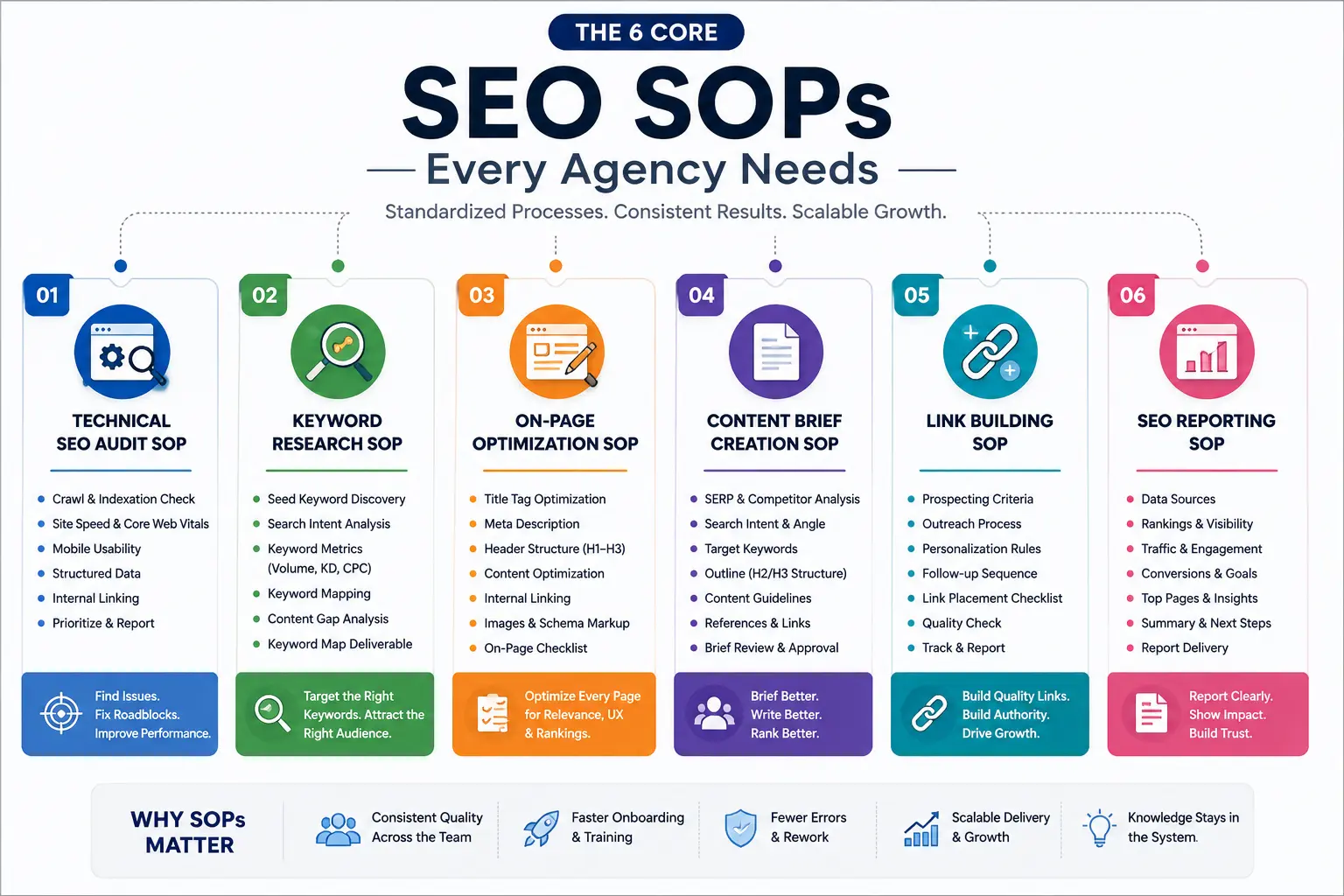
Not every task needs an SOP. Focus your documentation on processes that are high-frequency, involve multiple team members, or are high-stakes for client results. Here are the six that matter most.
1. Technical SEO Audit SOP
A technical audit is one of the most complex and variable tasks in SEO. Without a standard process, two team members will audit the same site and come back with completely different findings — not because one is wrong, but because each checked different things.
Your technical audit SOP should define:
→ Which tools to use at each stage (Screaming Frog for crawling, Google Search Console for indexation, PageSpeed Insights for Core Web Vitals)
→ Crawl settings to configure before starting (crawl depth, JavaScript rendering on/off, URL exclusions)
→ Priority order of checks: crawlability first, then indexability, Core Web Vitals, structured data, mobile usability, internal linking, redirect chains
→ How findings are categorized — critical, high, medium, low — with examples of each
→ The format for the deliverable before it goes to the client
For a detailed breakdown of what a comprehensive technical audit should cover, read our guide on technical SEO for website performance.
2. Keyword Research SOP
Keyword research is where most agency inconsistency begins. One strategist focuses on volume. Another prioritizes difficulty. A third adds keywords based on client suggestions without validating search intent.
Your keyword research SOP should define:
→ Your primary tool stack and how to use each tool in sequence
→ How to classify intent: informational, navigational, commercial, transactional, with examples for each category
→ Your criteria for including or excluding a keyword (minimum search volume, maximum difficulty threshold, relevance score)
→ How to map keywords to existing pages or identify content gaps requiring new pages
→ The format and structure of the final keyword map deliverable
Understanding how Google interprets keywords at a semantic level is increasingly important. Our article on how Google uses entities instead of keywords explains why pure volume-based keyword research is no longer sufficient for ranking in 2026.
3. On-Page Optimization SOP
On-page SEO is one of the most frequently delegated tasks in agencies. It is also one of the most inconsistently executed when there is no documented process.
Your on-page SOP should cover:
| On-Page Element | SOP Guideline |
|---|---|
| Title Tag | Include primary keyword, keep under 60 characters, match search intent |
| Meta Description | Include primary keyword and value proposition, under 160 characters |
| H1 Tag | One per page, include primary keyword naturally |
| H2/H3 Structure | Follow logical hierarchy, include secondary keywords where natural |
| Internal Links | Minimum 2-3 relevant internal links per page, descriptive anchor text |
| Image Alt Text | Describe the image, include keyword where genuinely relevant |
| Schema Markup | Define which schema types apply to which page types |
For agencies building content at scale, our on-page SEO services page outlines the foundational elements that should feature in every on-page SOP.
4. Content Brief Creation SOP
Content quality directly reflects how well it was briefed. A vague brief produces generic content. A detailed, structured brief produces content that can rank.
Your content brief SOP should define:
→ The research required before writing a brief: SERP analysis, competitor content audit, entity mapping
→ Mandatory sections every brief must contain: target keyword, secondary keywords, search intent, target word count, H2/H3 structure, internal links to include, external references to cite, tone and target audience
→ Quality checkpoint: who reviews the brief before it goes to a writer, and what they are checking for
→ Brief format: template that every brief follows regardless of which strategist writes it
As Google’s systems increasingly reward topical authority over isolated keyword targeting, your content brief SOP needs to reflect entity coverage and semantic depth — not just keyword placement.
5. Link Building SOP
Link building is the most process-sensitive SEO task in an agency environment. Done without a defined system, it creates inconsistent anchor text profiles, irrelevant placements, and outreach that damages your agency’s sender reputation over time.
Your link building SOP should include:
Prospecting Criteria
| Criterion | Minimum Standard |
|---|---|
| Domain Rating | Define your minimum DR threshold per client tier |
| Topical Relevance | Linking page must be relevant to client’s niche |
| Spam Score | Below 5% (Moz) or equivalent |
| Organic Traffic | Minimum traffic to confirm site is not deindexed |
Outreach Process
→ Personalization requirements for every outreach email
→ Follow-up sequence: timing and number of follow-ups before closing the prospect
→ Tracking method: how prospects are logged in your CRM or outreach tool
Quality Checklist Before Placing a Link
→ Is the target page indexed in Google?
→ Is the linking page topically relevant to the client’s niche?
→ Does the anchor text fit naturally in context?
→ Has the placement been confirmed live before logging as complete?
6. SEO Reporting SOP
The monthly report is your most visible client-facing deliverable. It shapes how clients perceive the value of your work — even when rankings are moving in the right direction.
Your reporting SOP should define:
→ Which data sources to pull: Google Analytics, Google Search Console, rank tracker
→ Which metrics to include and in what order: organic sessions, keyword rankings movement, impressions vs. clicks, goal completions, top-performing pages, pages requiring attention
→ Report template that every account uses — consistent layout, consistent branding
→ Narrative structure: what improved, why it improved, what is planned for the next period
→ Delivery timing and client communication protocol: who sends it, when, and what follow-up is required
💡 Pro Tip: Your report SOP should include a “story” section — two to three sentences in plain language summarizing the month. Most clients do not read data tables. They read the summary. Make sure your SOP accounts for this.
How to Actually Build Your SEO SOPs: A Practical Framework
Knowing what to document is only half the challenge. Here is a framework for creating SOPs your team will actually follow.
Step 1: Record Before You Write
The biggest mistake agency owners make is sitting down to write an SOP from scratch. Instead, record yourself or a senior team member performing the task — narrating every step as you go. Transcribe the recording using an AI tool, edit for clarity, add screenshots at key decision points, and you have a first draft in a fraction of the time.
Step 2: Involve the People Who Do the Work
SOPs written by founders or directors who are not doing the day-to-day tasks are the SOPs no one follows. Involve your team in documenting their own processes. They know the shortcuts, the common errors, and the questions that actually come up on client accounts.
Step 3: Define Quality at Every Checkpoint
An SOP without quality criteria is just a checklist. For each major task, define what “done correctly” looks like. What does a good title tag look like? What is an acceptable Domain Rating for a prospect? What does a completed on-page optimization look like before it moves to review?
Step 4: Store Them in One Accessible Place
SOPs that live in someone’s personal Google Drive get ignored. Use a centralized tool — Notion, Confluence, ClickUp, or a well-structured shared Google Drive. The rule: if a new team member cannot find and follow the SOP on their first day without asking anyone, it is not accessible enough.
Step 5: Build a Review Cadence
SEO changes fast. An SOP written around a tool that has since updated its interface, or built before a major Google algorithm change, creates more confusion than clarity. Set a quarterly review reminder for each core SOP. Maintain a running improvement log where team members note anything that no longer matches current best practice.
Why Most SEO SOPs Fail (And How to Avoid It)
Creating SOPs is not enough. Most agencies create them and then watch them gather dust. Here is why — and what to do differently.
| Why SOPs Fail | What to Do Instead |
|---|---|
| Too rigid — one process for all client types | Build decision points into the SOP for different client scenarios |
| Written by people who don’t do the work | Co-create with the team members who execute the tasks daily |
| Become outdated, nobody updates them | Set a quarterly review calendar with a named SOP owner |
| Don’t account for client-specific needs | Create vertical-specific variants for healthcare, real estate, e-commerce |
| Never tested with a new hire | Before finalizing, have someone unfamiliar with the task follow it cold |
Agencies working across multiple verticals — healthcare SEO, real estate SEO, e-commerce SEO need SOPs that flex for vertical-specific requirements. A technical audit SOP for an e-commerce site with 50,000 product pages requires completely different considerations than one for a local service business with 20 pages.
A Quick-Start SEO SOP Template
If you are starting from zero, use this structure for your first SOP. Apply it to any of the six core processes above.
| Section | What to Include |
|---|---|
| Title | Name of the task (e.g., “On-Page Optimization SOP”) |
| Purpose | One sentence explaining why this process exists |
| Scope | Which team members this applies to and which client types it covers |
| Tools Required | Every tool needed before starting the task |
| Pre-conditions | What must be true before this process begins |
| Step-by-Step Process | Numbered steps with screenshots at key decision points |
| Quality Checklist | Criteria that must be met before the deliverable moves to review |
| Common Mistakes | Two to three errors that frequently occur on this task |
| Owner and Review Date | Who maintains this SOP and when it was last reviewed |
The Connection Between SOPs and Scalable Agency Growth
There is a reason the fastest-growing SEO agencies invest heavily in process documentation before they invest in headcount.
When your processes are documented, you can hire mid-level talent and get senior-level output — because the system carries the knowledge. You can take on more clients without proportionally increasing delivery time. You can identify exactly where quality breaks down when a client result misses expectations. You can build case studies and thought leadership from repeatable, data-backed processes.
At HM Digital Solutions, our approach to building scalable SEO systems for agencies is grounded in the principle that great results should not depend on who shows up to work that day. They should depend on the system your team follows.
If you want to understand how leading agencies structure their full delivery model, read our in-depth breakdown of how SEO agencies work — including the internal workflows that separate high-performing agencies from average ones.
Frequently Asked Questions (FAQ)
Q: What is an SEO SOP?
An SEO SOP (Standard Operating Procedure) is a documented, step-by-step guide that defines how a specific SEO task should be performed — by whom, using which tools, in what sequence, and to what quality standard. It ensures the same task is completed consistently regardless of which team member executes it.
Q: Which SEO processes should be documented first?
Start with the six highest-impact processes: technical SEO audits, keyword research, on-page optimization, content brief creation, link building, and monthly reporting. These are the tasks most likely to produce inconsistent results when undocumented, and the ones where errors most directly affect client satisfaction.
Q: How long does it take to create an SEO SOP?
A single well-structured SOP typically takes two to four hours to create from scratch — or significantly less if you record a screen walkthrough first and transcribe it. The time investment pays back quickly: a good SOP saves your team the equivalent hours every time a new person joins or a task is delegated.
Q: How often should SEO SOPs be updated?
At minimum, review each SOP quarterly. Update immediately when a core tool changes its interface, when a Google algorithm update changes best practice, or when a recurring error in delivery reveals a gap in the documented process. Assign a named owner to each SOP so updates do not fall through the cracks.
Q: Can SOPs work for small SEO agencies or solo consultants?
Yes. Even a two-person agency benefits from documented processes. For solo consultants, SOPs make delegation to a virtual assistant possible without quality loss, and they create the foundation for scaling when the time comes. Start with your most repetitive, highest-volume tasks.
Q: What tools should I use to store and manage SEO SOPs?
The most common tools used by SEO agencies are Notion (flexible, easy to structure), Confluence (better for larger teams with complex documentation needs), ClickUp (combines SOPs with project management), and Google Drive (simple, accessible, no additional cost). The right tool is whichever one your team will actually open and use daily.
Conclusion: SOPs Are How Good Agencies Become Great Ones
An SEO SOP is not a bureaucratic exercise. It is how you take the expertise inside your team’s heads and turn it into a system that scales, trains, and protects your agency’s quality standards.
Start with the six core processes: technical audit, keyword research, on-page optimization, content briefs, link building, and reporting. Build them collaboratively. Involve your team. Define quality explicitly at every checkpoint. Store them centrally. Review them regularly.
The agencies consistently delivering results are not doing fundamentally different SEO to everyone else. They are doing the same SEO, consistently, to a documented standard — and that consistency compounds into results that agencies without systems simply cannot replicate.
Tanishka Vats
Lead Content Writer | HM Digital Solutions Results-driven content writer with over five years of experience and a background in Economics (Hons), with expertise in using data-driven storytelling and strategic brand positioning. I have experience managing live projects across Finance, B2B SaaS, Technology, and Healthcare, with content ranging from SEO-driven blogs and website copy to case studies, whitepapers, and corporate communications. Proficient in using SEO tools like Ahrefs and SEMrush, and content management systems like WordPress and Webflow. Experienced content writer with a proven track record of creating audience-centric content that drives significant results on website traffic, engagement rates, and lead conversions. Highly adaptable and effective communicator with the ability to work under deadlines.