
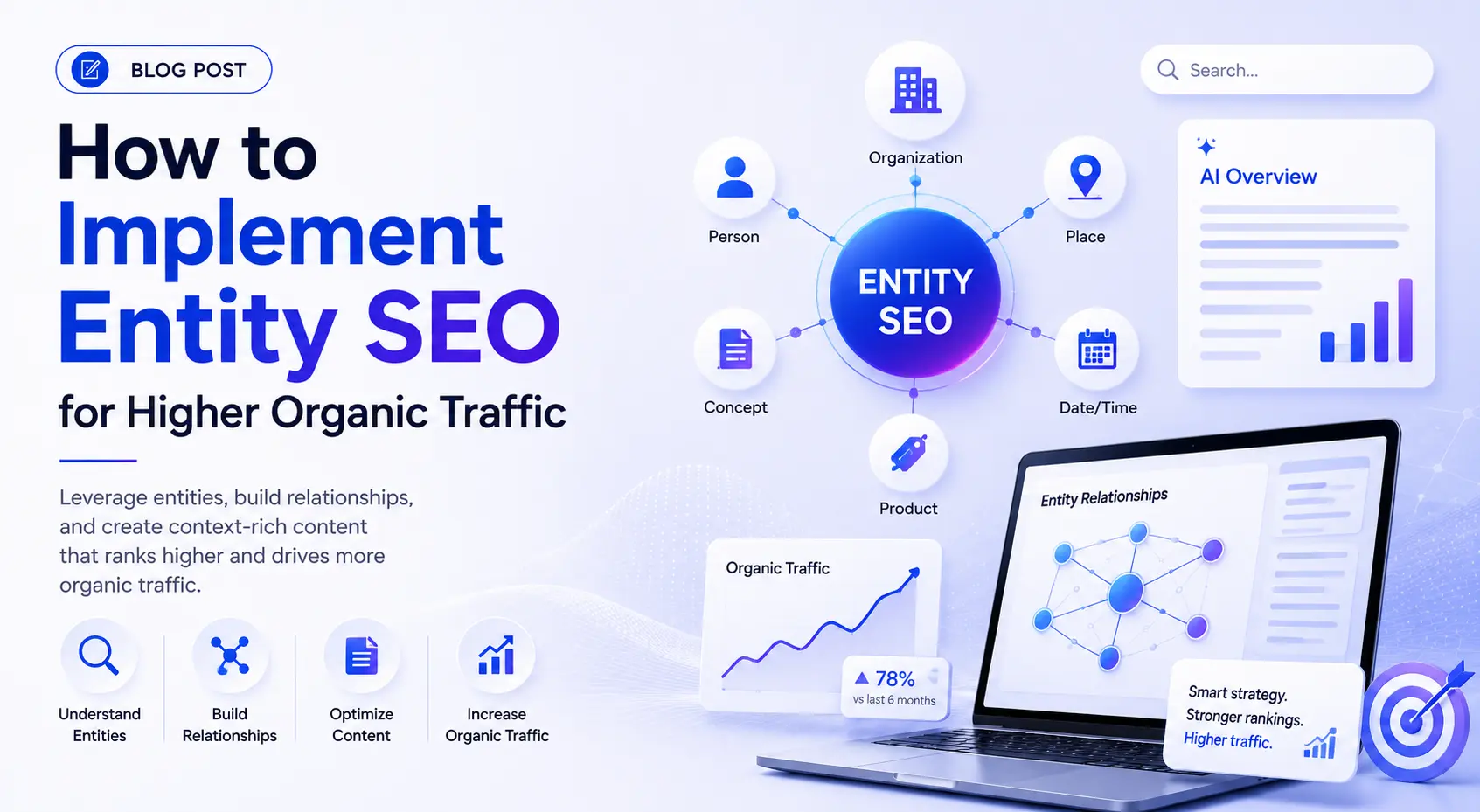
How to Implement Entity SEO for Higher Organic Traffic
If you have been doing SEO the traditional way, focusing only on keywords and backlinks, you are already playing catch-up. Google has quietly shifted how it ranks pages. It no longer just matches keywords. It understands meaning, context, and relationships between real-world “things.” That is where entity SEO comes in.
This guide walks you through exactly how to implement entity SEO, step by step, in a way that actually moves rankings. No fluff. Just practical strategy backed by how modern search actually works.
Table of Contents
1. What Is Entity SEO?
2. Why Entity SEO Matters in 2026
3. Entity SEO vs. Traditional Keyword SEO
4. How Google Processes Entities
5. Step-by-Step: How to Implement Entity SEO
-
- Step 1: Identify Your Core Entities
- Step 2: Build an Entity Map
- Step 3: Optimize Your Entity Home (About Page)
- Step 4: Use Schema Markup for Entity Clarity
- Step 5: Build Topical Authority Through Content Clusters
- Step 6: Strengthen Internal Linking Around Entities
- Step 7: Earn External Entity Mentions and Citations
- Step 8: Validate with Google’s NLP API
6. Entity SEO Tools You Should Use
7. Common Entity SEO Mistakes to Avoid
8. How Long Does Entity SEO Take to Show Results?
9. FAQ
What Is Entity SEO?
Entity SEO is the practice of optimizing your website and content so that search engines clearly understand what real-world “things” (entities) your brand, pages, and topics represent.
Google defines an entity as “a thing or concept that is singular, unique, well-defined, and distinguishable.” This could be a person, place, product, company, or idea.
Think of it this way:
→ “Apple” is an entity. It could be the fruit or the tech company. Context and relationships help Google tell them apart.
→ “HM Digital Solution” is an entity. When Google sees enough consistent information about it across the web, it builds a knowledge representation of your brand.
→ “Entity SEO” itself is a concept entity that Google understands in relation to semantic SEO, Knowledge Graph, schema markup, and topical authority.
The shift from keyword matching to entity understanding is what separates modern SEO from what worked five years ago.
Why Entity SEO Matters in 2026
Search engines have fundamentally changed. Google’s Knowledge Graph now holds billions of entities and facts. AI-powered systems like RankBrain, BERT, and MUM process meaning, not just words. And with AI Overviews now appearing in a growing share of search results, entity recognition is becoming even more critical for visibility.
Here is why you cannot ignore this anymore:
| Reason | Impact |
|---|---|
| Google thinks in entities, not keywords | Keyword-only strategy misses context signals |
| AI Overviews cite entity-established sources | Poor entity signals = lower AI mention chances |
| Knowledge Panels improve brand trust | Recognized entities get panels; others don’t |
| Entity content ranks for more query variations | One optimized entity can drive dozens of related queries |
| Topical authority beats page-by-page optimization | Entity clusters build authority faster than isolated pages |
Businesses that align their content and technical structure around entities consistently outperform those still chasing keyword density. This is not a prediction. It is what is already happening in competitive SERPs.
Entity SEO vs. Traditional Keyword SEO
Understanding the difference helps you see exactly where to focus.
| Aspect | Traditional Keyword SEO | Entity SEO |
|---|---|---|
| Focus | Exact match keywords | Real-world concepts and relationships |
| Goal | Rank for specific phrases | Build recognition for topics and things |
| Content approach | Repeat target keyword | Cover the topic fully, including related entities |
| Link strategy | Anchor text match | Contextual mention within topic clusters |
| Structured data | Optional | Critical for entity communication |
| AI search visibility | Limited | Strong, especially for AI Overviews |
| Long-term benefit | Can degrade with algorithm updates | Compounds over time as entity strengthens |
This does not mean keywords are dead. Entity SEO and keyword strategy work together. The difference is that entity SEO gives keywords their proper context.
How Google Processes Entities
Before you implement anything, it helps to understand what Google is actually doing behind the scenes.
Google processes entities through three main systems:
1. The Knowledge Graph This is Google’s database of entities and their relationships. When Google recognizes your brand, your content topics, or key people associated with your website as entities, it connects them within this graph.
2. Natural Language Processing (NLP) Google uses NLP to extract entities from your content. When you write about “technical SEO,” Google identifies it as a topic entity and connects it to related entities like “crawl budget,” “Core Web Vitals,” and “indexation.” Our blog on technical SEO for website performance covers how these signals affect rankings directly.
3. Structured Data (Schema Markup) Schema markup acts as a direct label for your entities. It tells Google, in machine-readable language, what your page is about, who your organization is, and how different pieces of content relate to each other. We have a detailed breakdown of how schema markup helps SEO if you want to go deeper on implementation.
Step-by-Step: How to Implement Entity SEO
Step 1: Identify Your Core Entities
Start by listing what your brand, content, and business actually represent as entities.
For a digital marketing agency, core entities would include:
→ The brand (HM Digital Solution)
→ Services (SEO, Local SEO, Technical SEO, Content Writing)
→ Topics (topical authority, knowledge graph, semantic search)
→ Industry concepts (Google algorithm, E-E-A-T, SERP features)
→ Locations (Delhi, India, target markets)
How to find entities relevant to your niche:
→ Search your primary topic on Google and look at the Knowledge Panel, People Also Ask, and related searches
→ Use Google’s NLP API demo (more on this in the tools section) to analyze your existing content
→ Look at Wikipedia and Wikidata for your niche topic to find how entities in your space are categorized and connected
→ Check what entities your top competitors are consistently associated with
For entity SEO specifically, key related entities include: semantic SEO, Knowledge Graph optimization, schema markup, topical authority, and structured data. You need to demonstrate understanding of and relationships between all of these, not just the primary topic.
Step 2: Build an Entity Map
An entity map is a visual or documented representation of how your core entities relate to each other. Think of it like a mind map where the center is your brand or main topic and branches represent connected concepts.
A simple entity map for an SEO agency might look like this:
| Core Entity | Related Entities | Why They Connect |
|---|---|---|
| HM Digital Solution | Delhi, India, digital marketing, SEO services | Location and service identifiers |
| SEO Services | technical SEO, on-page SEO, off-page SEO, local SEO | Service category relationships |
| Technical SEO | crawl budget, Core Web Vitals, schema markup, site architecture | Concept subcategories |
| Entity SEO | Knowledge Graph, semantic search, NLP, topical authority | Topic co-occurrence |
| Topical Authority | content clusters, internal linking, subject matter expertise | Related strategy concepts |
This map guides your content planning. Every page you create should clearly demonstrate one or more of these entity relationships. Our guide on entity mapping strategy for service businesses gives you a more detailed framework for building this out.
Step 3: Optimize Your Entity Home
Your About page is your most important entity-building page. SEO expert Jason Barnard (Kalicube) describes this as the “entity home” — the single canonical URL that anchors how algorithms understand your brand.
What your entity home (About page) needs:
→ Clear, consistent brand description that matches how your brand is described across all external platforms
→ Organization schema markup with your brand name, logo, founding date, location, and services
→ Links to your social profiles and external mentions (Wikidata, Crunchbase, LinkedIn)
→ Names and roles of key people associated with the brand (helps establish person entities connected to the organization entity)
Schema example for your About page:
json
{
  "@context": "https://schema.org",
  "@type": "Organization",
  "@id": "https://hmdigitalsolution.com/#organization",
  "name": "HM Digital Solution",
  "url": "https://hmdigitalsolution.com",
  "logo": "https://hmdigitalsolution.com/logo.png",
  "description": "Delhi-based SEO agency specializing in technical SEO, content strategy, and digital marketing services.",
  "address": {
    "@type": "PostalAddress",
    "addressLocality": "Delhi",
    "addressCountry": "IN"
  },
  "sameAs": [
    "https://www.linkedin.com/company/hm-digital-solution",
    "https://twitter.com/hmdigitalsol"
  ]
}
The sameAs property is critical. It explicitly connects your entity to external profiles, helping Google confirm your brand’s identity across the web.
Step 4: Use Schema Markup for Entity Clarity
Schema markup is the most direct way to communicate entity information to Google. It is not optional anymore. It is how you tell search engines what your content represents in machine-readable language.
Key schema types for entity SEO:
| Schema Type | Use Case | Entity Benefit |
|---|---|---|
| Organization | Brand identity, contact, social profiles | Establishes brand entity |
| Person | Author profiles, team pages | Links person entity to organization |
| Article / BlogPosting | Blog content | Tags content topics as entities |
| FAQPage | FAQ sections | Increases rich result eligibility |
| BreadcrumbList | Site navigation | Reinforces site structure and entity hierarchy |
| Service | Service pages | Clearly defines service entities |
| LocalBusiness | Local SEO pages | Ties location entity to brand |
When implementing schema on blog posts, always include the about property to explicitly state the topic entities the post covers:
json
{
  "@type": "BlogPosting",
  "headline": "How to Implement Entity SEO for Higher Organic Traffic",
  "about": [
    {"@type": "Thing", "name": "Entity SEO"},
    {"@type": "Thing", "name": "Knowledge Graph"},
    {"@type": "Thing", "name": "Semantic SEO"}
  ],
  "author": {
    "@type": "Organization",
    "@id": "https://hmdigitalsolution.com/#organization"
  }
}
This directly signals to Google which entities your content is about and who produced it.
Step 5: Build Topical Authority Through Content Clusters
Topical authority is what happens when Google recognizes your site as the go-to source for a particular entity or topic. It is built by creating comprehensive content that covers a primary entity and all its related sub-entities.
Content clusters work like this:
→ A pillar page covers the broad topic (e.g., Semantic SEO)
→ Cluster posts cover specific sub-topics in depth (entity mapping, vector search, NLP for SEO, Knowledge Graph signals)
→ Internal links connect the cluster posts back to the pillar and to each other
This is exactly the approach we have taken on this site. Our semantic content network guide explains how to build these clusters systematically, and our post on how Google uses entities instead of keywords gives you the foundational understanding that makes cluster planning much easier.
Quick content cluster audit:
→ Do you have a pillar page for each of your core entities?
→ Does each cluster post link back to the pillar?
→ Are related cluster posts linked to each other where contextually relevant?
→ Does each page explicitly cover the entity and its close relatives?
Gaps in this structure are gaps in your topical authority.
Step 6: Strengthen Internal Linking Around Entities
Internal linking for entity SEO is different from traditional internal linking. You are not just passing PageRank. You are reinforcing entity relationships.
The principle is simple: when you mention an entity in your content, link to the page that best represents that entity on your site. This is how Wikipedia does it. Every entity mention connects to the page that defines and expands on that entity.
Rules for entity-based internal linking:
1. Link to the most authoritative page you have for that entity (often your pillar page or service page)
2. Use natural anchor text that matches how the entity is commonly described, not forced keyword phrases
3. Do not link every single mention. Link where it adds genuine value to the reader
4. Prioritize linking from high-traffic pages to under-performing but topically related pages
For example, a blog post about information gain in SEO should naturally reference and link to related entity pages like topical authority, content clusters, and semantic search, because Google understands all of these as connected concepts.
A useful tool here is the keyword cannibalization guide on our site. Cannibalization problems are often entity problems in disguise — multiple pages competing for the same entity signal with no clear hierarchy.
Step 7: Earn External Entity Mentions and Citations
Google does not just trust what you say about yourself. It looks at what the broader web says about you.
External validation of your entity comes from:
→ Wikipedia and Wikidata entries related to your brand or key people
→ Industry publications that mention your brand in context with your expertise
→ Business directories (Google Business Profile, Crunchbase, Clutch, LinkedIn) with consistent NAP and description
→ Author bylines on external sites where your team publishes content
→ Press mentions and citations in authoritative content
Each consistent mention of your brand entity with a consistent name, description, and attributes adds to Google’s confidence about who you are and what you represent.
This is where PR and SEO genuinely intersect in entity building. A mention in Search Engine Journal or a recognized industry blog does more for your entity strength than ten average backlinks.
Step 8: Validate with Google’s NLP API
Before publishing important content, run it through Google’s Natural Language API demo (available at cloud.google.com/natural-language) to see which entities Google extracts from your text.
What to check:
→ Is your primary entity identified as the most prominent/salient entity?
→ Are related entities (that you intend to signal) being recognized?
→ Are there unintended entities being extracted that dilute your topical focus?
Entity salience is the score Google assigns to how prominent an entity is within a piece of content. A salience score close to 1.0 means Google sees that entity as the central subject. If your target entity is buried among unrelated entities, your topical signal is weak.
This validation step is something most SEOs skip and most competitors have not figured out yet.
Entity SEO Tools You Should Use
| Tool | Purpose | Cost |
|---|---|---|
| Google Natural Language API | Entity extraction and salience scoring | Free demo available |
| Google Search Console | Monitor entity-related query performance | Free |
| Semrush / Ahrefs | Topic research, competitor entity analysis | Paid |
| Schema Markup Validator (Google) | Validate structured data | Free |
| Wikidata | Check and contribute to entity databases | Free |
| InLinks | Entity-focused content optimization | Paid |
| WordLift | Automated entity tagging and internal Knowledge Graph | Paid |
| Google’s Rich Results Test | Verify schema is parsed correctly | Free |
You do not need to use all of these. Start with the free tools: Google NLP API for content validation, Search Console for performance monitoring, and Google’s schema validator for structured data checks. Layer paid tools in as your strategy scales.
Common Entity SEO Mistakes to Avoid
1. Inconsistent brand descriptions across platforms If your About page says one thing, your LinkedIn says another, and your Google Business Profile says something else, you are sending conflicting entity signals. Consistency is foundational.
2. Ignoring schema markup entirely Many sites still have zero structured data. Schema is how you directly communicate entity information to Google. Missing it means Google has to guess.
3. Creating content clusters without a pillar Cluster posts without a strong, comprehensive pillar page have no hub to point authority toward. Build the pillar first.
4. Over-optimizing anchor text Forcing exact-match anchor text on every internal link looks unnatural and does not help entity signals. Use natural, descriptive language.
5. Publishing thin content on entity-related pages If your service page or topic pillar is 400 words, you are not demonstrating depth. Entity-strong pages cover the topic comprehensively. Thin pages send weak signals.
6. Forgetting person entities If you or your team creates content, you are a person entity connected to your brand entity. Author pages with proper Person schema, external author profiles, and consistent bylines all strengthen this connection.
7. Not linking to Wikipedia or authoritative external sources Linking out to Wikipedia or Wikidata pages for entities you mention in your content helps Google understand the context you are operating in. This is standard practice in entity-first content.
How Long Does Entity SEO Take to Show Results?
Entity SEO is not a quick win strategy. It is a compounding investment.
| Timeframe | What You Can Expect |
|---|---|
| 0 to 2 months | Schema markup in place, NLP validation done, entity map documented |
| 2 to 4 months | Improved indexation, minor SERP feature appearances (FAQs, breadcrumbs) |
| 4 to 6 months | Topic cluster content strengthening entity signals, early ranking movement for related queries |
| 6 to 12 months | Meaningful organic traffic growth, wider query coverage, potential Knowledge Panel appearance |
| 12 months+ | Compounding authority, AI Overview mentions, strong topical dominance in your niche |
The reason it compounds is because every new piece of content you publish reinforces existing entity relationships. A site with strong entity foundations keeps growing in relevance over time without the constant need to chase algorithm updates.
FAQ
Q.1 What is an entity in SEO?
An entity is any uniquely identifiable thing, a person, place, brand, product, or concept that a search engine can recognize and connect to other related things in its Knowledge Graph. Google moved from keyword matching to entity understanding as part of building more intelligent, context-aware search results.
Q.2 How is entity SEO different from traditional SEO?
Traditional SEO focuses on ranking for specific keyword phrases through on-page optimization and link building. Entity SEO focuses on establishing your brand, content, and expertise as clearly recognizable entities that Google can categorize, understand, and connect to related topics. Both work together, but entity SEO produces more durable, compounding results.
Q.3 Do I need technical skills to implement entity SEO?
Basic implementation, like optimizing your About page, adding schema markup, and building content clusters, does not require advanced technical skills. Tools like Yoast, RankMath, and Google’s schema documentation make schema implementation accessible. Advanced steps like NLP API validation and Wikidata management have a learning curve but are not impossible for non-developers.
Q.4 How does schema markup help with entity SEO?
Schema markup is machine-readable code that tells Google exactly what entities your page represents, who created the content, what organization it belongs to, and what related topics it covers. Without schema, Google has to infer this from context alone. Schema gives direct, unambiguous entity signals.
Q.5 Can entity SEO help with AI Overviews and AI search?
Yes. AI systems like Google’s AI Overviews and tools like ChatGPT and Gemini rely heavily on Knowledge Graph data and entity relationships to construct answers. Sites with strong entity signals are more likely to be cited in AI-generated answers. This makes entity SEO increasingly important as AI search grows.
Q.6 What is topical authority and how does it connect to entity SEO?
Topical authority is Google’s assessment of how comprehensively and consistently you cover a particular subject. It is built by creating content clusters around core entities and related sub-entities. When Google sees that your site deeply covers a topic from multiple angles with clear entity relationships, it assigns you authority for that topic. Our post on topical authority vs. domain authority breaks down exactly how this plays out in rankings.
Q.7 What tools are best for entity SEO beginners?
Start with Google Natural Language API (free demo) to analyze entity extraction from your content, Google Search Console to monitor how your content performs across related queries, and Google’s Rich Results Test to validate your schema markup. These three free tools give you more insight than most paid options when you are starting out.
Q.8 Is entity SEO only for large websites?
Not at all. In fact, smaller, focused websites often build entity strength faster than large sites because they can create tight, coherent topic clusters without the noise of thousands of pages pulling in different directions. A small agency that deeply covers SEO as a topic entity can outrank larger generalist sites for specific queries.
Final Thoughts
Entity SEO is not a separate tactic you layer on top of your existing strategy. It is a shift in how you think about content, structure, and brand presence online.
When Google clearly understands what your website represents as an entity, what topics you have authority over, and how you relate to the broader knowledge landscape of your industry, rankings follow naturally. The traffic growth is a byproduct of Google’s trust in your entity.
Start with your entity home, build your schema foundation, map your content clusters, and validate your NLP signals. These are not complicated steps. They just require consistency and patience.
If you want help putting an entity SEO strategy in place for your business, our team at HM Digital Solution works with companies across industries to build lasting organic visibility. Contact us or connect on WhatsApp to talk through your site’s entity gaps.
Tanishka Vats
Lead Content Writer | HM Digital Solutions Results-driven content writer with over five years of experience and a background in Economics (Hons), with expertise in using data-driven storytelling and strategic brand positioning. I have experience managing live projects across Finance, B2B SaaS, Technology, and Healthcare, with content ranging from SEO-driven blogs and website copy to case studies, whitepapers, and corporate communications. Proficient in using SEO tools like Ahrefs and SEMrush, and content management systems like WordPress and Webflow. Experienced content writer with a proven track record of creating audience-centric content that drives significant results on website traffic, engagement rates, and lead conversions. Highly adaptable and effective communicator with the ability to work under deadlines.