
What Is AI Search Optimization?
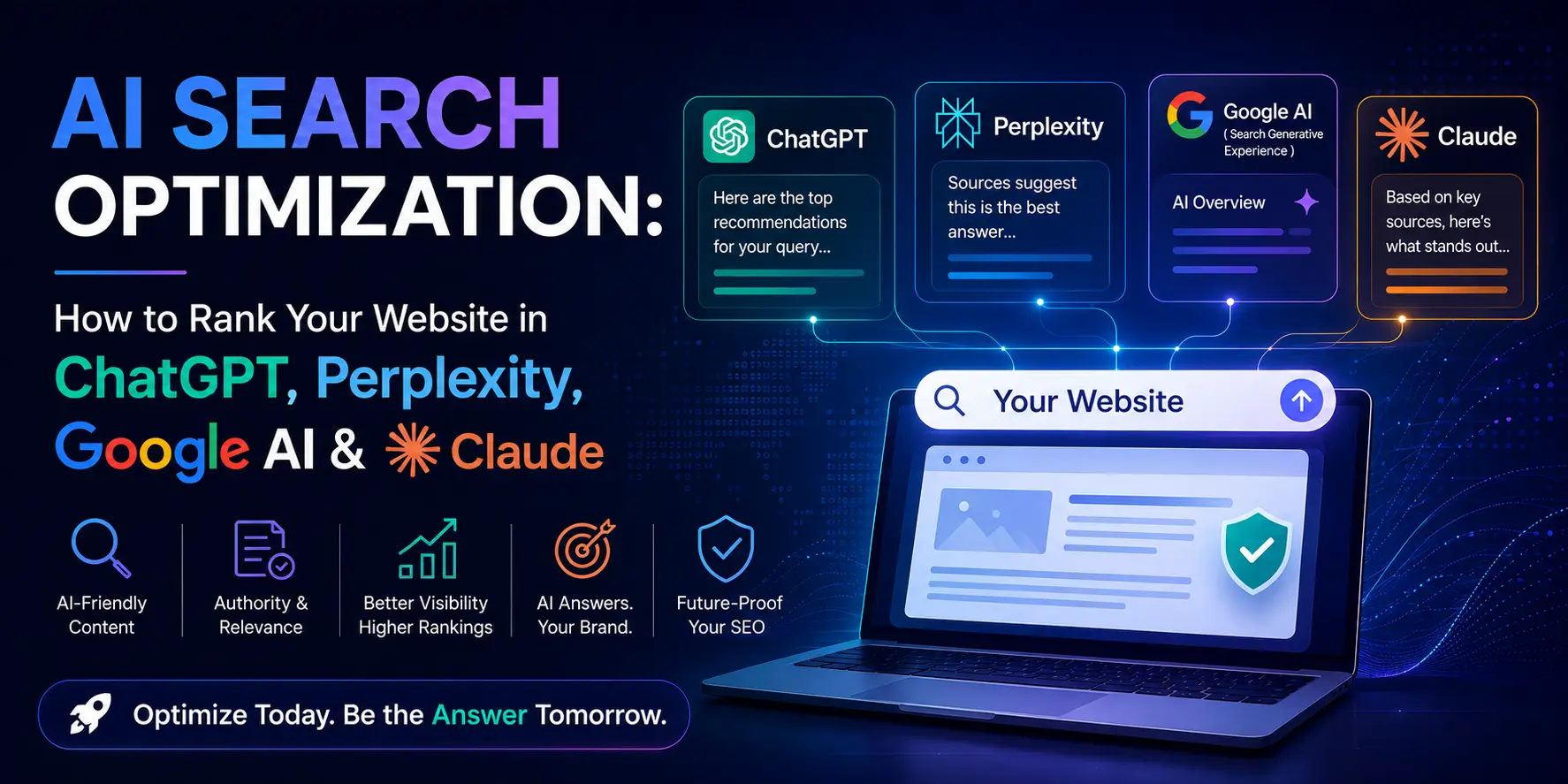
AI search optimization is the practice of making your website visible, credible, and citable across AI-powered platforms like ChatGPT, Google AI Overviews, Perplexity AI, Microsoft Copilot, Gemini, and Claude (by Anthropic).
Unlike traditional SEO, where you compete for a blue link on page one, AI search optimization focuses on getting your brand or content included inside the AI-generated answer itself.
Think about it this way. When someone asks ChatGPT “which is the best digital marketing agency in Delhi?” or “what SEO company should I hire for my edtech business?”, the AI gives a direct answer. It does not show ten links. It names a few trusted sources and cites them. AI search optimization is about making sure your brand gets cited in that answer.
This is also called:
- GEO (Generative Engine Optimization) — optimizing for AI-generated responses across ChatGPT, Claude, Perplexity, and Gemini
- AEO (Answer Engine Optimization) — getting featured in direct answer boxes and AI answers
- LLMO (Large Language Model Optimization) — the technical layer that helps LLMs understand and trust your site
All three work together. You cannot pick just one.
Why Traditional SEO Is Not Enough Anymore
Here is a number that should change how you think about search: as of March 2026, 65% of Google search result pages include AI Overviews. Up from just 25% in August 2024.
That means in most searches today, Google is already answering the question before the user clicks on anything.
Meanwhile, ChatGPT now handles over 5.7 billion monthly visits. Perplexity is growing fast. Google AI Mode is replacing the classic blue-link experience.
And here is the uncomfortable truth that most SEO articles skip: Ahrefs found that fewer than 9% of ChatGPT and Gemini citations come from URLs ranked in Google’s top 10. That means even if you rank #1 on Google, you may still be invisible in AI search.
The rules have changed. You need both traditional SEO and AI search optimization working together.
SEO vs AEO vs GEO vs LLMO: Key Differences
Understanding these four terms helps you build a strategy that covers all bases.
| Term | Full Form | Goal | Platform |
|---|---|---|---|
| SEO | Search Engine Optimization | Rank in blue links | Google, Bing |
| AEO | Answer Engine Optimization | Get featured in direct answers | Google Featured Snippets, Voice Search |
| GEO | Generative Engine Optimization | Get cited in AI-generated responses | ChatGPT, Perplexity, Gemini, Claude |
| LLMO | Large Language Model Optimization | Make your site readable and trustworthy to LLMs | All AI platforms |
These are not competing strategies. They are layers. A strong SEO foundation helps your GEO. Good AEO content improves your LLMO. Think of them as a pyramid. SEO is the base, GEO is the top.
One important point: traditional SEO still plays a major role. Studies show a 92% correlation between pages ranking in Google’s top 10 organically and pages cited in AI Overviews. You cannot skip SEO and jump straight to GEO.
How AI Search Engines Actually Decide Who to Cite
This is where most blogs get vague. Let us be specific.
AI platforms like ChatGPT use a combination of two things:
1. Parametric Memory — information baked into the model during training. This is based on what the AI has “read” from the internet before its training cutoff. Older, more cited, and more authoritative content has a higher chance of making it into this memory.
2. Real-Time Retrieval (RAG) — ChatGPT Search, Perplexity, and Google AI Overviews pull live results from search indexes (Bing for ChatGPT, Google for Gemini) and combine them with their own knowledge to generate an answer.
What this means for you: you need to be visible in both layers. Your brand should have a strong offline presence in crawled data (for parametric memory) AND your pages should be indexable, structured, and trustworthy enough to be retrieved in real-time.
ChatGPT evaluates content across four main signals:
→ Brand entity strength (does the AI know who you are?)
→ Topical authority (do you consistently cover this subject?)
→ Third-party citation co-occurrence (do other sites mention you alongside authoritative sources?)
→ Technical crawlability (can AI bots actually access and parse your pages?)
6 Core Ranking Factors for AI Search Optimization
Based on research across multiple AI platforms, here are the six factors that most consistently improve your chances of being cited:
1. Brand Mentions Across the Web
The more authoritative sites mention your brand, the more likely AI models are to recognize and surface it. This is not just about backlinks. Even unlinked mentions on news sites, industry blogs, Reddit, and Quora build brand entity strength.
Focus on digital PR, guest posting, podcast appearances, and getting reviewed or cited by industry publications.
2. Reviews and Reputation Signals
AI models pick up on review patterns. A brand with hundreds of consistent 4-5 star reviews on Google, Trustpilot, Justdial, or IndiaMart sends strong trust signals. Volume matters, and so does recency.
3. Content Relevance and Keyword Alignment
There is a strong correlation between the keywords in a query and the content AI recommends. Your pages need to clearly and directly address the topic being asked about. Think topical clusters, not just single pages.
4. Domain and Brand Age
Older, established brands are recommended more frequently. This does not mean new brands cannot rank, but it means consistent effort over time compounds significantly.
5. Third-Party Recommendations (Listicles, Roundups)
This one surprises people: a lot of ChatGPT recommendations come from “best of” articles and comparison listicles. If affiliate or editorial sites include your brand in “top 10 SEO agencies in Delhi” or “best digital marketing companies in India” articles, it signals to AI that you are worth recommending.
Getting listed on curated directories and earning inclusion in editorial roundups should be a specific part of your AI search strategy.
6. Domain Authority and Social Proof
The overall authority of your domain — inbound links from credible sites, active social media presence, Wikipedia mentions, and Wikidata entity listings — all contribute to how seriously AI models take your brand.
Step-by-Step AI Search Optimization Strategy
Step 1: Create an Entity Profile for Your Brand
AI models think in entities, not just keywords. An entity is a recognized, defined thing — a person, company, concept, or place.
To become an entity:
→ Create a Wikipedia page if eligible (or at least a Wikidata entry)
→ Add your brand to Google’s Knowledge Panel via Google Business Profile
→ Use consistent NAP (Name, Address, Phone) across all online platforms
→ Add Organization schema markup to your website with complete details
→ Get mentioned consistently across multiple authoritative sources
Step 2: Build Topical Authority with Content Clusters
AI models favor websites that comprehensively cover a topic, not just those that have one good article.
Build content clusters around your core topics. For example, if your primary topic is “SEO services in Delhi,” you should also have content on:
→ Local SEO for businesses in Delhi
→ Technical SEO guide for Indian businesses
→ On-page SEO checklist
→ How to choose an SEO agency
Each piece should link to the others. This signals topical depth and authority. For detailed guidance on building this structure, refer to our guide on site architecture for topical authority.
Step 3: Write AI-Ready Content
AI prefers content that:
→ Answers the question directly in the first 200 words (do not make the reader scroll to the answer)
→ Uses clear headings structured as questions
→ Includes data, statistics, and cited sources
→ Has concise, standalone paragraphs that can be extracted as citations
→ Uses FAQ format for common queries
Avoid long, meandering intros. Get to the point fast. Our internal guide on content optimization for Google AI Overviews covers the content structure in more depth.
Step 4: Add Structured Data (Schema Markup)
Schema markup is one of the most direct ways to help AI systems parse your content correctly.
The most important schema types for AI visibility:
| Schema Type | Why It Matters |
|---|---|
| Organization | Tells AI who you are, what you do, where you are |
| Article / BlogPosting | Signals content type and author authority |
| FAQ | AI extracts these directly for answer responses |
| HowTo | Used in step-by-step AI answers |
| Review / AggregateRating | Adds trust and reputation signals |
| BreadcrumbList | Helps AI understand site structure |
Research from Princeton and IIT Delhi shows that structured content with schema markup increases AI citation probability by over 50%.
Step 5: Build Citations Through PR and Outreach
Get your brand mentioned on:
→ Industry news sites and blogs
→ “Best of” and comparison articles
→ Local directory listings (especially for service businesses)
→ Q&A platforms like Quora and Reddit
→ YouTube and podcast mentions
The goal is consistent co-citation: your brand name appearing alongside terms like “SEO agency,” “digital marketing Delhi,” or whatever your core service is.
Step 6: Keep Content Fresh
Content updated within 30 days receives significantly more AI citations than stale material. Make a schedule to refresh your high-priority pages at least monthly — update statistics, add new examples, and update the dateModified field in your schema.
Technical Setup: Let AI Crawlers Access Your Site
This is a step most businesses completely skip. If your robots.txt is blocking AI crawlers, none of the above matters.
There are three types of AI bots:
→ Training crawlers — GPTBot, ClaudeBot, Google-Extended (used for model training)
→ Search/retrieval crawlers — OAI-SearchBot, PerplexityBot, Claude-SearchBot, BingBot (used for real-time citations)
→ User-triggered fetchers — ChatGPT-User, Claude-User, Perplexity-User (activated when a user asks a question live)
For AI citation visibility, you specifically need to allow the search/retrieval crawlers. Here is a recommended robots.txt configuration:
User-agent: OAI-SearchBot
Allow: /

User-agent: ChatGPT-User
Allow: /

User-agent: PerplexityBot
Allow: /

User-agent: ClaudeBot
Allow: /

User-agent: Bingbot
Allow: /
Also consider adding an llms.txt file to your root directory, similar to robots.txt but written specifically to guide AI systems on how to read your site. This is an emerging standard gaining adoption in 2026.
For a full technical breakdown of crawl management and indexation, our advanced indexation control guide is a good reference.
Finally, submit your sitemap to Bing Webmaster Tools. Since ChatGPT Search relies on Bing’s index for real-time retrieval, Bing indexation directly affects your ChatGPT citation chances — not just Google.
E-E-A-T and AI Search: Why Trust Signals Matter More Now
Google’s E-E-A-T framework (Experience, Expertise, Authoritativeness, Trustworthiness) was designed for human quality raters. But in 2026, it has become a core signal for AI citation decisions too.
AI models are trained to avoid recommending sources that could mislead users. Brands that demonstrate deep, verified expertise are cited more frequently.
How to strengthen your E-E-A-T for AI:
Experience — Include real case studies, client results, behind-the-scenes content, and documented processes. Show the work, not just the theory.
Expertise — Author bios should mention specific credentials, years of experience, and past work. Link to the author’s other published work and social profiles.
Authoritativeness — Get cited by other experts. Earn mentions in industry publications. Be active on LinkedIn, YouTube, and other platforms where your expertise is visible.
Trustworthiness — Maintain consistent business information across all directories. Display real testimonials. Show Google Business Profile reviews. Have a clear About page, privacy policy, and contact information.
For a deep dive into how Google evaluates these signals, our Google Quality Rater Guidelines breakdown is worth reading.
Real Case Study: How We Grew EME Academy’s AI Visibility from 0 to 24
One of our clients, EME Academy, Eastern India’s No. 1 Training Institute based in Kolkata, came to us with zero AI visibility. EME Academy offers job-oriented professional courses in Data Analytics, SAP, Digital Marketing, HR Management, and Web Development, and has mentored over 2 lakh aspirants. Despite being a well-established institute with a strong offline reputation, they had no presence in ChatGPT, no citations in Google AI Overviews, and their AI Mode mentions were negligible.
Here is where they started and where they are now (verified June 2026, SEMrush AI Search data):
| Metric | Before | After (3 months) |
|---|---|---|
| AI Visibility Score | 0 | 24 |
| Total AI Mentions | 0 | 41 |
| Cited Pages | 0 | 24 |
| ChatGPT Mentions | 0 | 14 |
| Google AI Overview Citations | 0 | 9 |
| Google AI Mode Mentions | 0 | 12 |
| Gemini Mentions | 0 | 6 |
| Organic Traffic | Baseline | +1.5K (tracked via SEMrush) |
| Organic Keywords | Baseline | 410 |
What we did:
The first step was a complete AI crawl audit. Their robots.txt was partially blocking OAI-SearchBot. We fixed that immediately.
Then we rebuilt their content architecture around topical clusters, one main page for each course category, supported by blog content that answered the specific questions prospective students were asking ChatGPT and Perplexity (“best data analytics course in Kolkata,” “which institute to join for digital marketing certification,” etc.).
We added Organization, Course, and FAQ schema across all key pages. We got them listed in multiple education directories and earned coverage in a few regional education news sites.
Within 3 months, their AI visibility went from 0 to 24, with 41 brand mentions across four major AI platforms. Their ChatGPT mentions alone (14 citations, 17 cited pages) were generating inbound inquiries from prospective students who said they found the institute through ChatGPT.
This is a real-world proof of what consistent AI search optimization can do for a service business in a competitive niche.
Tools to Track Your AI Search Visibility
You cannot optimize what you cannot measure. Here are the tools that help you track how your brand performs in AI search:
| Tool | What It Tracks |
|---|---|
| SEMrush AI Search | AI Visibility score, mentions across ChatGPT, Gemini, Perplexity, AI Mode |
| Ahrefs | Organic rankings, backlink profile, AI Overview tracking |
| Writesonic AI Visibility Report | AI citation tracking and competitive analysis |
| Google Search Console | Click data, impressions, AI Overview appearances |
| Bing Webmaster Tools | Bing index coverage (critical for ChatGPT Search) |
| Wellows / Profound | Dedicated AI citation monitoring platforms |
The most practical starting point for most businesses is SEMrush’s AI Search dashboard (as shown in our case study above) combined with manual prompt testing, regularly searching your target queries in ChatGPT, Perplexity, and Google AI Mode to see if your brand appears.
Common Mistakes to Avoid
Blocking AI crawlers in robots.txt — This is the most common technical mistake. Always check that OAI-SearchBot, PerplexityBot, and BingBot are allowed.
Writing for Google only — Optimizing purely for keyword rankings without considering how AI extracts and cites content will leave you invisible in AI answers.
No schema markup — Without structured data, AI systems have to guess what your content is about. With schema, you tell them directly.
Ignoring Bing indexation — ChatGPT Search pulls from Bing’s index. Most Indian businesses have only ever submitted sitemaps to Google. Submit to Bing Webmaster Tools today.
Publishing and forgetting — AI citation algorithms favor fresh content. Pages that are not updated lose ground quickly. Build a content refresh calendar.
No brand entity presence — If there is no Knowledge Panel, no Wikidata entry, no consistent NAP across the web, AI models simply cannot identify and verify your brand with confidence.
For a broader list of common SEO mistakes that also hurt AI visibility, our common SEO mistakes guide covers many of these patterns in detail.
FAQ
Q.1 What is AI search optimization?
AI search optimization (also called GEO, AEO, or LLMO) is the process of making your website visible and citable in AI-powered search platforms like ChatGPT, Google AI Overviews, Perplexity, Gemini, and Claude. It goes beyond traditional SEO by focusing on being included inside AI-generated answers.
Q.2 How is AI search optimization different from SEO?
Traditional SEO targets rankings in blue-link search results. AI search optimization targets inclusion in AI-generated answers, where the AI directly cites your content rather than showing a list of links. Both are necessary; they complement each other.
Q.3 How long does it take to rank in ChatGPT?
Technical fixes (like unblocking AI crawlers) can show results in days. Content optimization typically shows measurable citation improvements within 4 to 8 weeks. Authority signals built through PR and third-party mentions take 3 to 6 months to compound meaningfully. A coordinated effort usually delivers measurable improvement within 8 to 12 weeks.
Q.4 Does Google SEO help with ChatGPT ranking?
Partly. Strong Google rankings signal content quality and authority, which AI models recognize. However, ChatGPT Search specifically relies on Bing’s index for real-time retrieval, not Google’s. So Bing optimization is more directly relevant to ChatGPT citations.
Q.5 What schema markup should I add for AI visibility?
Start with Organization, Article or BlogPosting, FAQ, and BreadcrumbList. If you offer services, add LocalBusiness or Service schema. If you have courses or events, add those specific schema types. FAQPage schema is especially effective because AI systems extract FAQ answers directly into their responses.
Q.6 Can small businesses rank in ChatGPT?
Yes. Our case study shows that even a local edtech institute in Kolkata with zero AI visibility achieved strong results in 3 months with focused optimization. AI models do not exclusively favor large brands — they favor well-structured, authoritative, and consistently cited content.
Q.7 What is the llms.txt file?
llms.txt is an emerging standard file (placed in your website’s root directory, like robots.txt) that gives AI systems specific instructions about how to read and interpret your site. It is not yet universally required but is gaining adoption as a best practice for AI-first optimization in 2026.
Q.8 How do I check if I am being cited in ChatGPT?
The simplest way is manual testing, search your key queries in ChatGPT, Perplexity, and Google AI Mode and see if your brand appears. For systematic tracking, tools like SEMrush’s AI Search dashboard, Writesonic’s AI Visibility report, and Wellows offer automated monitoring.
Conclusion
AI search optimization is not a future trend. It is already the present reality. With over 65% of Google searches showing AI Overviews, and ChatGPT handling billions of queries every month, your brand’s visibility inside AI-generated answers is becoming as important as your Google ranking.
The good news: the fundamentals are not that different from what good SEO has always been about. Build genuine authority. Create content that directly answers real questions. Earn trust through reviews, PR, and third-party mentions. Keep your content fresh and technically clean.
The difference is in the details: structured data for AI extraction, entity optimization for brand recognition, robots.txt configuration for AI crawler access, and Bing indexation for ChatGPT visibility.
At HM Digital Solution, we have helped clients go from zero AI visibility to consistent citations across ChatGPT, Claude, Google AI Overviews, and Perplexity in as little as 3 months. If you want to build a strategy that works for both Google and AI search, explore our SEO services.
The brands getting cited in AI answers today are building a compounding advantage. Start now.
Tanishka Vats
Lead Content Writer | HM Digital Solutions Results-driven content writer with over five years of experience and a background in Economics (Hons), with expertise in using data-driven storytelling and strategic brand positioning. I have experience managing live projects across Finance, B2B SaaS, Technology, and Healthcare, with content ranging from SEO-driven blogs and website copy to case studies, whitepapers, and corporate communications. Proficient in using SEO tools like Ahrefs and SEMrush, and content management systems like WordPress and Webflow. Experienced content writer with a proven track record of creating audience-centric content that drives significant results on website traffic, engagement rates, and lead conversions. Highly adaptable and effective communicator with the ability to work under deadlines.