
SEO Myths: 15 Lies Agencies Tell Clients (And the Truth)
You have probably heard some version of this on a sales call: “We will get you to number one in 30 days.” It sounds great. It is also one of the most common SEO myths in the market.
Some agencies repeat these myths on purpose to close a deal. Many repeat them because they were taught the same wrong ideas. Either way, the business owner pays the price.
This guide lists 15 SEO myths that clients hear most often, explains the truth in simple words, and gives you questions to ask before you hire anyone.
Quick answer: The biggest SEO myths are guaranteed rankings, results in 30 days, keyword density rules, Domain Authority as a goal, more backlinks always being better, and SEO being a one-time job. Google says no one can guarantee a number one ranking, and real results usually take months, not days.
Why SEO Myths Spread So Easily
SEO is hard to see. You cannot open the hood and check what the agency did. So clients depend on trust, and that gap is where myths grow.
There are three common reasons:
• Sales pressure. A big promise closes a deal faster than an honest timeline.
• Old advice. Google changes often. Tips that worked in 2012 still float around on old blogs and videos.
• Tool scores. Many tools show colourful scores. People start treating those scores as if Google uses them.
If you are still deciding between a freelancer, an in-house person or an agency, read our guides on freelance SEO vs agency and in-house SEO vs hiring an SEO agency first.
The 15 SEO Myths at a Glance
| # | The myth | The truth in one line |
| 1 | “We guarantee a number one ranking” | No one can promise this, and Google says so |
| 2 | “You will see results in 30 days” | Early movement is possible, real growth takes months |
| 3 | “Use your keyword 2 to 3% of the time” | Keyword density is not a ranking rule |
| 4 | “We will raise your Domain Authority” | DA is a third party score, not a Google signal |
| 5 | “More backlinks means better rankings” | Link quality and relevance matter more than count |
| 6 | “SEO is a one-time setup” | SEO is ongoing work |
| 7 | “Longer content always ranks higher” | Word count is not a ranking factor |
| 8 | “Meta tags and meta keywords fix rankings” | Meta keywords are ignored, meta descriptions help clicks |
| 9 | “Running Google Ads will boost your SEO” | Ads and organic rankings are separate |
| 10 | “Social media likes improve rankings” | Social helps discovery, not direct ranking |
| 11 | “More traffic means SEO is working” | Leads and sales are the real test |
| 12 | “AI can write 100 pages for you cheaply” | Mass AI content without value can hurt you |
| 13 | “Local SEO is not needed for your business” | For local businesses it is often the fastest win |
| 14 | “SEO is too technical to explain” | A good agency can explain every task in plain words |
| 15 | “SEO is dead, you need expensive AI SEO now” | AI search still depends on strong SEO basics |
The 15 SEO Myths Explained
Myth 1: “We Guarantee a Number One Ranking”
This is the oldest SEO myth and the most dangerous one.
Google’s own guidance on hiring an SEO is clear: no one can guarantee a top ranking on Google. Nobody outside Google controls the results page, so be careful with anyone who promises a #1 spot.
So how do some agencies still give guarantees? Usually in one of two ways:
• They pick keywords that are very easy but get almost no searches. You rank first for a phrase nobody types.
• They use risky tricks that give a short boost and then a penalty.
The truth: An honest agency promises effort, process and reporting. It does not promise a position.
Myth 2: “You Will See Results in 30 Days”
Small movement can happen early, especially for local searches. But strong, steady growth takes time.
Google needs to crawl your pages, understand them and test how users react. A new site also has no history or trust yet. For a realistic view, read our guide on how to rank a new website fast.
A fair rule of thumb: a local business with a good Google Business Profile and a few strong pages may see movement in 2 to 4 months. A new site in a competitive market can need 6 to 12 months.
The truth: Be careful with anyone who gives you a fixed date. Ask for milestones instead, such as pages published, issues fixed and impressions growing.
Myth 3: “Use Your Keyword 2 to 3% of the Time”
Keyword density is a rule from the old days of SEO. It says that if you repeat your keyword a fixed number of times, you will rank better.
Google does not work like that. It looks at meaning, not at a count. Repeating a phrase again and again makes the page harder to read, and it can look like spam. Google’s spam policies clearly list keyword stuffing as a violation.
What to do instead:
• Use your main keyword in the title, the first paragraph and one or two headings.
• Add related words and questions naturally.
• Read the page aloud. If it sounds odd, fix it.
Our post on the power of long tail keywords shows how to choose phrases real customers type.
Myth 4: “We Will Raise Your Domain Authority”
Domain Authority, or DA, is a score made by Moz. Other tools have their own versions, like Domain Rating or Authority Score. They are useful to compare sites, but Google does not use them to rank you.
Some agencies sell “DA 40+” packages. You pay, the score goes up, and your leads stay the same.
The truth: A tool score is a guide, not a goal. Ask for improvements in real things: rankings for money keywords, calls, forms and enquiries. If you want the deeper view, read topical authority vs domain authority.
Myth 5: “More Backlinks Means Better Rankings”
Links still matter. But 500 weak links do not beat 5 good ones.
Cheap link packages often use spam directories, link farms and blog networks. Google’s spam policies include link schemes. Bad links can waste your money and may cause trouble later.
A good backlink is:
• From a real website with real visitors
• Relevant to your industry or city
• Earned because your content, tool or business is useful
The truth: Ask the agency to show sample links before you sign. If they cannot, that is your answer.
Myth 6: “SEO Is a One-Time Setup”
Some agencies sell SEO like a website build. They do an audit, change some titles and call it done.
But your competitors keep publishing. Google keeps updating. Customers keep changing the way they search. If you stop, you slowly slide back.
The truth: The first 90 days build the base. After that, you keep improving pages, adding content, collecting reviews and fixing new issues. Our SEO audit checklist shows what to review again and again.
Myth 7: “Longer Content Always Ranks Higher”
You may have read that you need 2,000 or 3,000 words on every page. That is not a Google rule.
Some topics need long guides. Some topics need a short, clear answer. A phone number page does not need 2,000 words.
Google says it wants helpful, people first content. Length is not the test. Usefulness is.
What to do instead: Look at the top results for your keyword and ask, “What can I add that they did not?” This idea is called information gain, and we explain it in our guide to information gain in SEO.
Myth 8: “Meta Tags and Meta Keywords Fix Your Rankings”
Two different things get mixed up here.
• Meta keywords tag: Google stopped using it for ranking back in 2009. Adding 30 keywords there does nothing.
• Title tag and meta description: The title tag is a strong signal and helps people decide to click. The meta description is not a direct ranking factor, but a good one can raise your click rate.
The truth: Meta tags are small but useful. They are not magic. Write them for humans first.
Myth 9: “Running Google Ads Will Boost Your SEO”
Many business owners believe that spending on ads will push their organic rank up. It does not.
Ads and organic results are separate systems. Ads can bring quick traffic while SEO builds, and the data from ads can show which keywords convert. But paying for ads does not give you an organic ranking boost.
The truth: Treat them as two channels that can support each other, not as one. Do not pay an agency for “SEO benefits” from your ad spend.
Myth 10: “Social Media Likes Improve Your Rankings”
Social media is great for brand awareness, trust and traffic. But likes and shares are not a direct ranking factor.
Where social helps SEO is indirectly: more people see your content, some of them link to it, and more people search your brand name. That is a real benefit, but it is not a direct signal.
The truth: Do social media because it grows your business, not because you think it is a shortcut to page one.
Myth 11: “More Traffic Means SEO Is Working”
A traffic graph that goes up looks good in a report. But what if the visitors never call you?
Traffic from the wrong keywords can be useless. A dentist in Janakpuri does not gain much from visitors searching “dentist salary in USA.”
The truth: Judge SEO by business results: calls, WhatsApp clicks, form fills, Google Maps direction requests and sales. Read our guide on SEO KPIs that matter beyond traffic and rankings to set the right goals.
Myth 12: “AI Can Write 100 Pages for You Cheaply”
AI tools can help with research, outlines and first drafts. The problem starts when an agency publishes hundreds of generic pages with no review.
Google does not ban AI content. But its spam policies target content made at scale mainly to rank, with little value for people. Pages that say the same thing as everyone else give Google no reason to pick you.
The truth: Use AI as an assistant, not as the author. Add real photos, real prices, real examples and expert review. We cover this in AI content detection vs human experience signals.
Myth 13: “Local SEO Is Not Needed for Your Business”
Some agencies skip local SEO because it looks small. But if your customers search with “near me” or a city name, local SEO is often the quickest way to get calls.
A clean Google Business Profile, matching business details, real photos and honest reviews can bring results sooner than a long blog plan.
The truth: If you serve one city or area, start local. Our guides on local SEO for small businesses and reviews for local SEO show how.
Myth 14: “SEO Is Too Technical to Explain”
This one is a favourite of agencies that do not want to be questioned.
Some SEO work is technical, yes. But every task can be explained in one or two simple lines: what we are fixing, why it matters, and how we will know it worked.
The truth: If your agency uses heavy jargon and gives you a report with no meaning, ask them to explain it in plain words. You can learn how a proper process looks in our post on how SEO agencies work.
Myth 15: “SEO Is Dead, You Need an Expensive AI SEO Package Now”
AI Overviews and chat tools have changed how results look. Some agencies use this fear to sell a brand new, costly service with a new name.
Here is the calm view. Google says the same SEO best practices apply to AI features in Search. Pages need to be crawlable, helpful and trustworthy. The basics still decide who gets found.
Clear answers, FAQs, accurate facts and good structure help in both normal search and AI search. See our guides on AI search optimization and content optimization for Google AI Overviews.
The truth: AI search is a new chapter, not a new subject. Pay for good work, not for a fancy label.
The HM 3-Question Test for Any SEO Agency
At HM Digital Solution, we use a simple test when we review an SEO proposal. You can use it too. It takes five minutes.
| Question | A good answer sounds like | A bad answer sounds like |
| 1. Proof: Can they show real work? | Case studies with real numbers, screenshots, and a client you can contact | “Our clients are confidential” and nothing else |
| 2. Process: Can they explain what they will do each month? | A clear task list, reasons for each task and a report format | “Our secret method” or heavy jargon |
| 3. Promise: Do they promise only what they control? | Work, timelines and milestones | Ranks, positions and “guaranteed” results |
If an agency fails even one of these, pause. If it fails two, walk away.
Red Flags and Green Flags Table
| Topic | Red flag | Green flag |
| Promises | “Page one in 7 days” | “Here is what we can improve and when you may see movement” |
| Reports | Only a rankings screenshot | Leads, calls, clicks and pages improved |
| Links | Cheap packages, no sample links | Outreach plan with relevant sites |
| Content | Bulk pages with no review | Fewer pages with real proof and expert input |
| Contract | Long lock-in, no exit | Clear scope, notice period and content ownership |
| Access | They hold your accounts | You own your Search Console, Analytics and Business Profile |
| Communication | Jargon and delays | Plain words and regular calls |
What to Ask Before You Hire an SEO Agency
1. Which keywords will you target, and why those?
2. What will you do in the first 30, 60 and 90 days?
3. How will you measure success in calls and leads, not only rankings?
4. Can I see two or three similar projects and what changed?
5. Will I have full access to my Google Search Console, Analytics and Business Profile?
6. Who owns the content and the accounts if we stop working together?
7. How do you build links, and can you show examples?
8. How often will we meet or get reports?
Cost matters too. Prices vary by city, competition and scope, so ask for a written scope before paying. We break this down in SEO pricing in India. If you are in Delhi NCR, our guide on what to look for when choosing the best SEO company in Delhi will help.
Want to check your current agency’s work? A fresh SEO audit gives you an independent view.
Our Experience
Here is real data from the Google Business Profile of one of our [business type] clients, from [start month] to [end date].
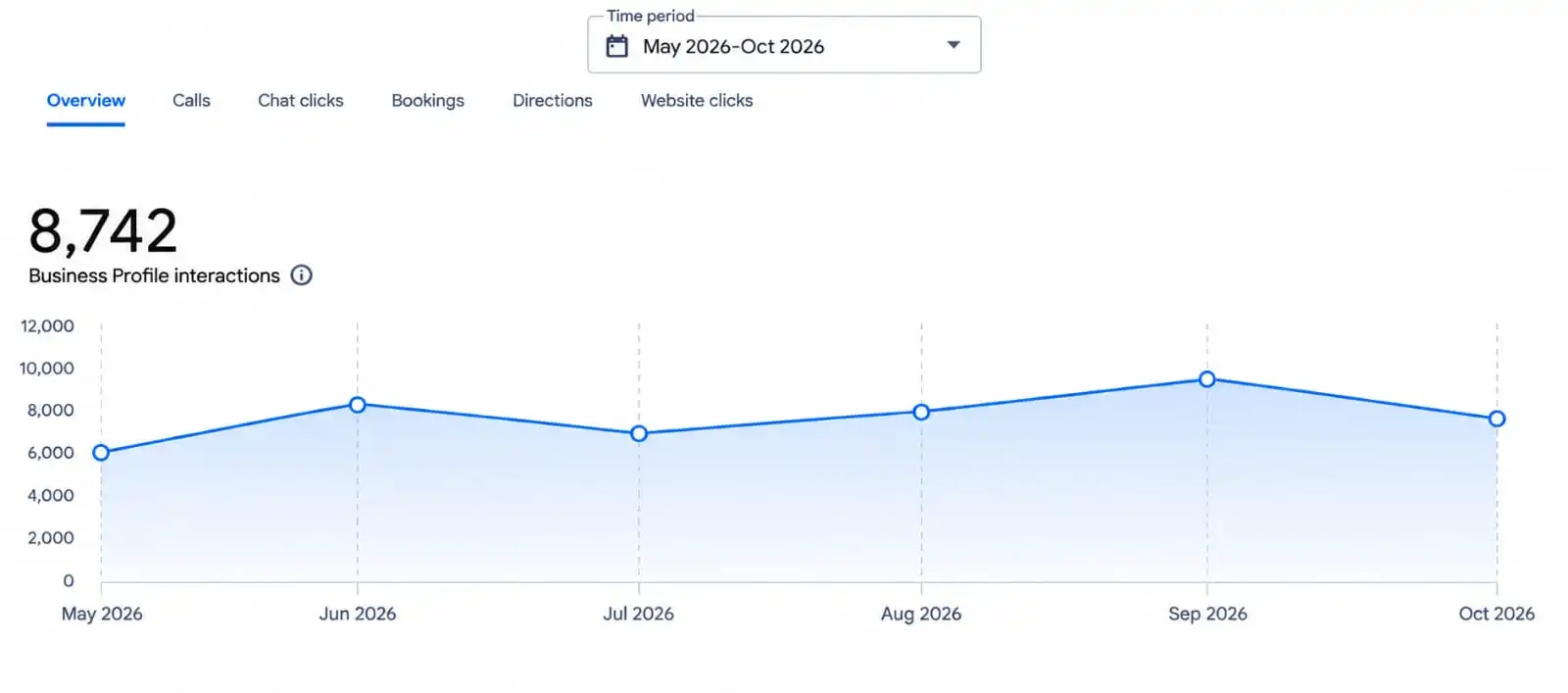
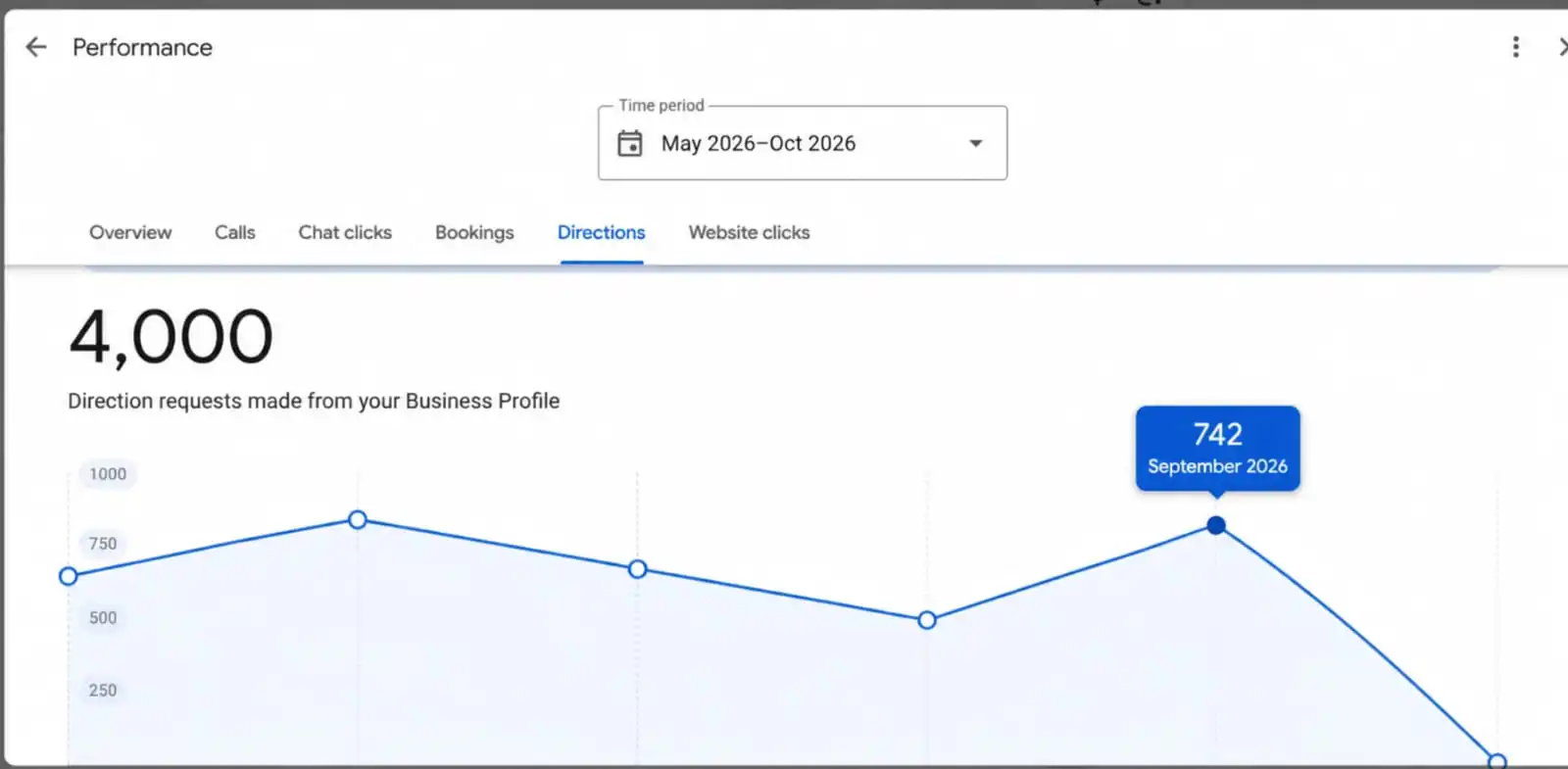
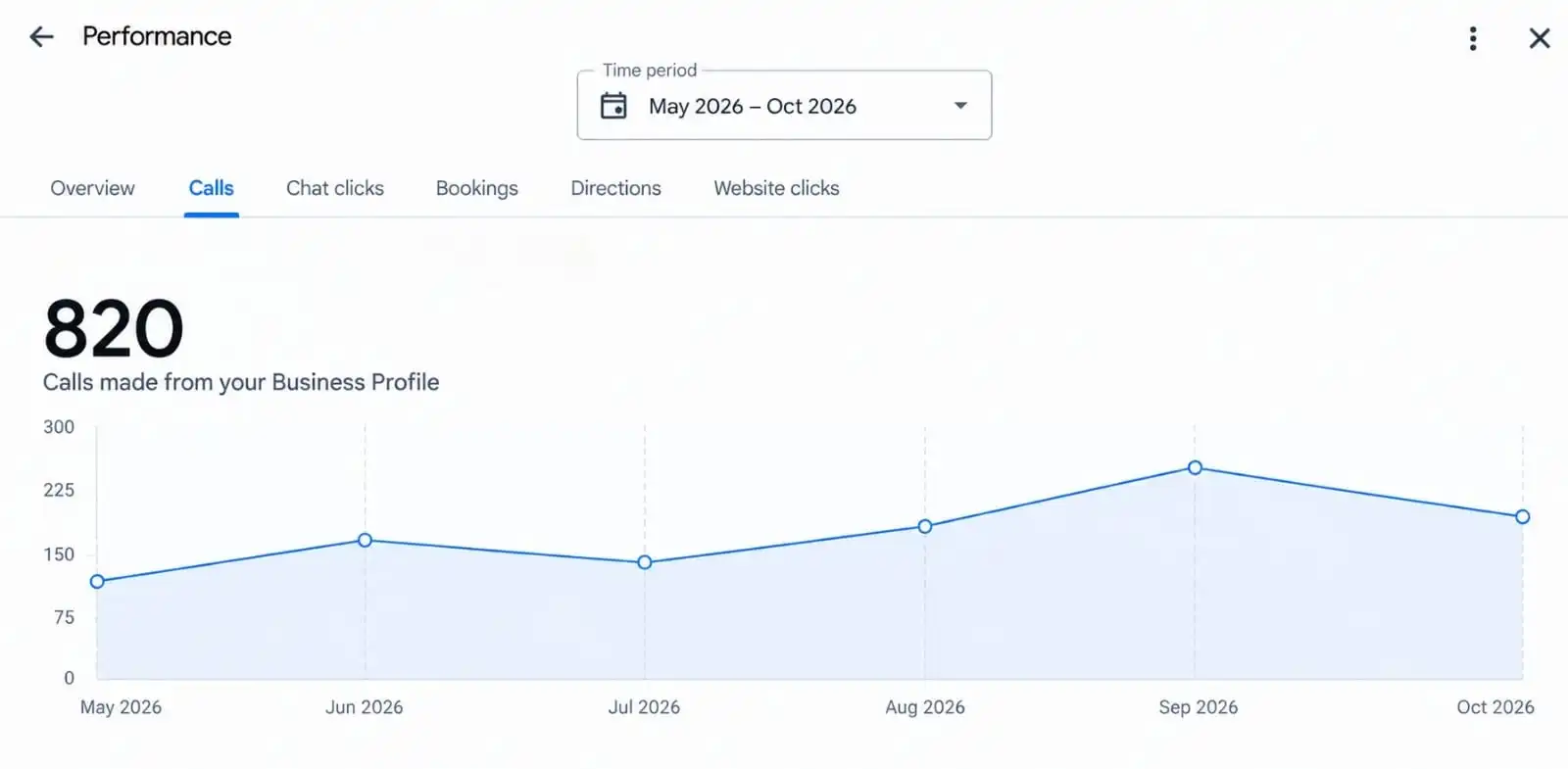
| Metric | Total (May to Oct 2026) |
|——–|————————-|
| Business Profile interactions | 8742 |
| Calls | 820 |
| Direction requests | 4000 |
For a local academy, these are the numbers that matter. A rankings report would never tell the owner that almost 820 people called and over 4,000 people asked for directions in five months.
We do not hide dips like this from clients. We use them as a signal to check seasonality, review activity, recent profile changes and competitor listings before we change the plan.
This is also why we ask agencies to show calls, directions and website clicks, not only a rankings screenshot. Rankings can look good while the phone stays silent, and the reverse can happen too.
Frequently Asked Questions
Q.1 What are the most common SEO myths?
The most common SEO myths are guaranteed number one rankings, results in 30 days, keyword density rules, Domain Authority as a goal, more backlinks always being better, and SEO being a one-time job. This guide covers all of them, plus nine more.
Q.2 Can anyone guarantee a number one ranking on Google?
No. Google itself says no one can guarantee a top spot. An agency can guarantee its own work, such as pages published or issues fixed, but not a position in search results.
Q.3 How long does SEO take to show results?
It depends on your competition and your starting point. A local business with a good Google Business Profile may see movement in 2 to 4 months. A new site in a tough market can need 6 to 12 months. Anyone who gives a fixed date is guessing.
Q.4 Is keyword density still important?
No. There is no ideal percentage. Use your main keyword naturally in the title, the opening and a few headings, then focus on covering the topic well.
Q.5 Do backlinks still matter for SEO?
Yes, but quality matters far more than quantity. A few relevant links from real websites are worth more than hundreds of cheap ones. Bad link packages can even cause problems.
Q.6 Does Google Ads help organic rankings?
No. Ads and organic results are separate. Ads can bring traffic quickly, but paying for them does not raise your organic rank.
Q.7 Is SEO dead because of AI search?
No. AI Overviews and chat tools change how answers are shown, but they still draw from clear, trusted and well organised pages. Good SEO basics still help you get found.
Q.8 How do I know if my SEO agency is good?
Use the HM 3-Question Test. Ask for proof, process and promises you can check. A good agency shows real work, explains tasks in plain words and does not promise rankings.
Q.9 Should I do SEO myself or hire an agency?
If your budget is tight and you have time to learn, you can handle the basics yourself, such as your Google Business Profile, service pages and tracking in Google Search Console. Hire help when you need technical fixes, faster growth or more time.
Q.10 What is the best way to avoid SEO scams?
Never buy a guaranteed ranking, keep ownership of your accounts, ask for a written scope and check reports that show leads, not only graphs. Also read our post on common SEO mistakes to avoid errors on your own side.
Final Thoughts
Most SEO myths come down to one thing: someone is selling certainty in a field that has none. Good SEO is not about secret tricks. It is about solid basics, helpful content, trust and patience.
Before you sign with any agency, run the HM 3-Question Test, ask the eight questions above and keep control of your own accounts.
If you want an honest opinion on your current SEO or a plan from scratch, contact HM Digital Solution for a free first discussion. You can also explore our SEO services in Delhi.
Tanishka Vats
Lead Content Writer | HM Digital Solutions Results-driven content writer with over five years of experience and a background in Economics (Hons), with expertise in using data-driven storytelling and strategic brand positioning. I have experience managing live projects across Finance, B2B SaaS, Technology, and Healthcare, with content ranging from SEO-driven blogs and website copy to case studies, whitepapers, and corporate communications. Proficient in using SEO tools like Ahrefs and SEMrush, and content management systems like WordPress and Webflow. Experienced content writer with a proven track record of creating audience-centric content that drives significant results on website traffic, engagement rates, and lead conversions. Highly adaptable and effective communicator with the ability to work under deadlines.