
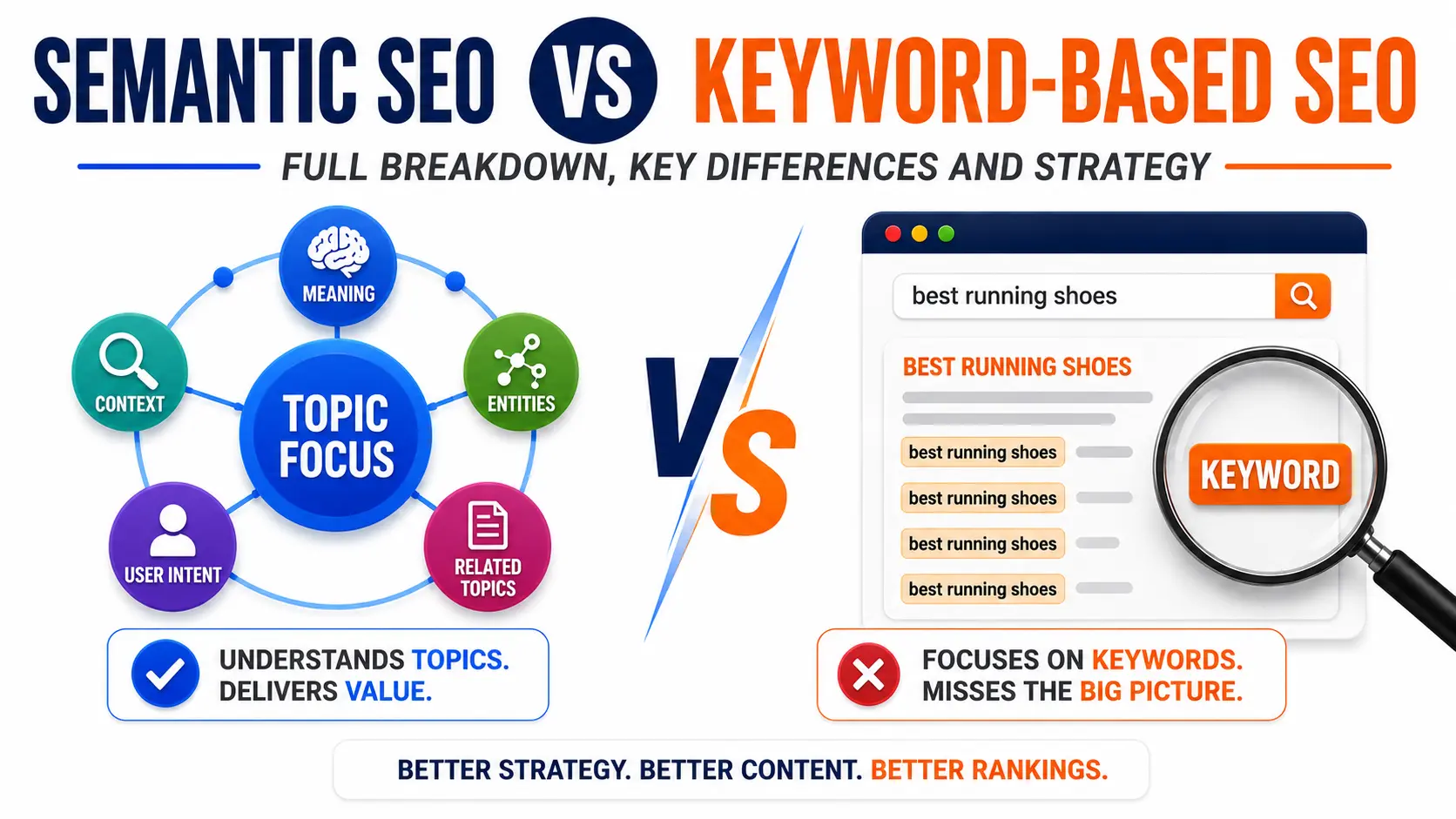
Semantic SEO vs Keyword-Based SEO: Full Breakdown, Key Differences and Strategy
If you have been working on your website’s SEO for a while, you have probably heard the term “semantic SEO” being thrown around a lot lately. At the same time, the old advice of “use this keyword 10 times in your content” still floats around in a lot of guides. So which one actually works in 2026?
The short answer is that semantic SEO has taken over, and keyword based SEO in its old form simply does not work the way it used to. But that does not mean keywords are useless. It means the way we use them has changed completely.
In this guide, we will break down exactly what semantic SEO is, how it is different from keyword based SEO, why Google moved in this direction, and how you can actually apply semantic SEO to your own website starting today.
What is Keyword Based SEO
Keyword based SEO is the traditional approach to search engine optimisation that most of us learned first. The idea is fairly simple. You find a keyword that people search for, you check its search volume, and then you build a page or write content around that exact phrase. The keyword gets placed in the title, the headings, the URL, the meta description, and sprinkled through the body content a certain number of times.
For a long time, this worked reasonably well because search engines were mostly matching strings of text. If your page contained the exact words someone typed into Google, you had a decent shot at ranking.
But this approach has some obvious problems. A page can be technically “optimised” for a keyword while still being thin, repetitive, or not actually useful to the person reading it. Keyword based SEO also struggles with how people actually search today, especially with longer, conversational, and voice based queries.
If you want to understand how this fits into the bigger picture of running an SEO campaign, our SEO audit checklist covers how to spot pages that are still stuck in this old keyword first mindset.
What is Semantic SEO
Semantic SEO is the practice of creating content based on topics, meaning, and intent rather than chasing one exact phrase. Instead of asking “what keyword should this page target”, semantic SEO asks “what is this page actually about, and what does someone need to know if they are interested in this subject”.
In practice, this means your content covers a topic in depth. It naturally includes related terms, synonyms, subtopics, and the kind of detail an expert would include if they were explaining the subject to someone in person. Search engines can then understand that your page is a genuinely complete resource on that subject, not just a page stuffed with one phrase.
This shift did not happen overnight. Google’s algorithm updates over the years, starting with Hummingbird and continuing through BERT and later systems, were all steps towards understanding language the way humans do, with context and relationships between words, rather than treating search queries as a string of separate keywords.
If you want a deeper look at how Google’s systems interpret entities instead of plain keywords, we have written about it in detail in how Google uses entities instead of keywords.
Semantic SEO vs Keyword SEO: Key Differences
Let’s go through the core differences one by one, because understanding these will help you see why semantic SEO produces better long term results.
1. Focus on Intent vs Exact Match
Keyword based SEO targets a specific phrase, regardless of why someone is searching for it. Semantic SEO starts with intent. For example, someone searching “best running shoes for flat feet” is not just looking for a page with that exact phrase. They want recommendations, possibly comparisons, maybe some explanation of why flat feet need specific support. A semantic approach builds content around that full need, not just the words in the query.
2. Single Keyword vs Topic Clusters
A keyword based page usually targets one phrase and its close variations. A semantic SEO approach instead builds a cluster of related content. One page becomes the central, comprehensive resource on a topic, and supporting pages or sections cover related subtopics in detail. This is closely tied to the idea of topical authority versus domain authority, where being recognised as an expert on a subject matters more than just having a strong overall domain score.
3. Content Depth and Quality
Keyword stuffed pages can be thin. They might repeat a phrase many times without adding much real information. Semantic SEO prioritises content depth. It answers the obvious questions, the follow up questions, and the related questions someone might have after reading the main answer. This naturally tends to produce longer, more useful content, but the goal is never length for its own sake. It is completeness.
4. Understanding Relationships Between Words and Entities
This is where things get technical, but the concept is simple to understand. Keyword based SEO treats “Delhi”, “SEO agency”, and “digital marketing” as separate strings of text to match. Semantic SEO understands that these are connected entities with relationships. A search engine that understands entities knows that an “SEO agency in Delhi” is a type of business, located in a specific city, offering a specific service, and related to other concepts like website ranking, Google Search Console, and content marketing.
This relationship based understanding is part of how Google’s systems use embeddings, which are numerical vector representations of queries, documents, or entities, to measure semantic similarity and match content based on meaning rather than exact keywords.
5. Performance in Voice and Conversational Search
People do not speak the way they type. When typing, someone might search “weather Delhi tomorrow”. When speaking to a voice assistant, the same person might say “what is the weather going to be like in Delhi tomorrow”. Keyword based SEO struggles to capture this natural variation because it is built around matching specific short phrases. Semantic SEO handles this naturally because it focuses on the underlying question, regardless of how it is phrased. We go into more detail on this in our guide on optimising content for voice search and AI search.
Why Google Moved Towards Semantic SEO
There are a few major reasons behind this shift, and understanding them helps explain why semantic SEO is not just a trend that will fade away.
Search engines got better at understanding language. Natural language processing models, including the ones powering Google’s algorithms today, can read a page roughly the way a human reader would. They can tell the difference between a page that genuinely explains a topic and one that is just repeating a phrase to manipulate rankings.
User behaviour changed. More people now search using voice assistants and longer, conversational queries. People increasingly use voice search to create lengthier conversational queries instead of short keyword phrases, and search engines had to adapt to match this behaviour.
AI generated answers need structured, well organised information. With the rise of AI Overviews and similar features, search engines are pulling information directly from web pages to construct answers. AI Overviews synthesize information from multiple sources, rewarding depth over keyword matching, which means a page that simply repeats a keyword has very little chance of being used as a source.
Competition pushed quality up. As more businesses learned basic keyword optimisation, it stopped being a differentiator. Semantic SEO, with its focus on depth, structure, and genuinely useful content, became one of the few remaining ways to stand out.
How Semantic SEO Works: Entities, Embeddings and Vector Search
To really understand semantic SEO, it helps to know a little about what is happening behind the scenes. You do not need to become a data scientist, but a basic understanding of these concepts will help you make better content decisions.
Entities
An entity is a real world thing with its own identity, such as a person, a place, a brand, a product, or a concept. Unlike a keyword, which is just a string of text that can mean different things depending on context, an entity has defined attributes and relationships. Google treats entities as real-world things with identity, while keywords are just text strings, and an entity has attributes, relationships, and a stable meaning, while a keyword can mean different things depending on context.
For example, the word “Apple” as a keyword is ambiguous. It could mean the fruit or the technology company. But “Apple Inc.” as an entity has a clear, stable identity with known attributes like its industry, founders, products, and headquarters.
Vector Embeddings
Vector embeddings are a way of representing the meaning of text as numbers. Search engines convert both your content and a user’s search query into these numerical representations, and then compare how close they are to each other. The higher the similarity score between your content’s embedding and the embedding of an authoritative reference on the same topic, the stronger your semantic precision is considered to be.
In simple terms, if your page covers a topic the way an expert would, including the related concepts, terms, and details an expert would naturally include, your content sits closer in this “meaning space” to other high quality content on that topic. This makes it easier for search engines to recognise your page as relevant and trustworthy.
We have written a more detailed explanation of this in vector search SEO and how embeddings are changing Google rankings, if you want to go deeper into the technical side.
Knowledge Graphs
Google’s Knowledge Graph is a massive database of entities and the relationships between them. It does not directly rank your pages, but it plays a role in how your content is interpreted. The Knowledge Graph supports entity disambiguation, helping search engines determine whether a word like “apple” is being used as a brand or a fruit in a given piece of content, and it also supports factual validation by comparing claims with consensus information.
The scale of this system has grown enormously. Google’s Knowledge Graph now holds more than 500 billion facts on more than 5 billion entities, and Gemini AI is trained on this data. Being represented accurately in this graph, through consistent information about your business across your website and other platforms, has become an important part of building topical trust.
How to Implement Semantic SEO on Your Website
Now let’s get practical. Here is how you can start applying semantic SEO principles to your own website, step by step.
Step 1: Identify the Core Topic, Not Just a Keyword
Before writing anything, ask yourself what the page is fundamentally about. If you run a local business, the core topic might be “SEO services for educational institutes” rather than just the keyword “education SEO services”. This framing helps you naturally include related subtopics like admissions marketing, course page optimisation, and local search visibility, all of which matter to the same audience.
Step 2: Map Out Related Subtopics and Questions
For any core topic, list out the questions a curious reader would actually have. If your topic is “semantic SEO”, related questions might include what entities are, how schema markup helps, what topical authority means, and how voice search fits in. Covering these naturally within your content, rather than as an afterthought, is what builds topical depth.
Step 3: Use Schema Markup to Clarify Entities
Schema markup is structured data added to your website’s code that explicitly tells search engines what your content is about. For a business, this might include your organisation’s name, services, location, and reviews. For an article, it might include the author, publish date, and the type of content. When Google understands your entity clearly, it can surface your brand more confidently across search features and AI responses. If you have not implemented this yet, our guide on how schema markup helps SEO walks through the basics and implementation tips.
Step 4: Build Internal Links Based on Relationships, Not Just Navigation
Internal linking in a semantic SEO strategy should reflect how topics relate to each other, similar to how a knowledge graph connects entities. Service pages should link to the organisation entity, and location pages should link to relevant services, mirroring the structure of a knowledge graph. If you are restructuring your site for this, our content silo SEO strategy guide explains how to group related content effectively.
Step 5: Write for Topic Coverage, Not Keyword Density
Forget counting how many times you use a keyword. Instead, after writing a draft, ask yourself if someone reading this would have any major follow up questions left unanswered. If yes, those gaps are opportunities to expand your content meaningfully.
Step 6: Maintain E-E-A-T Throughout
Experience, Expertise, Authoritativeness, and Trustworthiness remain central to how content is evaluated, semantic SEO or otherwise. This means citing real data where possible, being clear about who wrote the content and why they are qualified to do so, and keeping information accurate and up to date. Our article on the future of SEO and how E-E-A-T fits with AI experience covers this in more detail.
Semantic SEO and AI Overviews
One of the biggest reasons semantic SEO matters right now is its connection to AI Overviews and other AI generated search features. These features pull information from multiple sources to construct a direct answer, rather than just listing links.
For your content to have a chance of being included in these AI generated answers, it needs to be structured clearly, cover the topic comprehensively, and use language that aligns with how the topic is naturally discussed by experts. Content that references a higher number of connected entities has shown a meaningfully greater likelihood of being cited in AI Overviews compared to content that is sparse on entities.
This does not mean you need to write differently for AI versus for human readers. If anything, the opposite is true. Content that genuinely serves a human reader’s needs, in a clear and well organised way, tends to be exactly the kind of content these AI systems prefer to cite. For more on this specific topic, see our guide on content optimisation for Google AI Overviews.
Common Mistakes Businesses Make With Semantic SEO
Even businesses that understand the theory behind semantic SEO often make a few avoidable mistakes when putting it into practice.
Treating it as just “adding more keywords”. Some people interpret semantic SEO as simply finding a longer list of related keywords and stuffing those into the content instead. This misses the point entirely. The goal is genuine topic coverage, not a bigger list of phrases to repeat.
Ignoring technical SEO basics. Entities and structured data contribute to how search engines understand content, but they do not replace traditional ranking factors like backlinks, page quality, and user experience. A semantically rich page that loads slowly or has a poor mobile experience will still struggle to rank.
Writing overly long content without structure. Depth does not mean dumping everything you know into one giant block of text. Good semantic content is well organised, using headings, lists, and tables so both readers and search engines can navigate it easily.
Inconsistent information across the web. If your business name, address, or service descriptions vary across your website, Google Business Profile, and other listings, it can create confusion about your entity. Consistency helps search engines build a clear, stable picture of who you are and what you offer.
Forgetting that keywords still have a role. While the strategy has shifted, keywords are not irrelevant. They are still useful signals, especially in titles and headings, for telling readers and search engines what a page covers at a glance. The difference is that they are now one part of a much bigger picture, not the entire strategy. If you are still working through cannibalisation issues from older keyword heavy content, our guide on keyword cannibalization in SEO is worth a read.
Semantic SEO vs Keyword SEO: Quick Comparison Table
| Aspect | Keyword Based SEO | Semantic SEO |
|---|---|---|
| Primary focus | Exact keyword and its variations | Topic, intent, and meaning behind a query |
| Content structure | Single page targeting one phrase | Topic clusters covering a subject in depth |
| How relevance is judged | Keyword presence and density | Entity relationships and contextual coverage |
| Internal linking | Mostly for navigation | Reflects relationships between topics and entities |
| Voice search performance | Limited, struggles with natural phrasing | Strong, matches conversational queries |
| Role of schema markup | Optional | Important for entity clarity |
| Risk of thin content | High | Low, since depth is part of the approach |
| Long term sustainability | Decreasing | Increasing, aligned with AI search trends |
Frequently Asked Questions
Q.1 Is keyword research still important with semantic SEO?
Yes. Keyword research still helps you understand what language your audience uses and what topics they care about. The difference is that you use this research to inform the breadth and direction of your content, rather than as a checklist of phrases to repeat.
Q.2 Do I need to remove keywords from my existing content?
No, and you should not. The goal is not to avoid keywords, but to make sure your content goes beyond them by covering the topic in a genuinely useful and complete way. Existing content can usually be improved by expanding it to cover related questions and adding clearer structure, rather than rewriting it from scratch.
Q.3 How long should content be for semantic SEO?
There is no fixed word count. The right length depends on how much there is to genuinely say about a topic. Some topics can be covered well in a few hundred words, while others, like this one, naturally require more depth. The key is that every section should add real value, not just length for its own sake.
Q.4 Does semantic SEO mean I do not need to worry about exact match keywords in titles?
You should still use clear, descriptive titles and headings that reflect what someone is searching for. Semantic SEO does not mean avoiding clear language. It means your content should also cover the broader topic well enough that it ranks for many related searches, not just the one phrase in your title.
Q.5 Is semantic SEO only relevant for large websites?
Not at all. Small and local businesses benefit just as much, if not more, because semantic SEO helps establish clear topical authority in a specific niche or location, which is exactly the kind of focused expertise smaller businesses are well positioned to demonstrate.
Q.6 How does semantic SEO relate to local SEO?
For local businesses, semantic SEO means clearly establishing entities like your business, its services, and its location, and how they relate to each other. This helps search engines connect your business to local searches even when the exact wording of a query does not match your content word for word.
Final Thoughts
The shift from keyword based SEO to semantic SEO is not really about abandoning what worked before. It is about building on it. Keywords still tell you what people are searching for, but semantic SEO is about using that information to create content that genuinely understands and serves the topic as a whole.
If you are working on your website’s content strategy for 2026, the businesses that will see the strongest results are the ones that focus on becoming a genuine, well organised resource on their core topics, supported by clear entity signals, structured data, and content that answers the questions people actually have. That is what semantic SEO really means in practice.
Tanishka Vats
Lead Content Writer | HM Digital Solutions Results-driven content writer with over five years of experience and a background in Economics (Hons), with expertise in using data-driven storytelling and strategic brand positioning. I have experience managing live projects across Finance, B2B SaaS, Technology, and Healthcare, with content ranging from SEO-driven blogs and website copy to case studies, whitepapers, and corporate communications. Proficient in using SEO tools like Ahrefs and SEMrush, and content management systems like WordPress and Webflow. Experienced content writer with a proven track record of creating audience-centric content that drives significant results on website traffic, engagement rates, and lead conversions. Highly adaptable and effective communicator with the ability to work under deadlines.