

Content Silo SEO Strategy: How to Organize Content for Higher Rankings
If you have been doing SEO for a while, you already know that publishing more content is not enough. What actually moves the needle is how your content is organized.
Content silo SEO is one of the most debated site architecture strategies in the industry. Some SEOs swear by it. Others argue it’s outdated. The truth, as always, is more nuanced.
In this guide, we break down what content silos actually are, when they work, where they fail, and what a modern SEO professional should do instead in today’s semantic search environment.
What Is Content Silo SEO?
Content silo SEO is a site architecture strategy where website content is grouped into distinct, thematically related sections called “silos.” Each silo focuses on one main topic and contains all supporting content related to that topic.
Quick Definition: A content silo is a thematically grouped section of a website where related content is organized together and interlinked, designed to signal topical depth and authority to search engines.
The Bruce Clay Origin: Where Silos Come From
The concept of content siloing was invented and named by Bruce Clay, one of the most influential figures in early search engine optimization. Clay developed the siloing methodology in the late 1990s and early 2000s, when search engines were far less sophisticated than they are today.
His core argument was straightforward: search engines at the time struggled to understand what a website was “about” when content on unrelated topics was all mixed together and cross-linked. By organizing content into isolated thematic sections with no cross-linking, you essentially forced the search engine to see your site as a specialist on each topic rather than a generalist covering everything.
Clay described siloing as “organizing a website’s content by heavily queried themes to make it clear what topics a site is about.” At the time, this was genuinely effective. Search engines rewarded sites that clearly signaled topical focus, and strict link isolation helped achieve that signal.
The strategy spread widely across the SEO industry through the 2000s and 2010s, and many agencies and professionals still recommend it today, sometimes without acknowledging how much search engine algorithms have evolved since Clay originally developed the concept.
In its strictest form, the rule is simple: pages within a silo link to each other, but silos do not link to each other.
So if you run an SEO agency website with separate silos for Technical SEO, Local SEO, and Content SEO, content inside the Technical SEO silo would only link within that silo. A technical SEO article would never link to a local SEO article, even if the two topics were genuinely related.
That strict isolation is exactly where the strategy starts to break down in the modern search environment, but we will get to that.
How Does a Content Silo Structure Work?
A typical content silo has three levels:
| Level | Page Type | Example |
|---|---|---|
| Level 1 | Homepage | yourdomain.com |
| Level 2 | Silo/Category Page | yourdomain.com/technical-seo/ |
| Level 3 | Supporting Content | yourdomain.com/technical-seo/crawl-budget-optimization/ |
Each supporting page links up to its parent silo page. The silo page links down to all its supporting pages. Pages at the same level within a silo link to each other horizontally.
Here is what that looks like in practice for an SEO agency:
Silo 1: Technical SEO
- Crawl Budget Optimization
- JavaScript SEO Guide
- Hreflang Mistakes
- Log File Analysis
Silo 2: Local SEO
- Google Business Profile Optimization
- Local Citation Building
- Local Schema Markup
Silo 3: Content SEO
- Topical Authority
- Keyword Research
- Content Clusters
Under strict silo rules, an article in the Technical SEO silo cannot link to anything in the Local SEO or Content SEO silo, even if the content is directly relevant.
The URL structure also reinforces the silo hierarchy:
yourdomain.com/technical-seo/crawl-budget-optimization/
yourdomain.com/local-seo/google-business-profile/
yourdomain.com/content-seo/topical-authority/
This type of URL structure communicates content hierarchy clearly to both users and crawlers.
Types of Content Silos: Hard vs Soft (Virtual vs Physical)
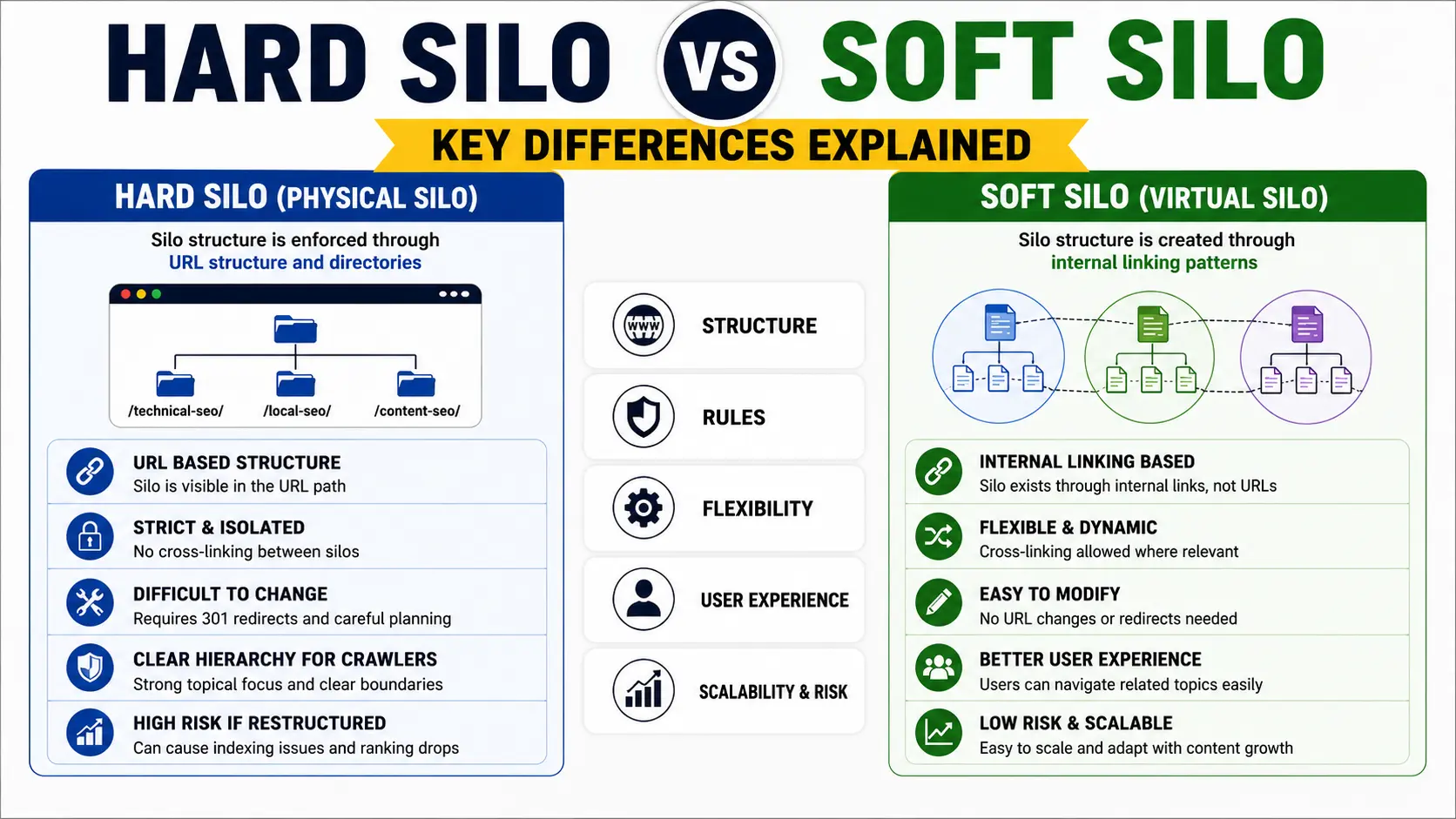
This is a distinction most beginner-level silo articles skip entirely. There are two types of content silos, and understanding the difference is critical for implementation. You will see different names for these in the industry: some sources call them “hard and soft” silos, others call them “physical and virtual.” They mean the same thing.
Hard Silos (Physical Silos)
Hard silos are enforced through URL structure and directory organization. The folders in your URL path directly reflect the silo grouping:
/technical-seo/crawl-budget/
/technical-seo/javascript-seo/
/local-seo/citations/
/local-seo/google-business-profile/
The silo structure is visible in the URL itself. Hard silos are the original Bruce Clay approach and create a very clear hierarchy for crawlers.
The downside: Hard silos are difficult to restructure once built. Changing your URL structure requires 301 redirects across potentially hundreds of pages, carries indexing risk, and can cause temporary ranking drops if not executed carefully.
Soft Silos (Virtual Silos)
Soft silos are created through internal linking patterns alone, without necessarily changing the URL structure. You can have flat URLs like:
/crawl-budget-optimization/
/javascript-seo-guide/
/local-citation-building/
But through deliberate internal linking, you create the same thematic grouping signal that a hard silo achieves through folder structure. Google reads the link relationships and understands which pages belong together topically.
For most SEO agencies and established client websites, soft/virtual silos are more practical. They deliver the topical grouping benefits without the risk of URL migration issues.
Bonus: The Reverse Silo (Advanced)
A reverse silo is a lesser-known but highly effective variation. In a standard silo, PageRank flows downward from pillar to cluster pages. In a reverse silo, you deliberately use supporting content to funnel PageRank upward toward a target page, typically a commercial or conversion page.
For example, if your most important page is a service page like /seo-services-in-delhi/, you would create multiple informational blog posts that all link back to that service page. Each informational post answers a related question and points the reader, and the link equity, toward the conversion page.
This is particularly effective for service businesses and local SEO, where you want to push ranking authority toward specific money pages rather than just informational content.
For most SEO agencies and client websites, soft silos are more practical for content organization, with reverse silos applied selectively to push authority toward priority commercial pages.
Why SEOs Use Content Silos
Before we critique the strategy, it is worth being fair about why content silos gained traction in the first place. There are legitimate benefits, especially for larger sites.
1. Clearer Crawl Paths for Bots
When Googlebot lands on a page, it follows internal links to discover new content. A well-structured silo gives the crawler a clear, logical path through related pages. This is particularly useful for enterprise sites with thousands of pages, where crawl budget optimization becomes critical.
As we have covered in detail in our guide on crawl budget optimization, how you structure your internal links directly affects how efficiently Google crawls your site.
2. Topical Authority Signaling
Google does not just rank individual pages. It evaluates the overall topical authority of a domain on a given subject. When all your content on a topic is interlinked and grouped together, it sends a stronger signal that your site genuinely covers that topic in depth.
This connects directly to how Google uses entities instead of keywords to understand content relevance, something that has become increasingly important after the Helpful Content updates.
3. Reduces Keyword Cannibalization
When content on related topics is properly siloed and interlinked, you are less likely to have multiple pages competing for the same keyword. Each page in the silo has a clear role and a distinct keyword focus, which reduces keyword cannibalization.
4. Improved User Navigation
From a UX perspective, siloed architecture makes it easier for visitors to find related content. A user reading about crawl budget is likely also interested in log file analysis or JavaScript SEO. Having those pages linked within the same silo keeps the user engaged without them needing to go back to the SERP.
The Real Problems with Strict Content Siloing
Here is where we need to be direct with you: strict content siloing, as originally defined, is an outdated strategy that can actively hurt your SEO.
Problem 1: It Creates Artificial Barriers Between Related Topics
Real topics do not exist in isolation. Technical SEO and content SEO overlap constantly. If you are writing about site architecture for topical authority, that article logically belongs in both the Technical SEO and Content SEO silos. Forcing it into one and cutting off links to the other makes your content less useful and less natural.
Google’s John Mueller has repeatedly stated that internal linking should be natural and contextually useful, not artificially constrained.
Problem 2: Risk of Orphan Pages
In a large site with strict siloing, pages at the edge of a silo can end up with very few internal links pointing to them. If a page sits deep in a silo and the silo’s parent page does not prominently link to it, it can effectively become an orphan page that Google rarely crawls or indexes well.
Problem 3: Misses Cross-Silo Link Juice Opportunities
PageRank distribution through internal links is one of the key mechanisms for surfacing important content. In a strict silo, your strongest pages can only pass link equity within their own silo. If your most authoritative page is in the Technical SEO silo but your most important conversion page is in the Local SEO silo, you are leaving PageRank on the table.
Problem 4: Does Not Reflect How Google Actually Reads Content Today
Google’s understanding of content has evolved significantly. With BERT, MUM, and the shift toward vector search and semantic understanding, Google is far more capable of understanding topical relationships across pages, even without a rigid silo structure. The strict isolation that silos enforce is more of a hindrance than a help in this environment.
Content Silos vs Topic Clusters: Key Differences
This comparison gets confused a lot, even by experienced SEOs. Here is a clean breakdown:
| Factor | Content Silos (Strict) | Topic Clusters |
|---|---|---|
| Core concept | Isolated thematic sections | Hub-and-spoke content model |
| Cross-section linking | Not allowed | Allowed and encouraged |
| Pillar page | Optional (category page) | Central requirement |
| Internal linking flexibility | Rigid | Flexible |
| Risk of orphan pages | High | Low |
| Alignment with modern SEO | Outdated | Current best practice |
| PageRank distribution | Limited to silo | Can flow across clusters |
| Best for | Very large sites with strict taxonomy | Most websites and agencies |
The critical difference is this: topic clusters allow you to link between different content groups when it is contextually relevant. Silos forbid this entirely.
A semantic content network, which is the approach we use and recommend, takes topic clusters one step further by mapping content to entity relationships rather than just keyword groupings.
How to Build a Content Silo Strategy That Actually Works
For SEO professionals, the practical advice is this: use the organizational logic of silos with the linking flexibility of topic clusters. Here is a step-by-step approach.
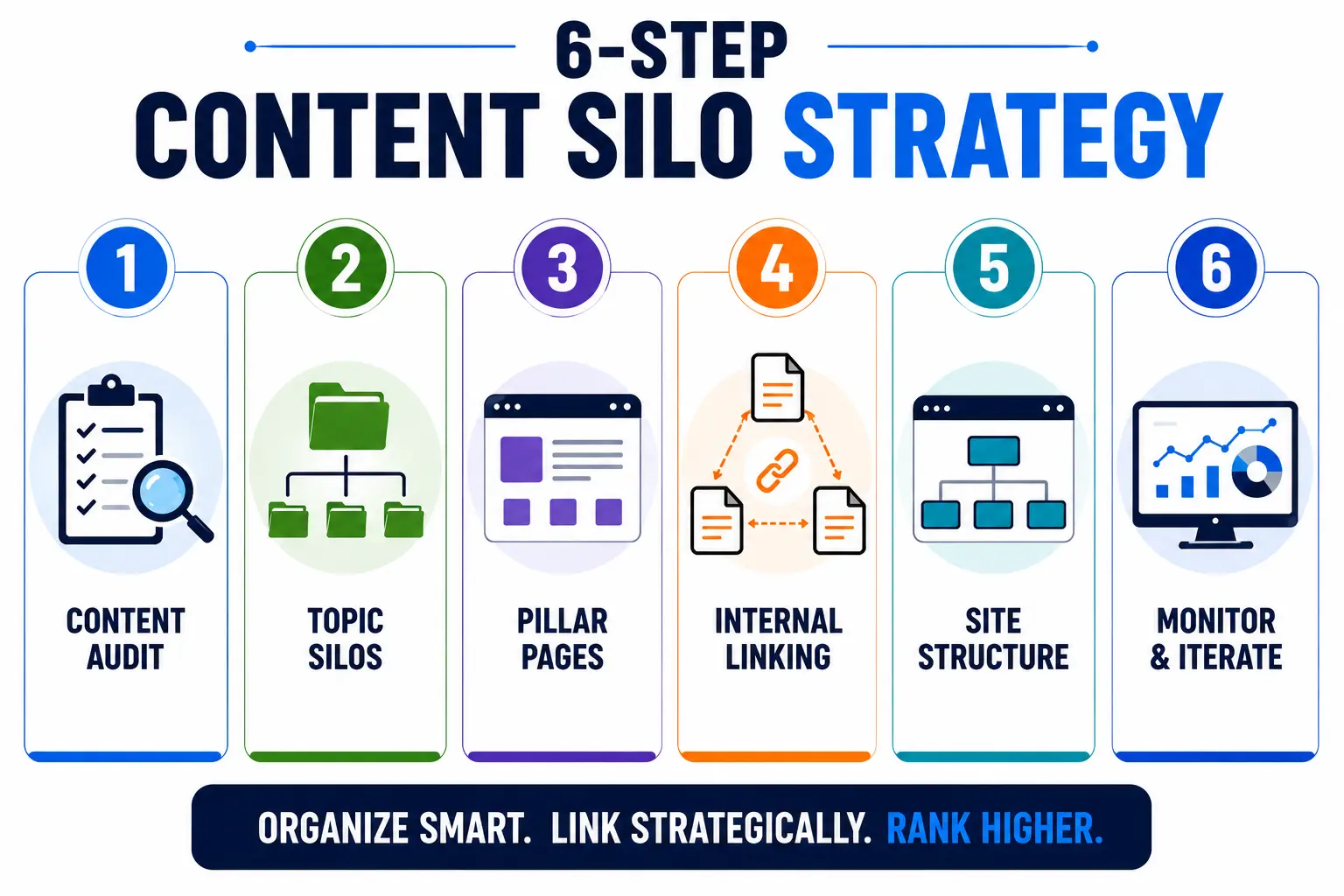
Step 1: Audit Your Existing Content
Before building or restructuring, you need to know what you have. Map all existing URLs to their primary topic. Identify:
- Which pages are topically related
- Which pages have few or no internal links (potential orphans)
- Which pages are ranking well and could serve as pillar pages
Tools like Screaming Frog, Google Search Console (using the advanced google search console filters we cover in this guide), and internal link reports from Ahrefs are useful here.
Step 2: Define Your Core Topic Silos
Based on your audit, group your content into broad thematic categories. For an SEO agency, this might look like:
- Technical SEO
- On-Page SEO
- Local SEO
- Content SEO
- Agency Operations
Each of these becomes a silo. But remember, you are not enforcing strict isolation. You are just defining the primary home for each piece of content.
Real-World India Example: How a Delhi E-commerce Brand Restructured with Silos
One of the most common scenarios we handle at HM Digital Solution is an e-commerce or service business that has been publishing content randomly for years, with no topical structure.
Consider a Delhi-based fashion e-commerce brand selling ethnic wear. Their blog had 80+ articles covering everything from “how to style a saree” to “best fabrics for summer” to “occasion wear guide” with no internal linking structure. Category pages had almost no supporting content pointing back to them.
After a content silo audit, we grouped their content into four silos:
| Silo | Pillar Page | Supporting Pages |
|---|---|---|
| Saree Guide | /saree-buying-guide/ |
How to drape, fabric types, occasion sarees, regional styles |
| Salwar Kameez | /salwar-kameez-guide/ |
Fabric guide, size chart, styling tips, wedding vs daily wear |
| Occasion Wear | /occasion-wear-guide/ |
Wedding, festival, office, party wear guides |
| Care and Maintenance | /ethnic-wear-care-guide/ |
Washing, storage, ironing, stain removal by fabric |
All blog posts were mapped to their closest silo. Internal links were added from each blog post back to the pillar page and horizontally to related posts within the same silo. Cross-silo links were added where genuinely relevant (e.g., a saree fabric article linking to the care guide).
Within three months, the pillar pages moved from page 3-4 to page 1 for their target keywords. Organic sessions on category pages increased significantly because Googlebot was now crawling those pages more frequently through the improved internal link structure.
The key takeaway: the content already existed. The silo structure was the missing piece.
Step 3: Identify or Create Pillar Pages
Each silo needs a pillar page: a comprehensive, high-quality piece of content that broadly covers the silo’s main topic. This pillar page:
- Targets a broad, high-volume keyword (e.g., “Technical SEO Guide”)
- Links out to all major cluster pages within the silo
- Receives links from all cluster pages back to it
Step 4: Build Horizontal Internal Links (The Part Most Guides Ignore)
This is where you go beyond strict silos. Once your silo structure is in place, add cross-silo internal links wherever they are contextually relevant.
For example, if your article on crawl budget optimization mentions the importance of content quality for Googlebot prioritization, link to your pillar on Content SEO. If your local SEO article references schema markup, link to your Technical SEO schema guide.
This is exactly how Wikipedia structures its content. Every article links outward to related topics freely, regardless of category. And Wikipedia dominates search rankings at scale.
Step 5: Reinforce with URL Structure and Navigation
Where possible, use subdirectories that reflect your silo structure:
yourdomain.com/technical-seo/
yourdomain.com/local-seo/
Reinforce the silo in your navigation menus and breadcrumbs. Breadcrumbs are particularly valuable here because they signal hierarchy to both users and Google, and they automatically create internal links back up the silo chain.
Step 6: Monitor and Iterate
Content architecture is not a one-time task. Use log file analysis to see which pages Googlebot is crawling most frequently. If important silo pages are being crawled less often than they should be, you likely need more internal links pointing to them.
Track your pillar pages in Google Search Console. Their impressions and click-through rates will tell you whether the topical authority signaling is working.
Content Silo SEO in 2026: What Has Changed? {#content-silo-seo-2026}
The core logic of silo SEO, which is that related content should be grouped and interlinked, remains valid. But the execution has changed significantly.
What has changed:
AI Overviews and AEO: Google’s AI Overviews pull from pages that demonstrate clear topical depth and entity coverage. A well-structured content silo that comprehensively covers a topic is more likely to be cited in AI Overviews than isolated pages with no topical context. If you are not already thinking about content optimization for Google AI Overviews, your silo strategy needs to account for this.
Entity-Based Understanding: Google now understands content through entity relationships, not just keyword co-occurrence. Your silo structure should map to entity relationships, not just keyword groups. An article about “crawl budget” and an article about “Googlebot” are about related entities, not just related keywords. The entity mapping strategy for your content architecture reflects this shift.
Helpful Content System: Google’s Helpful Content System evaluates whether content demonstrates genuine first-hand expertise. A silo full of thin, keyword-stuffed pages is worse than a smaller, tightly focused silo with fewer but more expert-level pages.
LLM Search (ChatGPT, Perplexity, Gemini): As LLM-based search grows, well-structured, comprehensive content silos become even more important. LLMs pull from sources that have clear, well-organized information on a topic. Understanding how LLMs interpret search intent is increasingly relevant to your content architecture decisions.
Common Mistakes SEO Professionals Make with Silos
Even experienced SEOs make these mistakes when implementing content silos:
Mistake 1: Building silos around keywords instead of topics Keyword-based grouping can lead to silos that are too narrow or that overlap. Build around broad topics and let keyword research inform the content within each silo, not define its boundaries.
Mistake 2: Forgetting about information gain Every piece of content in your silo should add something new. If multiple pages cover the same angle, you are creating a competition problem within your own silo. Focus on information gain SEO to ensure each page has a distinct angle.
Mistake 3: No cross-silo linking at all Following strict silo rules in 2026 will cost you. Always link contextually across silos when it genuinely helps the reader.
Mistake 4: Ignoring the pillar page Some agencies build silo content without a clear pillar. Without a pillar, the silo has no center and PageRank has nowhere to consolidate.
Mistake 5: Not auditing internal links after publishing Content silos need maintenance. Every new page you publish should be reviewed for internal linking opportunities with existing silo pages.
FAQ
Q.1 What does “silo” mean in SEO?
In SEO, a silo refers to a thematically organized section of a website where all content on a specific topic is grouped together and interlinked. The term comes from grain silos, which store a single type of grain in isolation. In website architecture, a silo stores a single topic cluster in an organized, internally linked structure to help search engines understand the site’s topical depth.
Q.2 Does content silo SEO still work in 2026?
The organizational principle works. The strict isolation rule does not. Modern silo strategies focus on thematic grouping with flexible internal linking, which is essentially the topic cluster model. Sites that organize content into clear topical silos and link contextually across them consistently outperform sites with scattered, unstructured content.
Q.3 What is the difference between a hard silo and a soft silo?
A hard silo (also called a physical silo) organizes content through the URL folder structure, e.g., /technical-seo/crawl-budget/. A soft silo (also called a virtual silo) creates the same topical grouping through internal linking alone, without changing the URL structure. For most established sites, soft silos are more practical because they avoid the risk of URL migration.
Q.4 What is the difference between a content silo and a topic cluster?
The key difference is cross-section linking. Topic clusters allow and encourage links between different clusters when contextually relevant. Strict silos prohibit any linking between silos. In practice, modern SEO professionals use a hybrid: the organizational structure of silos with the linking flexibility of topic clusters.
Q.5 Can content silos hurt your SEO?
Yes, if implemented too strictly. Cutting off all cross-topic internal links creates artificial barriers, risks orphan pages, and limits how PageRank flows across your site. Strict siloing also works against how Google now reads content through semantic and entity relationships. The key is to use the organizational logic of silos without the rigid linking restrictions.
Q.6 How many content silos should a website have?
There is no universal number. Build a silo only for topics where you can genuinely create at least 8 to 10 high-quality, distinct pieces of content. If you cannot cover a topic in sufficient depth, it should be a sub-section of an existing silo rather than its own standalone silo.
Q.7 Should I use physical or virtual silos?
Physical silos (enforced via URL structure) work best for brand new websites or sites undergoing a complete redesign where there is no migration risk. Virtual silos (enforced via internal linking) are more practical for established sites. The linking patterns matter far more than the URL folder structure for modern Google.
Q.8 How does content silo SEO connect to topical authority?
Topical authority is the outcome that a well-executed silo strategy is designed to build. When Google sees a comprehensive, well-interlinked set of content all covering related aspects of a topic, it recognizes the domain as authoritative on that topic. Silos are the structural mechanism; topical authority is the result. See our detailed guide on topical authority vs domain authority for more on how this works in practice.
Final Thoughts
Content silo SEO is not a binary choice between strict isolation and no structure at all. The right approach for any SEO professional is to use thematic grouping and pillar-based architecture to signal topical depth, while allowing natural, contextual cross-linking that genuinely helps users and reflects how topics actually connect to each other.
The sites ranking at the top of competitive SERPs in 2026 are not following Bruce Clay’s original strict silo rules. They are building comprehensive topic coverage, strong pillar pages, and a flexible internal linking structure that flows naturally across their entire site.
Tanishka Vats
Lead Content Writer | HM Digital Solutions Results-driven content writer with over five years of experience and a background in Economics (Hons), with expertise in using data-driven storytelling and strategic brand positioning. I have experience managing live projects across Finance, B2B SaaS, Technology, and Healthcare, with content ranging from SEO-driven blogs and website copy to case studies, whitepapers, and corporate communications. Proficient in using SEO tools like Ahrefs and SEMrush, and content management systems like WordPress and Webflow. Experienced content writer with a proven track record of creating audience-centric content that drives significant results on website traffic, engagement rates, and lead conversions. Highly adaptable and effective communicator with the ability to work under deadlines.