
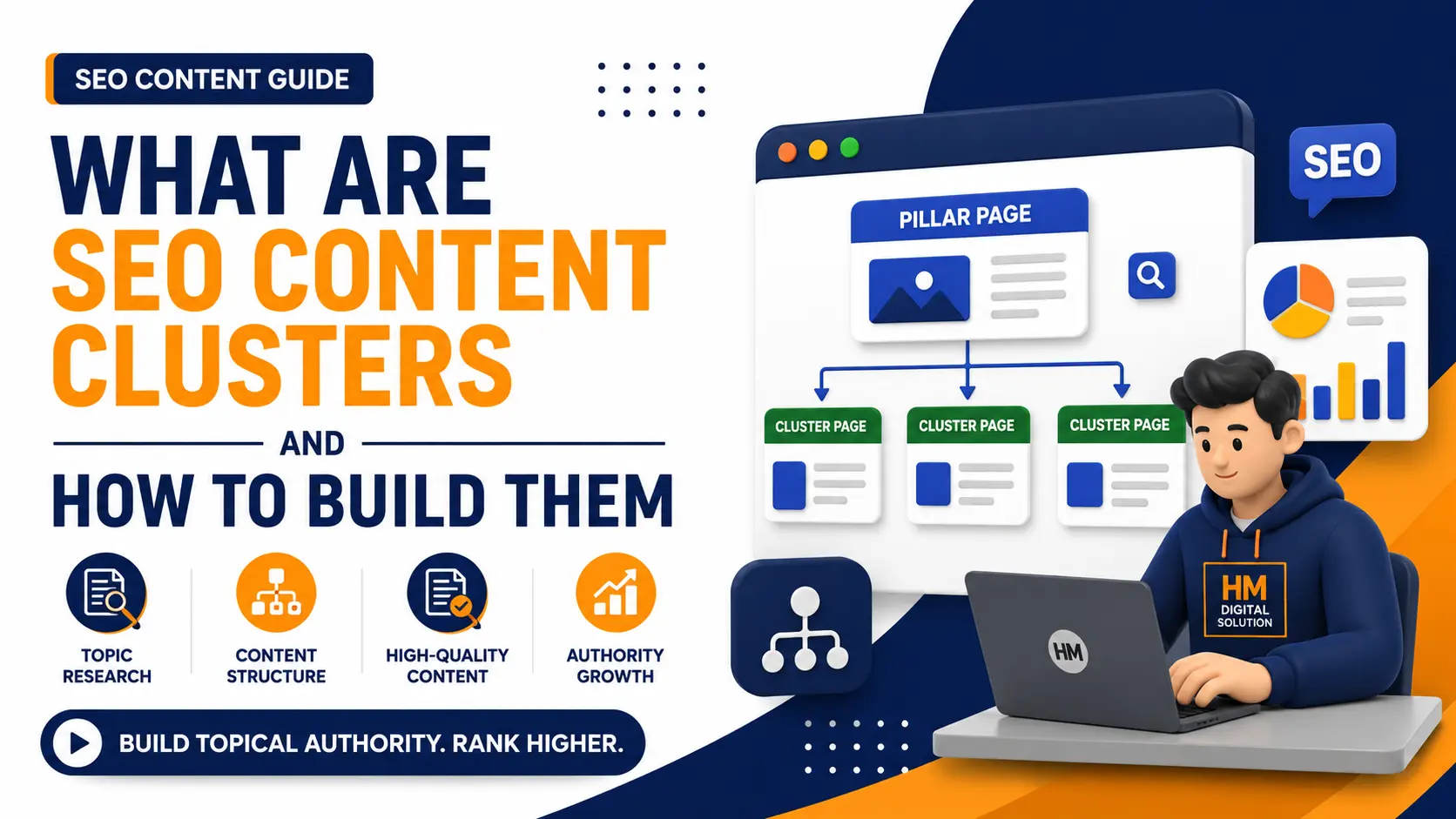
What Are SEO Content Clusters and How to Build Them
If you have spent any time researching SEO strategy, you have probably come across the term content clusters seo. It sounds technical, but the idea behind it is simple. Instead of writing random blog posts on different topics, you organize your content around one central theme and link everything together.
In this guide, we will explain what content clusters are, why they matter for SEO, and how you can build one for your own website step by step. We will also look at real examples, common mistakes, and the tools you need to get started.
What Are Content Clusters in SEO
A content cluster is a group of web pages built around one main topic. The group has one pillar page that covers the topic broadly, and several smaller pages called cluster pages that go deep into specific subtopics. All these pages link to each other using internal links.
Think of it like a library. A pillar page is the main shelf label, like “Cooking.” The cluster pages are the individual books under that shelf, like “Baking Basics,” “Knife Skills,” or “Italian Recipes.” Every book points back to the shelf, and the shelf points to every book.
When you search content clusters seo on Google, you will find that most experts agree on this basic structure. The goal is to help both users and search engines understand how your content fits together.
Why Content Clusters Matter for SEO
Search engines do not just look at individual pages anymore. They look at your whole website to understand what you know and how deep your expertise goes. This is where content clusters seo strategy becomes useful.
Here is why this approach works so well.
It builds topical authority. When you publish many connected articles on one subject, Google starts to see your site as a trusted source on that topic. This helps you rank for more keywords over time, not just one.
It supports E-E-A-T. Google evaluates content based on Experience, Expertise, Authoritativeness, and Trust. A well organized cluster shows that you have covered a topic from every angle, which signals real expertise rather than a single shallow post.
It improves internal linking. Search engines crawl your site through links. A strong internal linking structure, similar to what we explain in our guide on site architecture for topical authority, helps Google find and index your pages faster.
It reduces keyword cannibalization. Without a clear structure, you can end up with multiple pages competing for the same keyword. Our article on keyword cannibalization in SEO explains this problem in detail and how clusters help avoid it.
It improves user experience. Visitors can easily move from one related article to another without leaving your site. This keeps them engaged longer and reduces bounce rate.
It helps with AI search too. Large language models like ChatGPT often pull information from well structured, authoritative websites. A strong content clusters seo setup increases your chances of being referenced in AI generated answers as well as traditional search results.
Content Cluster vs Content Silo vs Topic Cluster
People often use these three terms interchangeably, but there are small differences worth knowing.
| Term | Meaning | Linking Style |
|---|---|---|
| Content Cluster | A pillar page with related subpages linked together | Pillar links to subpages, subpages link back to pillar |
| Content Silo | A strict grouping of content by category, sometimes with limited cross linking to other silos | Mostly internal within the same category |
| Topic Cluster | Another name for content cluster, used commonly in inbound marketing | Same as content cluster |
In practice, most modern SEO strategies use a mix of both ideas. You group content into clear categories like a silo, but you also allow some cross linking between related clusters where it makes sense. If you want a deeper breakdown, check our guide on content silo SEO strategy.
Key Parts of a Content Cluster
Before you start building, it helps to understand the basic building blocks.
1. Pillar Page
This is the main page of the cluster. It gives a broad overview of the topic and briefly touches on every subtopic. It usually targets a high volume, broad keyword.
2. Cluster Pages
These are the supporting pages. Each one focuses on a specific subtopic in detail and targets a more specific, often longer keyword. For example, if your pillar page is about “digital marketing,” a cluster page might cover “email marketing for small businesses.”
3. Internal Links
These connect the pillar page and cluster pages in both directions. They are what turn a group of separate articles into an actual cluster.
4. Keyword Mapping
Each page in the cluster should target a different keyword to avoid overlap. This is closely tied to entity based planning. Our article on entity mapping strategy for service businesses explains how to map keywords to entities instead of just matching exact phrases.
How to Build SEO Content Clusters Step by Step
Now let us get into the actual process of building a content cluster.
Step 1: Pick a Core Topic
Start with a topic that is broad enough to support multiple articles but specific enough to stay focused. Ask yourself these questions:
- What does my business actually offer?
- What do my customers search for before they buy?
- What topics do my competitors already rank for?
- What content do I already have that I can build on?
If you run a coaching institute, for example, “exam preparation” could be your core topic, with subpages on study schedules, mock tests, and subject specific tips. We cover a related example in our article on how SEO for coaching institutes can increase admissions.
Step 2: Do Proper Keyword Research
Once you have a topic, find out what people are actually searching for. Use a keyword tool to look at:
- Search intent (informational, commercial, transactional)
- Monthly search volume
- Keyword difficulty
Group similar keywords together. These groups will later become your individual pages. This step is where content clusters seo planning really comes together, because the keyword groups decide your page structure.
Step 3: Map Out Your Pillar and Cluster Pages
Once you know your keyword groups, decide which one becomes the pillar page and which ones become cluster pages. The pillar page usually targets the broadest, highest volume keyword. The cluster pages target narrower, more specific keywords.
Draw this out before you start writing. A simple table works well.
| Page Type | Example Page | Target Keyword |
|---|---|---|
| Pillar | What Is Topical Authority in SEO | topical authority seo |
| Cluster | Topical Authority vs Domain Authority | topical authority vs domain authority |
| Cluster | How to Build Site Architecture for Authority | site architecture for SEO |
| Cluster | Semantic SEO vs Keyword Based SEO | semantic seo vs keyword seo |
This mapping process is also where you avoid the keyword overlap issues we mentioned earlier in our keyword cannibalization guide.
Step 4: Write High Quality, Original Content
This is where most clusters fail. Many websites build the structure correctly but fill it with thin or generic content. To rank well with content clusters seo, every page needs to be genuinely useful.
Keep these points in mind while writing:
- Use your primary keyword naturally in the title, first paragraph, and a few times through the body
- Cover the topic in more depth than your competitors
- Write for your reader first, not just for search engines
- Use simple language and short paragraphs
- Add real examples, data, or experience where possible
This is also where E-E-A-T comes in. Google wants to see that the content comes from someone with real experience and expertise on the subject, not content stitched together from other articles.
Step 5: Build Internal Links Between Pages
Once your pages are live, connect them properly.
- Link from the pillar page to every cluster page
- Link from each cluster page back to the pillar page
- Where relevant, link cluster pages to each other
Use natural anchor text that includes your keywords, but never force a link where it does not fit. This is the same approach we follow across our own blog, where we connect related topics like semantic content networks and semantic SEO vs keyword based SEO only where they genuinely add value for the reader.
For more technical guidance on Google’s own recommendations around helpful linking and content quality, you can refer to Google’s Search Central documentation.
Step 6: Track and Improve Performance
Building the cluster is not the end of the work. Track how each page performs over time using a tool like Google Search Console.
- Watch keyword rankings for each page
- Check which pages get the most impressions and clicks
- Update underperforming pages with fresh information
- Add new cluster pages as new subtopics become relevant
A content cluster should grow over time. The more well linked, well written pages you add, the stronger your topical authority becomes.
Content Cluster Examples
Here are a few simple examples to make the concept clearer.
| Industry | Pillar Page Idea | Cluster Page Ideas |
|---|---|---|
| Healthcare | Complete Guide to Skin Allergies | Causes of Skin Allergies, Allergy Treatment Options, When to See a Doctor |
| Education | Guide to Cracking Competitive Exams | Study Schedule Templates, Mock Test Strategy, Time Management Tips |
| E-commerce | Beginner’s Guide to Online Shopping Safety | How to Spot Fake Reviews, Safe Payment Methods, Return Policy Basics |
| Digital Marketing | Complete Guide to SEO | On Page SEO, Off Page SEO, Technical SEO, Local SEO |
This same pattern works for almost any industry, from healthcare to real estate to education, as long as the topic is broad enough to support multiple connected pages.
Common Mistakes to Avoid
Even experienced marketers make mistakes when building clusters. Watch out for these.
Choosing a topic that is too narrow. If you cannot think of at least four or five subtopics, your core topic is probably too small.
Skipping the pillar page. Some sites publish cluster pages without ever creating a strong central pillar page. This weakens the whole structure.
Forgetting internal links. A group of related articles with no links between them is not a cluster. It is just a list of blog posts.
Targeting the same keyword on multiple pages. This creates competition between your own pages instead of helping you rank.
Publishing thin content. A cluster page that is only 300 words with no real depth will rarely outrank competitors who have written something more complete.
Ignoring performance data. Clusters need regular updates. A page that worked well a year ago might need fresh information today.
Tools That Help You Build Content Clusters
| Tool Type | What It Helps With |
|---|---|
| Keyword Research Tool | Finding seed keywords and related search terms |
| Keyword Clustering Tool | Grouping similar keywords into page level topics |
| Google Search Console | Tracking impressions, clicks, and rankings after publishing |
| Internal Linking Plugin | Suggesting relevant internal links as you write |
| Content Optimization Tool | Checking keyword usage, readability, and structure before publishing |
You do not need every tool on this list to get started. A solid keyword research tool combined with Google Search Console is often enough for small and mid sized websites.
FAQs
Q.1 What is the difference between a content cluster and a regular blog post?
A regular blog post stands alone. A content cluster connects multiple related posts around one central pillar page through internal links, which helps build topical authority.
Q.2 How many cluster pages should a pillar page have?
There is no fixed number. Most pillar pages work well with five to ten cluster pages, but this depends on how broad the topic is and how much your audience searches around it.
Q.3 Do content clusters help with AI search results too?
Yes. AI tools often favor websites that show clear topical depth and strong internal structure, which is exactly what a well built content cluster provides.
Q.4 How long does it take to see results from a content cluster strategy?
Most websites start seeing ranking improvements within two to four months, though this depends on competition, domain authority, and content quality.
Q.5 Can small businesses use content clusters too?
Absolutely. In fact, content clusters seo strategy works especially well for small businesses because it helps you compete on specific, less competitive keywords instead of trying to rank for broad terms immediately.
Q.6 Should I update old content clusters?
Yes. Search engines favor fresh, accurate content. Review your clusters every few months and update outdated statistics, broken links, or weak sections.
Final Thoughts
Content clusters are one of the most effective ways to build long term SEO growth. Instead of publishing random articles, you create a connected system of pages that work together to build authority on a topic. This approach supports better rankings, stronger E-E-A-T signals, and a better experience for your readers.
If you want help planning and building a content clusters seo strategy for your own website, our team at HM Digital Solution can guide you through the entire process, from keyword research to content creation and internal linking.
Tanishka Vats
Lead Content Writer | HM Digital Solutions Results-driven content writer with over five years of experience and a background in Economics (Hons), with expertise in using data-driven storytelling and strategic brand positioning. I have experience managing live projects across Finance, B2B SaaS, Technology, and Healthcare, with content ranging from SEO-driven blogs and website copy to case studies, whitepapers, and corporate communications. Proficient in using SEO tools like Ahrefs and SEMrush, and content management systems like WordPress and Webflow. Experienced content writer with a proven track record of creating audience-centric content that drives significant results on website traffic, engagement rates, and lead conversions. Highly adaptable and effective communicator with the ability to work under deadlines.