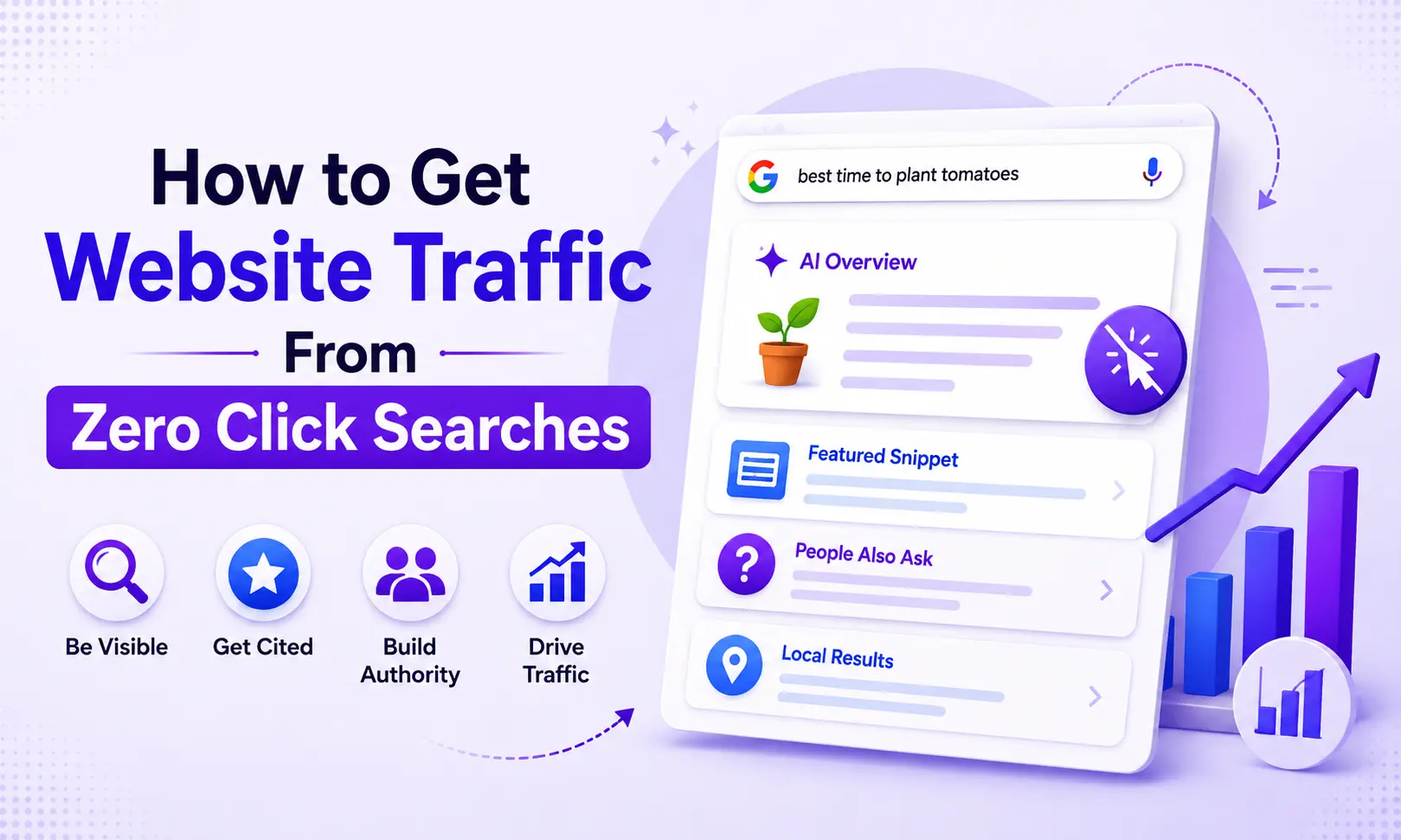
How to Get Website Traffic From Zero Click Searches in 2026
In our work with clients across Delhi and Mumbai, we noticed something unusual in their Search Console data starting mid-2024: impressions were climbing 40 to 60 percent month-on-month, but organic sessions were flat or falling. At first it looked like a tracking issue. It was not. It was zero-click search arriving at scale.
The data confirms what we were seeing on the ground. According to SparkToro and Datos, 64.82% of all Google searches in 2026 end without a single click. But the more important number for Indian businesses is this: AI Overviews are now being triggered more frequently with every passing quarter, and that adoption is accelerating faster in English-language markets than anywhere else.
This guide is not a general overview of zero-click search. It is what we have actually seen work for Indian businesses competing in a SERP that increasingly answers questions before users can click anywhere.
What Are Zero Click Searches?
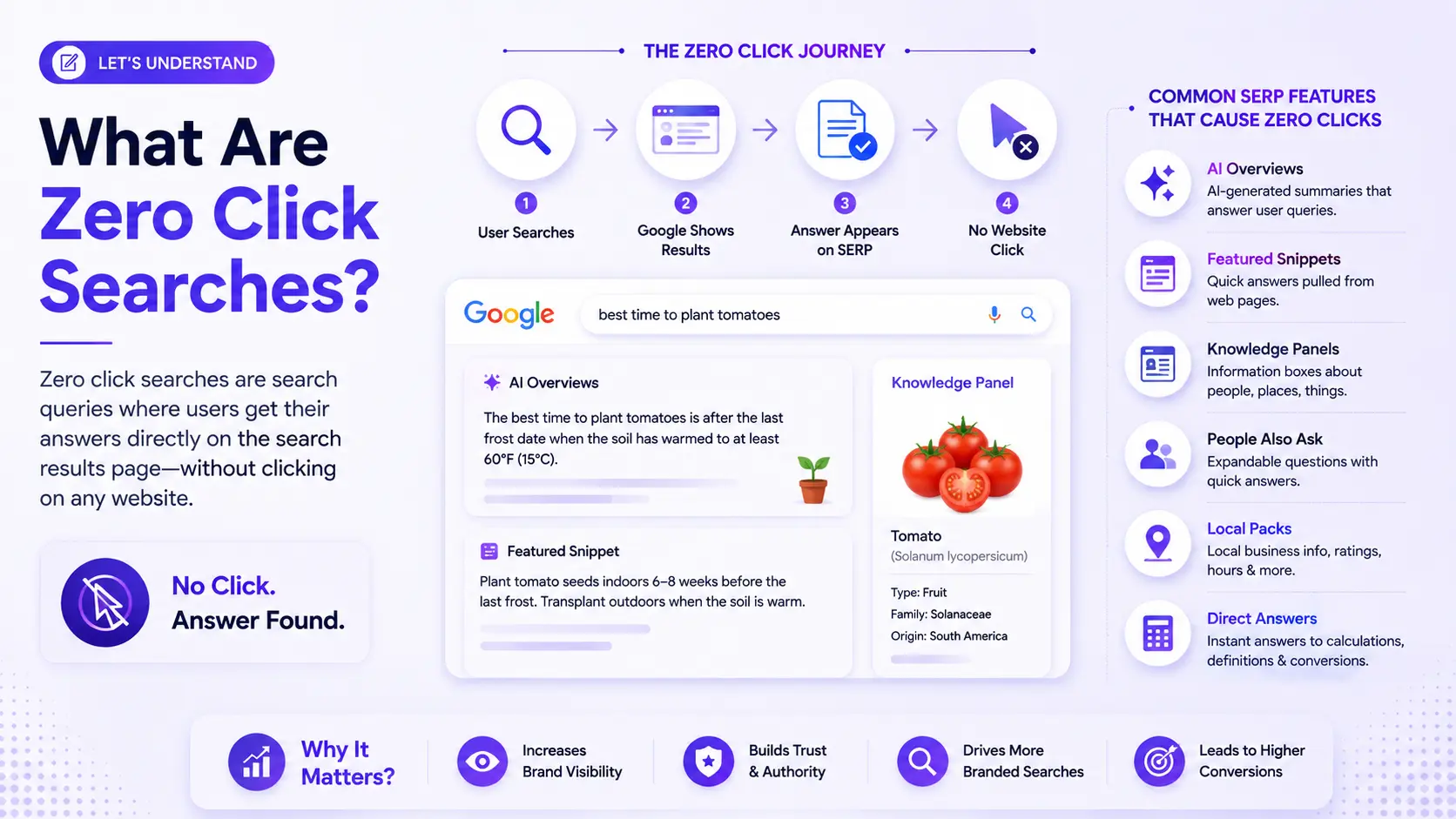
A zero click search is any search query where the user gets their answer directly on the search engine results page without clicking through to any website.
Google provides this answer through one or more of these SERP features:
→ AI Overviews (formerly Google SGE): AI-generated summaries that synthesize answers from multiple sources
→ Featured snippets: A highlighted text box pulled from a single web page, shown above organic results
→ Knowledge panels: Information cards on the right side of the SERP, typically for brands, people, or places
→ People Also Ask (PAA) boxes: Expandable Q&A sections that answer related questions inline
→ Local packs: Map listings with business name, rating, hours, and phone number
→ Direct answers: Calculators, unit converters, definitions, and fact cards built into the SERP itself
The user asks a question. Google answers it. The user moves on. No click happens.
This does not mean your content had no impact. If your content was the source Google cited, your brand was seen. And that brand exposure has measurable downstream effects on direct traffic, branded searches, and eventually conversions.
Zero Click Search Statistics That Matter in 2026
Before building a strategy, it helps to understand the scale of what you are dealing with. Here are the most reliable data points currently available:
| Stat | Source | What It Means |
|---|---|---|
| 64.82% of Google searches end without a click | SparkToro / Datos, 2026 | Nearly 2 in 3 searches never reach a website |
| AI Overviews triggered on 13.14% of queries in March 2025, up from 6.49% in January 2025 | Semrush, 2025 | Adoption is doubling every few months |
| 58.5% of U.S. searches ended without a click in 2024 | Semrush / Datos, 2024 | Zero-click is already the majority user behaviour |
| Google AI Mode has a 93% zero-click rate | Semrush, 2025 | AI-native search is almost entirely zero-click |
| Zero click rate was 50% in 2019, now 64.82% | SparkToro, 2026 | This trend predates AI and keeps accelerating |
The most important takeaway from this data: fewer clicks does not mean less value. The clicks that do happen are higher intent. The brand exposure from being cited in AI answers generates real downstream traffic. The game has changed, not ended.
Why Zero Click Searches Are Increasing
Zero click searches are not new. They have been growing since Google introduced featured snippets in 2014. But the pace accelerated sharply when Google rolled out AI Overviews globally in 2024. Three forces are driving this:
1. AI Overviews Are Expanding Faster Than Most Brands Realise
AI Overviews were triggered for just 6.49% of queries in January 2025. By March 2025, that number had jumped to 13.14%, according to Semrush data. That is a near-doubling in under 90 days. For Indian businesses targeting English-language queries, this growth curve means the window to adapt is narrowing quickly. A query like “how to reduce bounce rate” now returns a structured, step-by-step answer inside the SERP. Most users do not need to click anywhere for more detail.
2. Google’s Business Incentives Align With Zero Clicks
Keeping users on Google’s own properties means more ad exposure, more engagement with Google’s ecosystem, and more data. Google has a structural incentive to answer queries without routing traffic outward. This is not a conspiracy theory. It is just business logic, and it has been Google’s direction since at least 2014.
3. Indian Users Are Adopting Voice and Mobile Search Rapidly
This is a factor most global zero-click guides miss entirely. India has over 500 million smartphone users, and a significant share of searches happen via voice on mobile. Voice queries are conversational, question-based, and almost always resolved by a direct answer in the SERP. If your audience is searching on a phone in Hindi-English mix, they are already part of the zero-click majority. Understanding how Google’s ranking system evaluates content helps explain why Google selects certain sources for these features over others.
What Is AEO and Why It Matters Alongside SEO
SEO optimizes your content to rank in traditional search results and drive clicks. Answer Engine Optimization (AEO) extends that by optimizing for visibility and citations in AI-generated responses, including Google AI Overviews, ChatGPT, Perplexity, and Gemini.
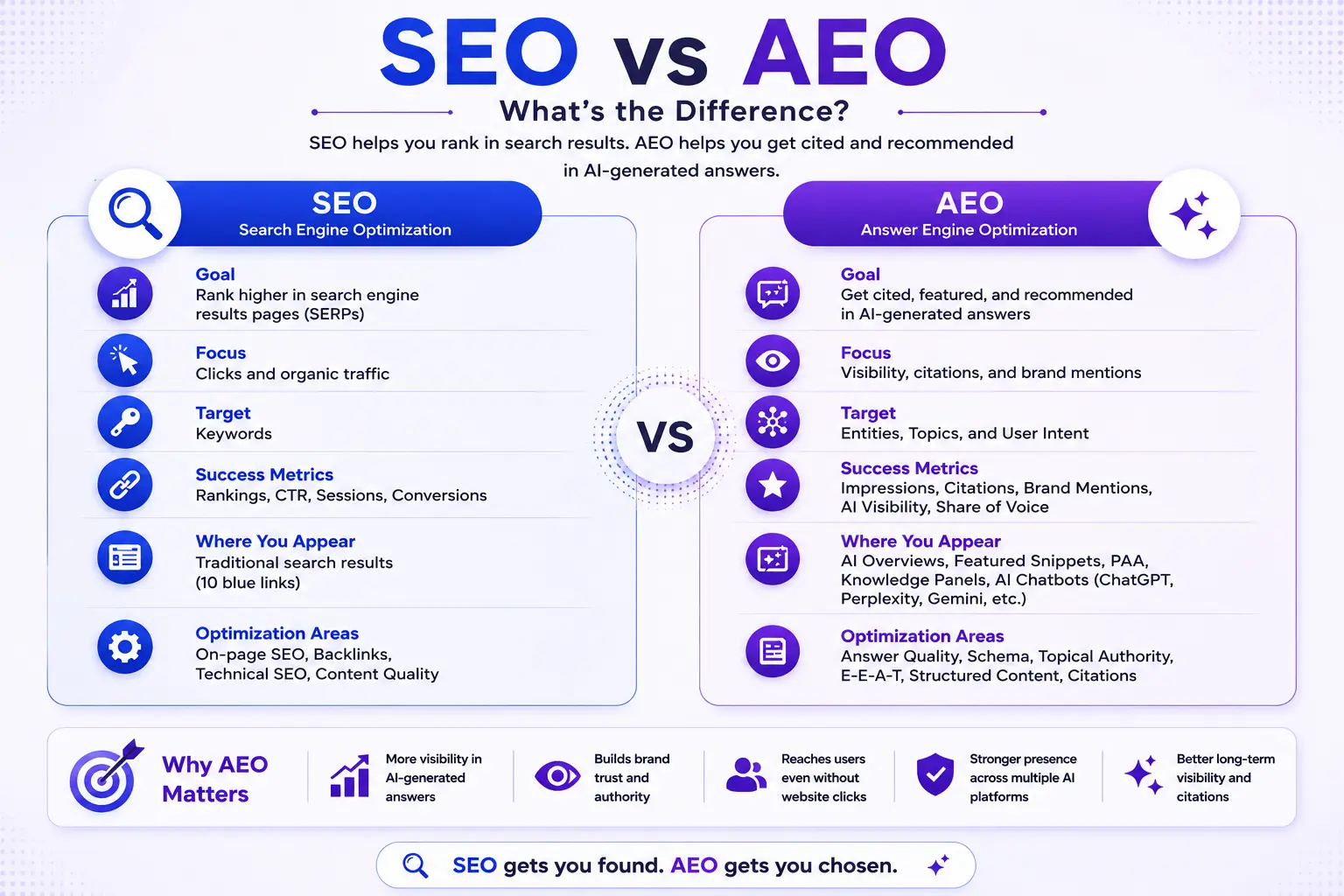
In practical terms, your content now needs to work in two different contexts simultaneously:
As a standalone resource when users visit your site directly, and as source material that AI engines extract, summarize, and cite when answering queries on behalf of millions of users who never visit any site.
Here is how SEO and AEO differ in practice:
| What SEO Has Always Done | What AEO Adds |
|---|---|
| Increase content visibility in organic results | Earn citations and references in AI-generated answers |
| Track rankings, traffic, and CTR | Track citations, brand mentions, snippet captures, and AI visibility |
| Build comprehensive pages targeting keywords | Create direct, self-contained answers with clear source attribution |
| Optimize for Google | Optimize for Google, ChatGPT, Perplexity, and Gemini simultaneously |
The structural difference between SEO content and AEO content is not about keywords. It is about self-containment. An AI system extracting a section from your article cannot carry context from the rest of the page. Each section must deliver a complete, accurate answer on its own or it will not be selected.
For Indian businesses, this matters because AI search adoption is growing across both English and bilingual audiences. Being cited in an AI Overview or ChatGPT response builds brand recognition with users who may never have found you through traditional search.
How Zero Click Searches Affect SEO and Traffic
The impact of zero click searches varies significantly depending on the type of content and queries you target. Here is an honest breakdown:
What Gets Hurt
Top-of-funnel informational content suffers the most. Blog posts targeting definition queries, “what is” questions, and simple how-tos are now frequently answered entirely in the SERP. If your content strategy relied heavily on capturing this traffic, you have likely already seen impressions rise while clicks fall.
This is a real phenomenon. SEO professional Ankush Gupta documented exactly this in a case study: his client’s impressions doubled after AI Overviews launched, but their CTR dropped from 1.5% to under 0.5%. More visibility, fewer clicks. We have seen the same pattern with several of our own clients in the e-commerce and education verticals.
What Gets Helped
Transactional and navigational queries remain largely click-dependent. When someone searches “buy SEO services in Delhi” or “HM Digital Solution contact,” they need to visit a specific page. Google cannot satisfy that intent without a click.
High-complexity content also remains resilient. Original research, detailed guides, case studies, and proprietary frameworks require depth that AI Overviews cannot fully replicate. Users who want the full picture still click through.
The New Reality
The future of SEO is not about choosing between rankings and visibility. It is about optimizing for both at the same time, because they now serve different but complementary goals.
Which Queries to Target and Which to Avoid
This is the section that most guides skip, but it is the most strategic decision you will make in a zero click world. Not all zero click queries are worth pursuing. Some offer real business value. Others are a waste of time.
Queries Worth Pursuing
| Query Type | Example | Why It Is Worth It |
|---|---|---|
| High-intent comparison queries | “SEO agency vs in-house SEO” | Influences purchasing decisions |
| Problem-identification queries | “Why is my website traffic dropping” | Buyer is aware of a problem you solve |
| Brand awareness queries | “What is topical authority in SEO” | Shows expertise to your target audience |
| Local intent queries | “SEO agency in Delhi” | Google uses local pack data which drives calls and visits |
| Long-tail question queries | “How to fix keyword cannibalization” | Lower AI Overview saturation, easier to win |
Queries to Avoid or Deprioritise
| Query Type | Example | Why to Skip |
|---|---|---|
| Pure definition queries | “What is a meta tag” | Fully answered by Google’s knowledge graph |
| Basic factual queries | “When was Google founded” | Instant answer, zero value for you |
| Highly competitive general queries | “What is SEO” | Dominated by Wikipedia and major publishers |
| Price-only queries | “SEO cost in India” | Rarely converts, hard to differentiate |
The rule of thumb: pursue zero click queries where visibility leads somewhere useful for your business. Avoid queries where winning the snippet earns you nothing more than an impression.
7 Strategies to Get Traffic From Zero Click Searches
Strategy 1: Optimise Content to Win Featured Snippets
Featured snippets are the most direct path to zero click visibility that also drives meaningful traffic. Pages that own featured snippets get the brand mention in the SERP and still capture the higher-intent clicks that happen after users see the snippet and want more detail.
To win featured snippets:
→ Identify queries that already show a featured snippet in Google (these are the easiest to compete for, since the format is proven)
→ Write a direct, self-contained answer of 40 to 60 words right below the question heading
→ Use the exact question phrasing as your H2 or H3 heading
→ Follow the direct answer with 2 to 3 paragraphs of supporting detail to signal depth
→ Use numbered lists for “how to” queries and bullet lists for “best of” queries
One important nuance: do not try to win featured snippets for queries where the snippet fully satisfies intent and you have no product or service that addresses the next step. Win snippets where the user will still want to click through for more.
Strategy 2: Build Your Brand Into AI Overview Citations
Sites cited as sources in Google’s AI Overviews receive brand visibility and authority signals even without click-through traffic. Getting cited in AI Overviews is the new version of ranking on page one. Here is how to improve your chances:
→ Publish original data and research: AI systems consistently prefer sources that provide unique information over those summarising existing content. Original statistics, case studies, and first-hand findings are cited more frequently.
→ Write self-contained sections: Each section of your content should make sense on its own, without requiring context from the rest of the article. AI systems extract individual sections, not entire pages.
→ Use clear attribution: Cite your sources and reference real studies. AI Overviews favour content that demonstrates it is grounded in evidence.
→ Improve E-E-A-T signals: Author bios, credentials, real experience, and organisational authority signals all influence whether Google trusts your content enough to cite it. Our deep dive into Google’s Helpful Content system explains exactly how these signals are evaluated.
Strategy 3: Use Schema Markup to Claim SERP Real Estate
Schema markup tells Google exactly what your content is about and in what format, which increases your eligibility for rich results that appear in zero click SERPs.
The three schema types with the highest impact for zero click visibility:
FAQPage Schema: Marks up Q&A content so Google can extract individual question-answer pairs for People Also Ask boxes and AI Overviews. Add this to any page with a structured FAQ section.
HowTo Schema: Ideal for step-by-step guides. Increases your chance of appearing in AI-generated step lists and featured snippet carousels. Each step should be clear, actionable, and contain one instruction only.
LocalBusiness Schema: Critical for local businesses. Powers knowledge panels and local pack results. Include your business name, address, phone number, opening hours, and service areas.
After adding schema, validate it using Google’s Rich Results Test. Broken schema actively reduces your visibility rather than helping it.
Strategy 4: Create Answer-First Content Structure
Most content is written to be read from top to bottom. Zero click SEO requires a different structure. Google and AI systems extract the most useful paragraph from your page. That paragraph needs to be immediately findable and immediately useful.
The answer-first content structure looks like this:
- Question as heading (H2 or H3, using the exact phrasing your audience searches)
- Direct answer in 40 to 60 words (self-contained, factually accurate, no setup required)
- Supporting explanation (2 to 3 paragraphs with context, examples, and data)
- Structured supporting elements (table, numbered list, or bullet list where relevant)
This structure serves two goals simultaneously. It increases your chances of being extracted for zero click features. And it improves the reading experience for users who do click through, because they find answers faster.
For content that follows this principle consistently, see how we approach information gain in SEO as a content quality signal.
Strategy 5: Target People Also Ask Boxes Systematically
People Also Ask boxes are one of the most underestimated zero click opportunities available. They appear on almost every informational query, they expand dynamically as users click them, and they are significantly easier to win than featured snippets.
To target PAA boxes:
→ Use Google’s autocomplete and the PAA box itself to find the exact questions your audience asks around a topic
→ Create a dedicated FAQ section on every key page that addresses these questions directly
→ Keep each answer between 40 and 60 words
→ Add FAQPage schema to make the Q&A structure machine-readable
→ Cover follow-up questions, not just the primary question on the page
PAA boxes also have a compounding effect. Each time a user clicks a PAA answer, new related questions appear. Pages that answer multiple related questions well can appear in multiple PAA slots for the same query.
Strategy 6: Build Local Visibility for Zero Click Local Queries
For businesses with a physical location or a defined service area, local pack results are among the most valuable zero click features available. When someone searches “SEO agency near me” or “digital marketing services in Delhi,” Google shows a map with three business listings including name, rating, phone number, and hours. The user gets what they need without visiting any website. But they may still call directly.
To maximise local zero click visibility:
→ Keep your Google Business Profile complete and regularly updated with photos, posts, and accurate hours
→ Ensure your NAP (Name, Address, Phone) is consistent across your website, GBP, and all directories
→ Collect genuine customer reviews consistently, since ratings appear directly in the local pack
→ Add LocalBusiness schema to your website homepage and contact page
→ Create dedicated pages for each city or area you serve with genuinely unique content
Our local SEO services guide covers the full local optimisation process for Delhi and surrounding markets.
Strategy 7: Diversify Traffic Beyond Google Search
This is the strategy that most SEO-focused guides avoid mentioning, but it is essential in a zero click world. Email lists, push notifications, branded apps, and social media followings are the durable assets in a zero-click world. Businesses with substantial direct traffic channels are largely insulated from Google’s AI Overview expansion because their audience relationship does not depend on search discovery.
Practical diversification actions:
→ Build an email list: Every piece of content should offer a reason to subscribe. People on your email list do not need to find you through Google.
→ Increase branded search demand: When people search for your brand name directly, Google treats it as a trust signal. Create content and campaigns that make your brand memorable enough to search for.
→ Invest in YouTube SEO: Video is far less affected by zero click trends than text search. YouTube SEO is an increasingly important parallel channel.
→ Build a presence on AI platforms: Ensure your brand is mentioned across trusted sources that AI systems like ChatGPT and Perplexity frequently cite. Being cited in AI platforms drives referral traffic that does not depend on Google clicks at all.
How to Measure Zero Click Visibility Without Paid Tools
Traditional SEO metrics like organic sessions and keyword rankings give an incomplete picture in a zero click world. Here is how to track what actually matters using free tools:
Google Search Console (Free)
Impressions vs Clicks trend: Go to Performance > Search Results. If your impressions are rising while clicks are flat or falling, this is the classic zero click pattern. You are gaining visibility but losing traffic. This is not necessarily bad, but it tells you where to act.
Question-based query filter: Filter queries by “what,” “how,” “why,” “where,” and “when.” Track impressions and CTR for these question queries specifically. These are your zero click exposure metrics.
Featured snippet identification: Queries where you rank position 0 or where your page appears in a snippet box can sometimes be inferred from your average position data combined with high impressions and low CTR. Our guide on advanced Google Search Console filters shows how to set these up properly.
Manual SERP Monitoring (Free)
For your 20 to 30 most important target keywords, run manual Google searches monthly in incognito mode and record:
→ Does an AI Overview appear?
→ Is your content cited in the AI Overview?
→ Does a featured snippet appear? Do you own it?
→ How many PAA boxes appear? Do you appear in any?
→ Does a local pack appear? Are you in it?
Build a simple spreadsheet to track this monthly. It takes about 30 minutes and gives you a clear picture of your zero click SERP real estate.
Branded Search Volume (Free via Google Search Console)
Filter your Search Console queries by your brand name. Track how branded search volume changes over time. When your content is being cited in AI Overviews and featured snippets, branded search volume typically increases within 4 to 8 weeks even without click growth. This is your clearest signal that zero click visibility is generating real business value.
Additional Metrics Worth Tracking
Beyond Search Console, these metrics give a fuller picture of your zero click performance:
→ SERP Feature Share: Your percentage of featured snippet, PAA, and knowledge panel appearances for target keywords
→ Multi-Platform Visibility: Track brand mentions across Google, Bing, and conversational AI platforms like ChatGPT and Perplexity
→ Assisted Conversions: Users who saw your brand in a zero click feature and converted later, even without a direct click
Zero Click Search vs Traditional SEO: Key Differences
| Factor | Traditional SEO | Zero Click SEO |
|---|---|---|
| Primary goal | Rankings and clicks | Visibility, citations, and brand exposure |
| Key metric | Organic sessions, CTR | Impressions, SERP feature share, branded search growth |
| Content structure | Written to be read | Written to be extracted and cited |
| Success signal | Traffic growth | Impression growth + downstream branded search growth |
| Schema markup | Helpful | Essential |
| Featured snippets | Good to have | Core strategy |
| Brand authority | Supports rankings | Determines citation eligibility |
| Local SEO | Drives clicks | Drives calls and directions directly from SERP |
| AI platform presence | Not required | Increasingly important |
The critical insight here is that traditional SEO and zero click SEO are not opposites. They are the same discipline at different stages of the user journey. Strong traditional SEO makes you eligible for zero click features. Zero click visibility drives the branded searches and direct traffic that traditional SEO cannot capture.
Understanding topical authority vs domain authority is important here because topical authority is what makes Google confident enough to cite your content in AI Overviews and featured snippets.
Common Mistakes Brands Make With Zero Click SEO
Treating zero click as a problem to solve rather than a reality to adapt to. The brands that panic and try to “fight” zero click trends by obsessing over CTR end up optimising for the wrong thing. Zero click is not going away. Adapting your strategy is the only productive response.
Chasing featured snippets for queries with no commercial value. Winning the snippet for “what is a domain name” earns you zero business value. Always ask what happens after someone sees your brand in a zero click feature. If there is no logical next step for your business, it is not worth pursuing.
Ignoring schema markup on key pages. Schema is not a technical nicety for zero click SEO. It is the mechanism by which Google understands and extracts your content. Pages without relevant schema are at a structural disadvantage for every SERP feature that matters.
Publishing content that only works as a whole article. AI systems and featured snippet algorithms extract individual sections. If each section of your content cannot stand on its own, it will not be selected. Review your most important pages and ask: does each H2 section contain a complete, self-contained answer?
Not tracking impressions alongside clicks. If you are only measuring organic sessions and CTR, you are measuring half the picture. Rising impressions with falling CTR is the zero click pattern. Without impression data, you cannot see it happening or respond to it.
Neglecting E-E-A-T signals across your content. Google does not cite sources it does not trust. Author credentials, original experience, factual accuracy, and site-level authority all influence whether your content is selected for AI Overviews and featured snippets. This is not optional in 2026.
Ignoring AI platforms entirely. Brands that only optimise for Google are missing a growing share of the zero click landscape. ChatGPT, Perplexity, and Gemini collectively handle hundreds of millions of queries daily. If your brand is not mentioned across the trusted sources these platforms cite, you are invisible to a significant portion of your potential audience.
FAQ
Q.1 What is a zero click search?
A zero click search is a Google search where the user finds their answer directly on the search results page without clicking through to any website. Google provides these answers through features like AI Overviews, featured snippets, knowledge panels, People Also Ask boxes, and local packs.
Q.2 How common are zero click searches in 2026?
Very common. According to SparkToro and Datos data updated in 2026, 64.82% of all Google searches end without a click. That means roughly 5.5 billion of Google’s 8.5 billion daily searches result in no website visit at all.
Q.3 Do zero click searches hurt SEO?
They reduce click-through rates, particularly for informational content. But they also create new forms of value: brand visibility through citations, downstream branded search growth, and higher-quality traffic from the clicks that do happen. The clicks that survive in a zero click world are significantly higher intent than traditional organic clicks.
Q.4 What is AEO and how is it different from SEO?
AEO stands for Answer Engine Optimization. SEO optimizes for rankings and clicks in traditional search results. AEO extends that by optimizing for visibility and citations in AI-generated responses across platforms like Google AI Overviews, ChatGPT, Perplexity, and Gemini. In 2026, a complete search strategy requires both.
Q.5 How do I appear in Google AI Overviews?
Publish content with strong E-E-A-T signals, original data or unique insights, clear answer-first structure, and relevant schema markup. AI Overviews favour sources that are trusted, authoritative, and provide information that cannot be found in a generic summary elsewhere.
Q.6 What is the difference between a featured snippet and a zero click search?
A featured snippet is one specific type of zero click feature. It is a highlighted text box pulled from a single web page that appears above organic results. Zero click search is the broader category that includes featured snippets, AI Overviews, knowledge panels, PAA boxes, local packs, and direct answers.
Q.7 Can small businesses benefit from zero click SEO?
Yes, especially through local pack visibility and People Also Ask boxes. Local businesses that maintain a complete Google Business Profile with accurate information and genuine reviews appear in local packs, which drive direct calls and direction requests without any click to a website. This is one of the highest-converting channels in local SEO.
Q.8 Which type of content is most vulnerable to zero click searches?
Short informational content targeting definitions, simple facts, and “what is” queries is most vulnerable. These queries are now almost entirely answered by Google’s knowledge graph or AI Overviews. Long-form original research, detailed guides, and proprietary frameworks are significantly more resilient because they provide depth that AI systems cannot fully replicate.
Zero Click Is Not the End of SEO. It Is a Promotion.
Traditional SEO put your link in front of users and hoped they clicked. Zero-click SEO puts your answer in front of users before they even see the links. That is not a demotion. That is a different kind of visibility, and for brands that understand it, a significant competitive advantage.
The businesses that will struggle in this environment are those still measuring success purely through sessions and CTR. The businesses that will grow are those tracking impressions, AI citation frequency, branded search volume, and SERP feature share alongside their traditional metrics.
If you are starting from scratch, focus on three things first: structure your existing content so each section can stand alone as a self-contained answer, add FAQPage and HowTo schema to your highest-traffic pages, and start tracking branded search volume in Search Console as a proxy for zero-click brand exposure.
Your next steps:
1. Audit which of your important keywords trigger zero click SERP features in Google Search Console
2. Identify 5 to 10 queries where you could win a featured snippet or PAA placement with better structured content
3. Add FAQPage and relevant schema to your highest-traffic pages
4. Start tracking impressions and branded search volume alongside your existing traffic metrics
5. Identify where your brand currently appears (or does not appear) in AI platform responses for your key queries
If you want help building a content and SEO strategy that accounts for zero click search, AI Overviews, and the full modern search landscape, our team at HM Digital Solution works with businesses across healthcare, real estate, finance, and e-commerce to build visibility that translates into real business results.
(1) Comment